


Changes in Histone H3 Acetylation on Lysine 9 Accompany Aβ 1-40 Overexpression in an Alzheimer's Disease Yeast Model
- PMID: 34746682
- PMCID: PMC8567091
- DOI: 10.17912/micropub.biology.000492
Changes in Histone H3 Acetylation on Lysine 9 Accompany Aβ 1-40 Overexpression in an Alzheimer's Disease Yeast Model
Abstract
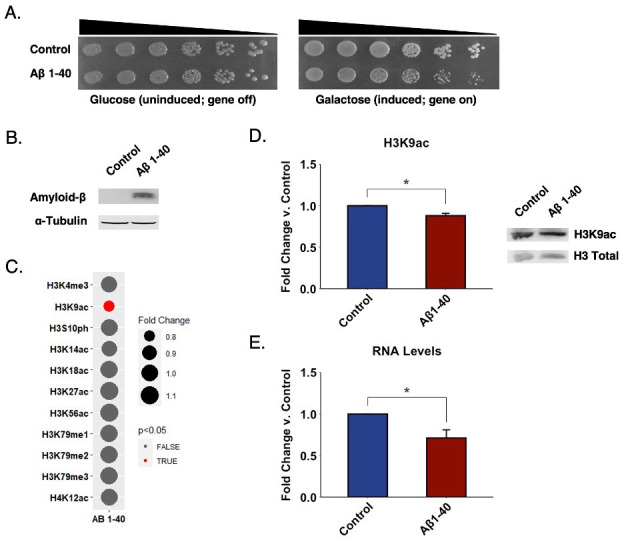
Alzheimer's Disease (AD), the most common type of dementia, is a neurodegenerative disease characterized by plaques of amyloid-beta (Aβ) peptides found in the cerebral cortex of the brain. The pathological mechanism by which Aβ aggregation leads to neurodegeneration remains unknown. Interestingly, genetic mutations do not explain most AD cases suggesting that other mechanisms are at play. Epigenetic mechanisms, such as histone post-translational modifications (PTMs), may provide insight into the development of AD. Here, we exploit a yeast Aβ overexpression model to map out the histone PTM landscape associated with AD. We find a modest decrease in the acetylation levels on lysine 9 of histone H3 in the context of Aβ 1-40 overexpression. This change is accompanied by a decrease in RNA levels. Our results support a potential role for H3K9ac in AD pathology and allude to the role of epigenetics in AD and other neurodegenerative diseases.
Copyright: © 2021 by the authors.
Figures
References
-
- Chen K, Bennett SA, Rana N, Yousuf H, Said M, Taaseen S, Mendo N, Meltser SM, Torrente MP. Neurodegenerative Disease Proteinopathies Are Connected to Distinct Histone Post-translational Modification Landscapes. ACS Chem Neurosci. 2018 Jan 01;9(4):838–848. doi: 10.1021/acschemneuro.7b00297. - DOI - PMC - PubMed
Grants and funding
LinkOut - more resources
Full Text Sources
Molecular Biology Databases
Miscellaneous