Review
. 2021 Aug 11;2(5):100231.
doi: 10.1016/j.xplc.2021.100231. eCollection 2021 Sep 13.

Metabolism, signaling, and transport of jasmonates

Affiliations
Review

Metabolism, signaling, and transport of jasmonates

Mengya Li et al. Plant Commun. .

Abstract

Biosynthesis/metabolism, perception/signaling, and transport are three essential aspects of the actions of phytohormones. Jasmonates (JAs), including jasmonic acid (JA) and related oxylipins, are implicated in the regulation of a range of ecological interactions, as well as developmental programs to integrate these interactions. Jasmonoyl-isoleucine (JA-Ile) is the most bioactive JAs, and perception of JA-Ile by its coreceptor, the Skp1-Cullin1-F-box-type (SCF) protein ubiquitin ligase complex SCFCOI1-JAZ, in the nucleus derepresses the transcriptional repression of target genes. The biosynthesis and metabolism of JAs occur in the plastid, peroxisome, cytosol, endoplasmic reticulum, and vacuole, whereas sensing of JA-Ile levels occurs in the nucleus. It is increasingly apparent that a number of transporters, particularly members of the jasmonates transporter (JAT) family, located at endomembranes as well as the plasma membrane, constitute a network for modulating and coordinating the metabolic flux and signaling of JAs. In this review, we discuss recent advances in the metabolism, signaling, and especially the transport of JAs, focusing on intracellular compartmentation of these processes. The roles of transporter-mediated cell-cell transport in driving long-distance transport and signaling of JAs are also discussed.

Keywords: cellular compartmentation; jasmonates; metabolism; signaling; transport.


Figures

Figure 1
Figure 1
Intracellular compartmentation of the biosynthesis, metabolism, and signaling of JAs. The biosynthesis of JA occurs sequentially in the plastid/chloroplast and peroxisome/cytosol from α-LeA (the main route indicated by blue arrows) or from hexadecatrienoic acid (16:3) (summarized from knowledge obtained primarily in Arabidopsis). Some compounds in the pathway are substrates of enzymes located in distinct intracellular compartments. These constitute nodes (metabolic branching points indicated by red dots) through which metabolic flux can be diverted toward distinct end products. Peroxisomal JA is then transported to the cytosol, where diverse JA derivatives are produced, including the bioactive JA-Ile and possibly 12-OH-JA-Ile, which then enter the nucleus to activate core JA signaling by reprogramming gene expression. JA-Ile may move into the ER and is deactivated by hydrolysis or deconjugation. The endomembranes of the plastid, peroxisome, vacuole, and ER are shown by green, orange, blue, and purple lines, respectively (double-layer membranes are indicated by double lines); the PM is shown by double black lines representing the phospholipid bilayer, and enzymes localized at these intracellular compartments are indicated by letters in the same color. The NE with a double membrane and nuclear pore is shown. Biologically active compounds are indicated by red letters. Also shown are JASSY and OPDAT1, localized at the outer and inner membrane of the chloroplast, respectively, and probably involved in the efflux of OPDA, and CTS localized at the peroxisomal membrane and involved in the import of OPDA.
Figure 2
Figure 2
Sensing of JA-Ile levels and signaling dynamics in the nucleus. Sensing of nuclear JA-Ile levels by the transcriptional states (repression, depression, and activation) of JA-responsive genes. At low JA-Ile levels (top left), the transcription of JA-responsive genes is repressed owing to the accumulated JAZ proteins that bind and repress MYCs, involving indirect recruitment of TPL via JAZ-bound NINJA. This repressed state is then derepressed by elevated JA-Ile levels in response to environmental and developmental cues (top right), which promotes the binding of JA-Ile (red dot) with JAZ in the SCFCOI1 coreceptor, polyubiquitylation of JAZ, and subsequent degradation of JAZ by the 26S proteasome. The degradation of JAZ unmasks the MED25 binding site on MYC to engage the Mediator complex and recruit additional coactivators (e.g., HAC1 and LUH), resulting in the formation of the transcription preinitiation complex with RNA polymerase II (Pol II) and the activation of JA-responsive genes (bottom). Because JA-responsive genes encode JA-Ile catabolic enzymes and/or stable JAZ proteins, negative feedback loops are established to terminate JA responses with a characteristic time delay, eventually restoring the repressed state. Nuclear JA-Ile levels are modulated by JAT1, in turn regulating the derepression and activation states. AtJAT1-mediated nuclear entry of JA-Ile concentrates and partitions JA-Ile in the nucleus, driving the equilibrium between JA and JA-Ile in the direction of JA-Ile in the cytosol, thus rapidly and efficiently activating JA-Ile signaling. By contrast, JAT1-mediated cellular export removes JA from the cytosol, driving the equilibrium between JA and JA-Ile in the direction of JA, attenuating JA-Ile signaling and facilitating the cell-cell transport of JA from source to sink cells. MED25, Mediator subunit 25; HAC1, histone acetyltransferase 1; LUH, Leunig homolog; Pol Ⅱ, RNA polymerase II; TPL, Topless.
Figure 3
Figure 3
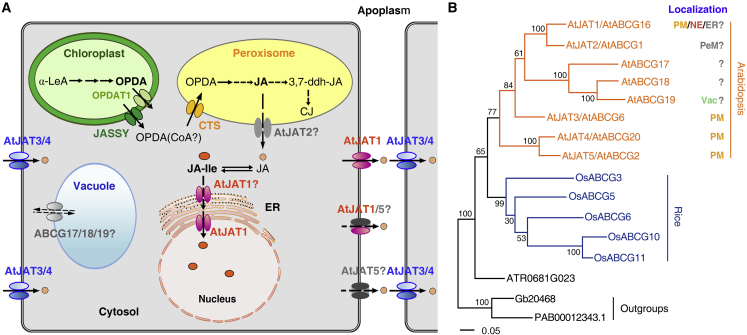
Regulatory networks connected by transporter-mediated intra- and intercellular transport of JAs. (A) Schematic model showing networks connected by transporter-mediated intracellular and intercellular transport of JAs. JASSY and OPDAT1 channels localized at the membrane of the plastid envelope and the CTS transporter localized at the peroxisomal membrane mediate the plastidial efflux and peroxisomal influx of OPDA, respectively. AtJAT1 localized at both the NE and PM mediates the nuclear entry of JA-Ile and cellular efflux of JA. AtJAT2 localized at the peroxisomal membrane probably participates in the peroxisomal export of JA. AtJAT3, AtJAT4, and AtJAT5 are localized at the PM; AtJAT3/4 mediate JA import, and AtJAT5 may be involved in JA export. The possible vacuolar localization and transport activity of AtABCG17/18/19 in the AtJAT family await evaluation. Question marks indicate putative transporters that remain to be further characterized. (B) The phylogenies of JAT families in Arabidopsis and rice (O. sativa). The maximum likelihood (ML) tree was constructed with confidence (bootstrap) values shown on the branches, and the scale bar represents the number of amino acid changes per site. The subcellular localizations of AtJAT members (PeM, peroxisomal membrane; Vac, vacuole) are shown. The single JAT members in the genomes of the gymnosperms G. biloba (Gb20468) and P. abies (PAB 00012343.1) (used as the outgroup) and the basal angiosperm A. trichopoda (ATR0681G023) were included in the analysis.

References

    1. Afitlhile M.M., Fukushige H., Nishimura M., Hildebrand D.F. A defect in glyoxysomal fatty acid beta-oxidation reduces jasmonic acid accumulation in Arabidopsis. Plant Physiol. Biochem. 2005;43:603–609. - PubMed
    1. An C., Li L., Zhai Q., You Y., Deng L., Wu F., Chen R., Jiang H., Wang H., Chen Q. Mediator subunit MED25 links the jasmonate receptor to transcriptionally active chromatin. Proc. Natl. Acad. Sci. U S A. 2017;114:8930–8939. - PMC - PubMed
    1. Bannenberg G., Martinez M., Hamberg M., Castresana C. Diversity of the enzymatic activity in the lipoxygenase gene family of Arabidopsis thaliana. Lipids. 2009;44:85–95. - PubMed
    1. Bannenberg G., Martinez M., Rodriguez M.J., Lopez M.A., Ponce de Leon I., Hamberg M., Castresana C. Functional analysis of alpha-DOX2, an active alpha-dioxygenase critical for normal development in tomato plants. Plant Physiol. 2009;151:1421–1432. - PMC - PubMed
    1. Basso V., Veneault-Fourrey C. Role of jasmonates in beneficial microbe-root interactions. Methods Mol. Biol. 2020;2085:43–67. - PubMed

Publication types

MeSH terms

LinkOut - more resources