Review
. 2021 Aug 23;2(5):100235.
doi: 10.1016/j.xplc.2021.100235. eCollection 2021 Sep 13.

Plant cell cultures as heterologous bio-factories for secondary metabolite production

Affiliations
Review

Plant cell cultures as heterologous bio-factories for secondary metabolite production

Tong Wu et al. Plant Commun. .

Abstract

Synthetic biology has been developing rapidly in the last decade and is attracting increasing attention from many plant biologists. The production of high-value plant-specific secondary metabolites is, however, limited mostly to microbes. This is potentially problematic because of incorrect post-translational modification of proteins and differences in protein micro-compartmentalization, substrate availability, chaperone availability, product toxicity, and cytochrome p450 reductase enzymes. Unlike other heterologous systems, plant cells may be a promising alternative for the production of high-value metabolites. Several commercial plant suspension cell cultures from different plant species have been used successfully to produce valuable metabolites in a safe, low cost, and environmentally friendly manner. However, few metabolites are currently being biosynthesized using plant platforms, with the exception of the natural pigment anthocyanin. Both Arabidopsis thaliana and Nicotiana tabacum cell cultures can be developed by multiple gene transformations and CRISPR-Cas9 genome editing. Given that the introduction of heterologous biosynthetic pathways into Arabidopsis and N. tabacum is not widely used, the biosynthesis of foreign metabolites is currently limited; however, therein lies great potential. Here, we discuss the exemplary use of plant cell cultures and prospects for using A. thaliana and N. tabacum cell cultures to produce valuable plant-specific metabolites.

Keywords: plant cell culture; secondary metabolites; synthetic biology.


Figures

Figure 1
Figure 1
Simplified Scheme of secondary metabolite producing pathways in plant cell Based on their biosynthetic origins, plant secondary metabolites can be divided into three major groups: Flavonoids and allied phenolic and polyphenolic compounds, alkaloids and terpenoids. Their producing process deeply rely on shikimate pathway or MEP/MVA pathway. Abbreviations: 4CL, 4-coumaroyl-CoA lyase; PAL, phenylalanine ammonia-lyase; TAL, tyrosine ammonia-lyase; 4CL, 4-coumaroyl-CoA lyase; CHS, chalcone synthase; CHI, chalcone isomerase; F3H, flavanone 3-hydroxylase; FLS, flavonol synthase; TDC, tryptophan decarboxylase; STR strictosidine synthase; SLS, secologanin synthase. MVA, Mevalonate; MEP, Methylerythritol phosphate; IPP, Isopentenyl diphosphate; DMAPP, Dimethylallyl pyrophosphate; GPP, Geranyl diphosphate; FPP, Farnesyl diphosphate; GGPP, Geranylgeranyl diphosphate; GFPP, Geranylfarnesyl diphosphate
Figure 2
Figure 2
Overview of plant cell culture producing secondary metabolites (A) WT Arabidopsis plant for cell culture. (B) Transformed Arabidopsis cell culture. (C) Scale up culture in bioreactors. (D) Chromatography purification.
Figure 3
Figure 3
Homologous recombination provides an efficient way to build large vectors. Multi-fragment cloning is no longer difficult. The diagram shows an example of homologous recombination in S. cerevisiae to build a vector containing six genes in one step. R1–7 indicate seven different homologous regions with over 60 bp. P and T represent the promoter and terminator. Recent research indicates the method enabled more than 30 fragments of ligase (Shih et al., 2016; Vashee et al., 2020).
Figure 4
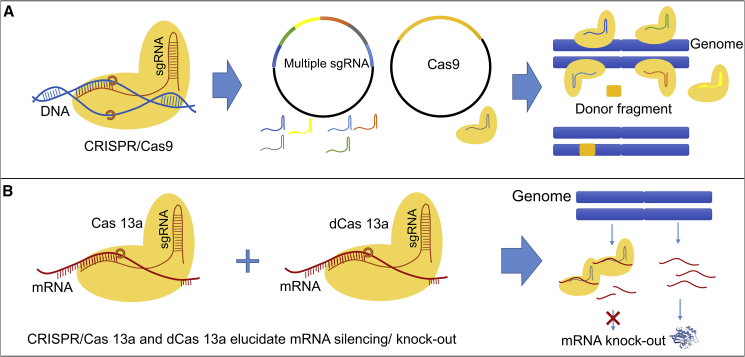
Figure 4
Examples of CRISPR/Cas gene editing for DNA and RNA. (A) CRISPR/Cas enables the knock in of genes or promoter exchanges. (B) CRISPR/Cas13a for RNA silencing.
Figure 5
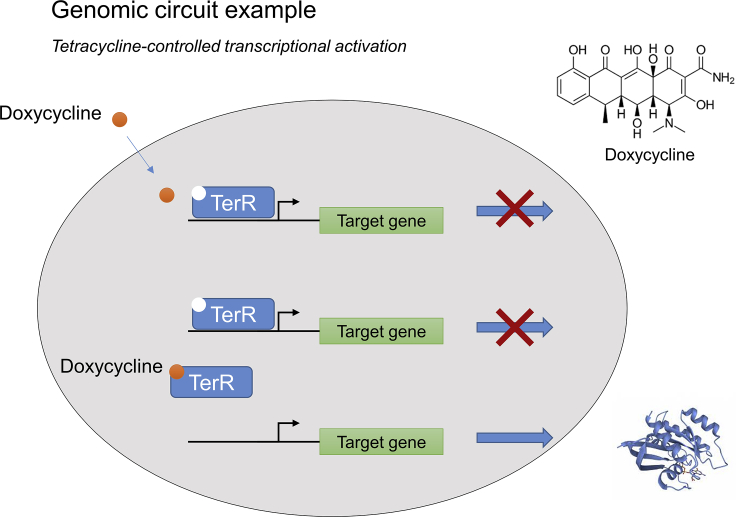
Figure 5
Working mechanism of the Tet repressor. TetR is a repressor that can bind to a specific promoter region (tetO) and repress the expression of the target gene. Tetracycline serves as an inducer for the release of TetR from the region. The repression model indicates the basic principle of inducer switches.

References

    1. Abudayyeh O.O., Gootenberg J.S., Essletzbichler P., Han S., Joung J., Belanto J.J., Verdine V., Cox D.B.T., Kellner M.J., Regev A. RNA targeting with CRISPR–Cas13. Nature. 2017;550:280–284. - PMC - PubMed
    1. Ajo-Franklin C.M., Drubin D.A., Eskin J.A., Gee E.P.S., Landgraf D., Phillips I., Silver P.A. Rational design of memory in eukaryotic cells. Genes Dev. 2007;21:2271–2276. - PMC - PubMed
    1. Ali S., Kim W.-C. A fruitful decade using synthetic promoters in the improvement of transgenic plants. Front. Plant Sci. 2019;10:1433. - PMC - PubMed
    1. Andres J., Blomeier T., Zurbriggen M.D. Synthetic switches and regulatory circuits in plants. Plant Physiol. 2019;179:862–884. - PMC - PubMed
    1. Angenon G., Dillen W., Van Montagu M. In: Plant Molecular Biology Manual. Gelvin Stanton B., Schilperoort Robbert A., editors. Springer; Dordrecht: 1994. Antibiotic resistance markers for plant transformation; pp. 125–137.

Publication types

LinkOut - more resources