. 2022 Jan 4;12(1):jkab366.
doi: 10.1093/g3journal/jkab366.

Natural variation in the transcriptional response of Drosophila melanogaster to oxidative stress

Affiliations

Natural variation in the transcriptional response of Drosophila melanogaster to oxidative stress

Timothy J S Ramnarine et al. G3 (Bethesda). .

Abstract

Broadly distributed species must cope with diverse and changing environmental conditions, including various forms of stress. Cosmopolitan populations of Drosophila melanogaster are more tolerant to oxidative stress than those from the species' ancestral range in sub-Saharan Africa, and the degree of tolerance is associated with an insertion/deletion polymorphism in the 3' untranslated region of the Metallothionein A (MtnA) gene that varies clinally in frequency. We examined oxidative stress tolerance and the transcriptional response to oxidative stress in cosmopolitan and sub-Saharan African populations of D. melanogaster, including paired samples with allelic differences at the MtnA locus. We found that the effect of the MtnA polymorphism on oxidative stress tolerance was dependent on the genomic background, with the deletion allele increasing tolerance only in a northern, temperate population. Genes that were differentially expressed under oxidative stress included MtnA and other metallothioneins, as well as those involved in glutathione metabolism and other genes known to be part of the oxidative stress response or the general stress response. A gene coexpression analysis revealed further genes and pathways that respond to oxidative stress including those involved in additional metabolic processes, autophagy, and apoptosis. There was a significant overlap among the genes induced by oxidative and cold stress, which suggests a shared response pathway to these two stresses. Interestingly, the MtnA deletion was associated with consistent changes in the expression of many genes across all genomic backgrounds, regardless of the expression level of the MtnA gene itself. We hypothesize that this is an indirect effect driven by the loss of microRNA binding sites within the MtnA 3' untranslated region.

Keywords: adaptation; gene expression; metallothionein; population genetics; transcriptomics.


Figures

Figure 1
Figure 1
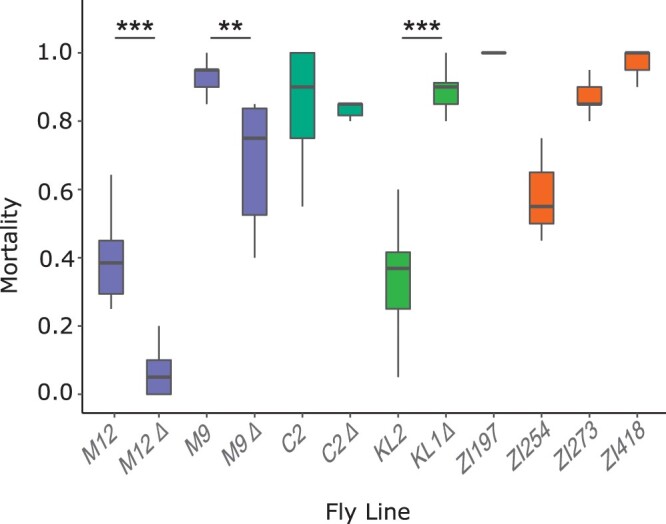
Mortality after 48 h of exposure to MSB-dosed food in lines originating from: Munich, Germany (M9 and M12); Nicosia, Cyprus (C2); Kuala Lumpur, Malaysia (KL), and Siavonga, Zambia (ZI). Differences between MtnA genotypes within the same background were tested with a Wilcoxon test. **P < 0.01, ***P < 0.001.
Figure 2
Figure 2
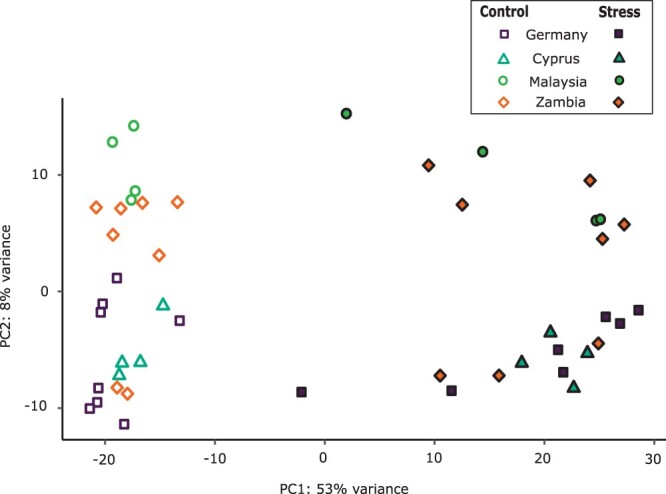
PCA plot showing the amount of variation explained by treatment and population of origin: Munich, Germany (M9 and M12); Nicosia, Cyprus (C2); Kuala Lumpur, Malaysia (KL), and Siavonga, Zambia (ZI). Filled symbols represent the MSB-stress samples, while open symbols represent the control samples.
Figure 3
Figure 3
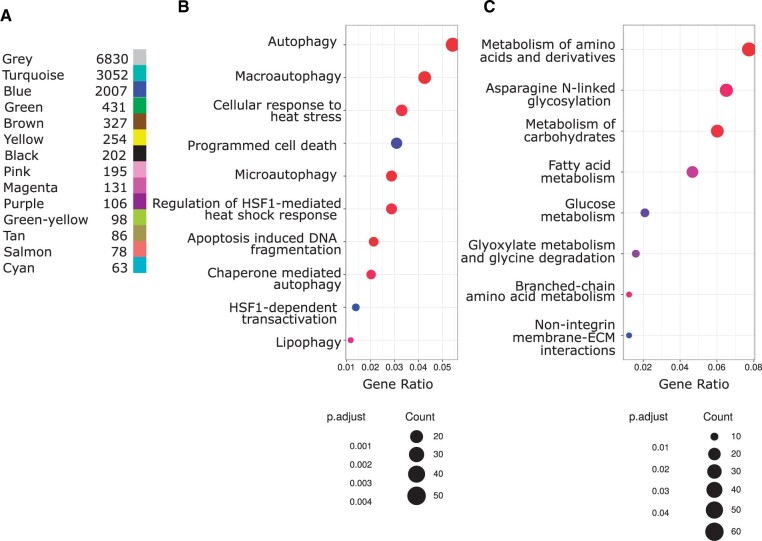
Weighted gene coexpression network analysis (WGCNA): (A) Number of genes in the final merged modules, (B) Reactome dotplot of enriched terms for the turquoise module, (C) Reactome dotplot of enriched terms for the blue module. P-values (“p.adjust”) are adjusted according to the method of Benjamini and Hochberg (1995). The number of genes in a pathway is encoded in the dot size (count).
Figure 4
Figure 4
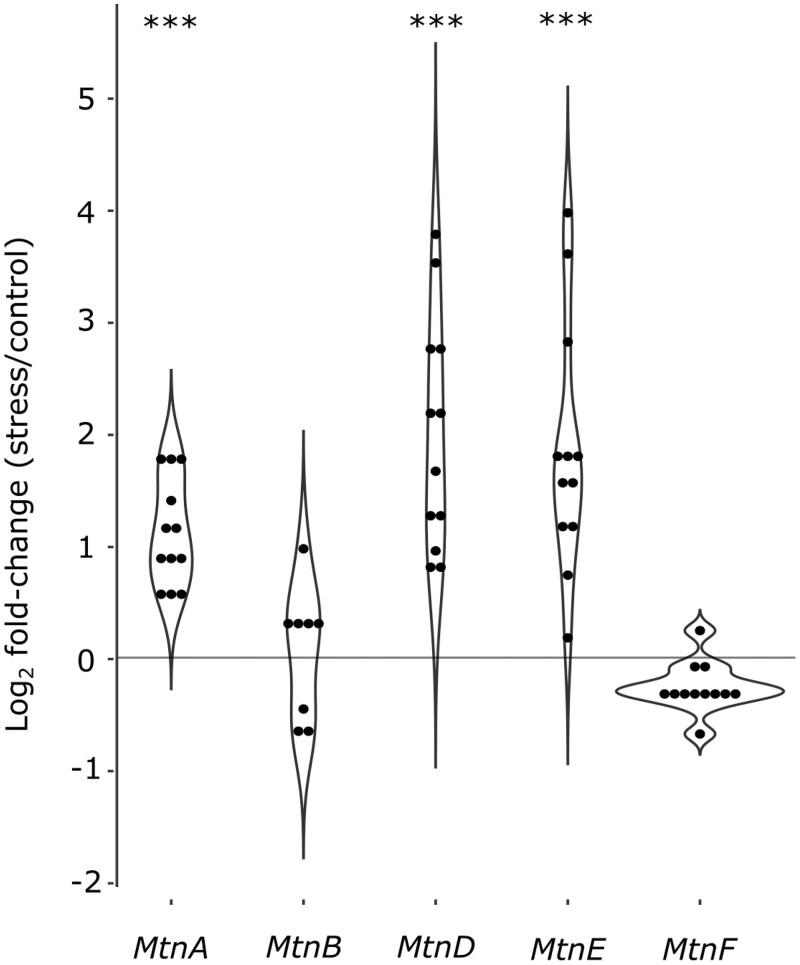
MSB-induced log2 fold-change in expression (stress/control) of the metallothionein group genes MtnA, MtnB, MtnD, MtnE, and MtnF. The points within each violin plot represent the values of the different inbred lines. Values for MtnC and some data points for MtnB are not included, as expression was below the detection threshold. Asterisks indicate the adjusted P-value from a Wald test as applied in DESeq2 in stress vs control comparisons across all lines. ***P < 0.001.
Figure 5
Figure 5
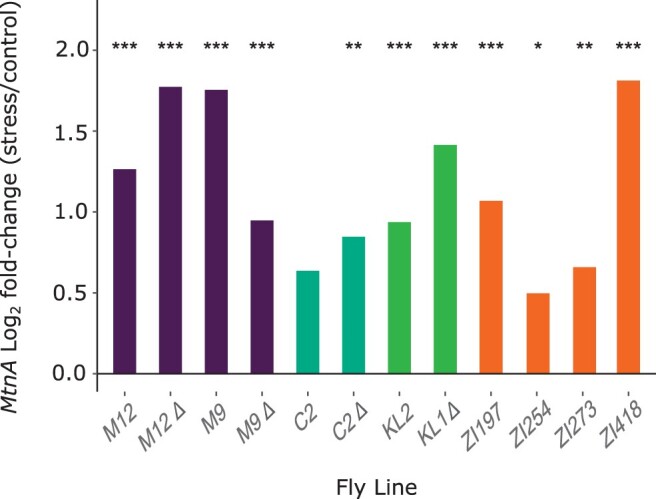
Log2 fold-change in MtnA expression induced by oxidative stress in different backgrounds: Munich, Germany (M9 and M12); Nicosia, Cyprus (C2); Kuala Lumpur, Malaysia (KL), and Siavonga, Zambia (ZI). Lines homozygous for the MtnA 3′ UTR deletion are denoted by “Δ.” Asterisks indicate the adjusted P-value from a Wald test as applied in DESeq2. * P < 0.05, **P < 0.01, ***P < 0.001.
Figure 6
Figure 6
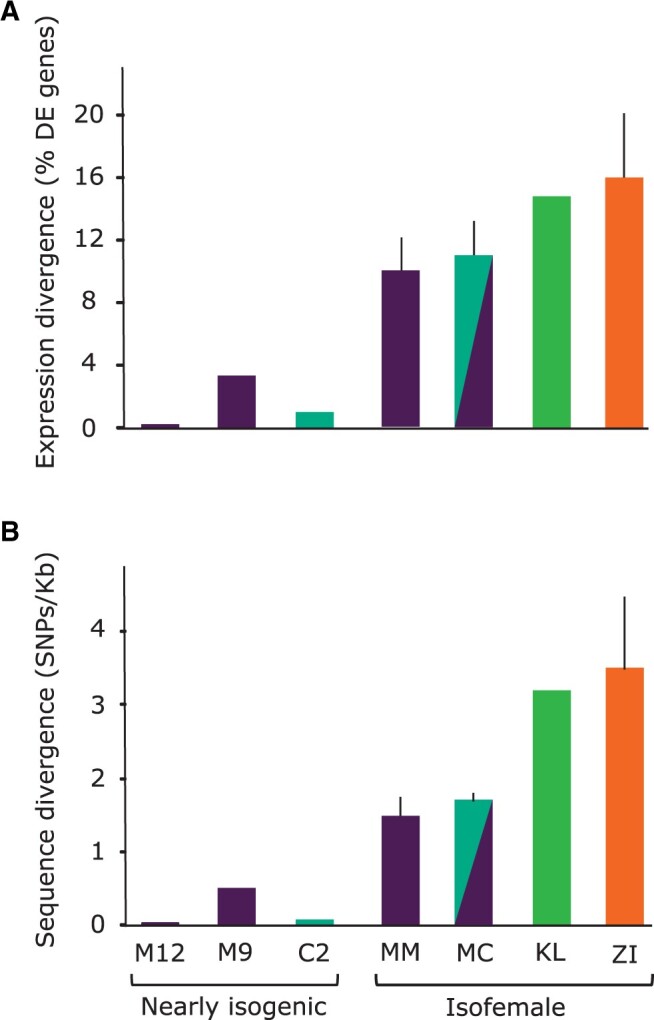
Comparison of variation between nearly isogenic lines from Munich, Germany (M9, M12) and Nicosia, Cyprus (C2), and isofemale lines from Kuala Lumpur, Malaysia (KL), and Siavonga, Zambia (ZI). (A) Gene expression divergence shown as the percentage of differentially expressed (DE) genes at a false discovery rate of 5%. (B) DNA sequence divergence in transcribed regions. “MM” indicates a comparison between the M12 and M9 lines, while “MC” indicates a comparison between both Munich lines and C2. In cases where multiple comparisons were possible, the mean is plotted with error bars indicating the standard deviation.
Figure 7
Figure 7
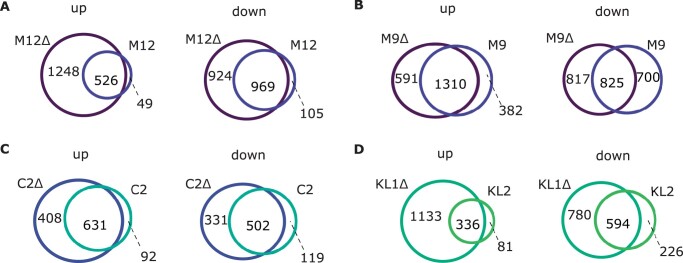
Venn diagram showing the number of shared differentially expressed genes under oxidative stress in deletion (“Δ”) and nondeletion lines in the (A) M12, (B) M9, (C) C2, and (D) KL genetic backgrounds.
Figure 8
Figure 8
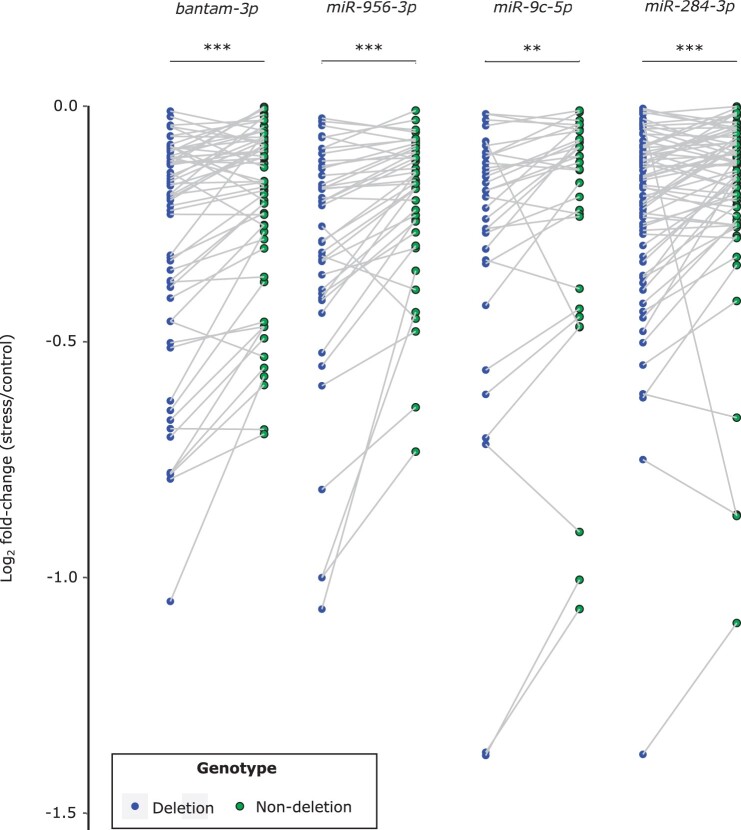
Log2 fold-changes (stress/control) of downregulated target genes of miRNAs with predicted binding sites within the MtnA 3′ UTR deletion region (miR-284-3p, miR-956-3p, miR-9c-5p, and bantam-3p). Two target genes that fall below the limits of the y-axis (log2 fold-change <−1.5) are not shown in the plot, but were included in the statistical analysis. Differences between the deletion and nondeletion background were tested using a paired sample Wilcoxon test. **P < 0.01, ***P < 0.001.

References

    1. Abel J, de Ruiter N.. 1989. Inhibition of hydroxyl-radical-generated DNA degradation by metallothionein. Toxicol Lett. 47:191–196. doi:10.1016/0378–4274(89)90075-1. - PubMed
    1. Agarwal V, Subtelny AO, Thiru P, Ulitsky I, Bartel DP.. 2018. Predicting microRNA targeting efficacy in Drosophila. Genome Biol. 19:152.doi:10.1186/s13059-018–1504-3. - PMC - PubMed
    1. Akman SA, Dietrich M, Chlebowski R, Limberg P, Block JB.. 1985. Modulation of cytotoxicity of menadione sodium bisulfite versus leukemia L1210 by the acid-soluble thiol pool. Cancer Res. 45:5257–5262. - PubMed
    1. Atanesyan L, Günther V, Celniker SE, Georgiev O, Schaffner W.. 2011. Characterization of MtnE, the fifth metallothionein member in Drosophila. J Biol Inorg Chem. 16:1047–1056. doi:10.1007/s00775-011–0825-4. - PubMed
    1. Baker H, DeAngelis B, Frank O, Khalil M, Hutner SH, et al.1996. Antioxidant survey to assess antagonism to redox stress using a prokaryotic and an eukaryotic system. Experientia. 52:597–599. doi:10.1007/BF01969736. - PubMed

Publication types

Substances