


Acute flaccid myelitis and Guillain-Barré syndrome in children: A comparative study with evaluation of diagnostic criteria
- PMID: 34747551
- PMCID: PMC9299116
- DOI: 10.1111/ene.15170
Acute flaccid myelitis and Guillain-Barré syndrome in children: A comparative study with evaluation of diagnostic criteria
Abstract
Background and purpose: Differentiation between acute flaccid myelitis (AFM) and Guillain-Barré syndrome (GBS) can be difficult, particularly in children. Our objective was to improve the diagnostic accuracy by giving recommendations based on a comparison of clinical features and diagnostic criteria in children with AFM or GBS.
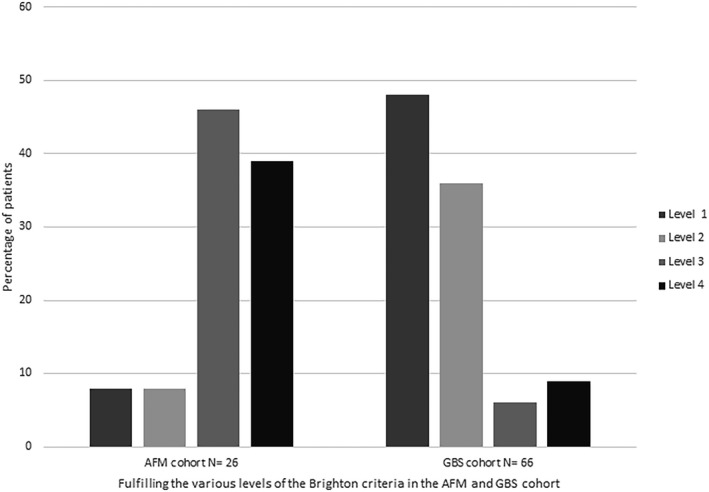
Methods: A cohort of 26 children with AFM associated with enterovirus D68 was compared to a cohort of 156 children with GBS. The specificity of the Brighton criteria, used for GBS diagnosis, was evaluated in the AFM cohort and the specificity of the Centers for Disease Control and Prevention (CDC) AFM diagnostic criteria in the GBS cohort.
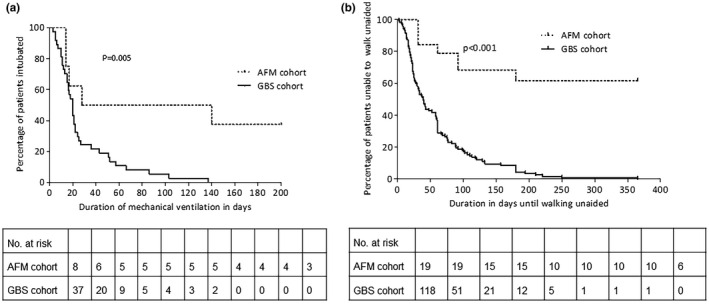
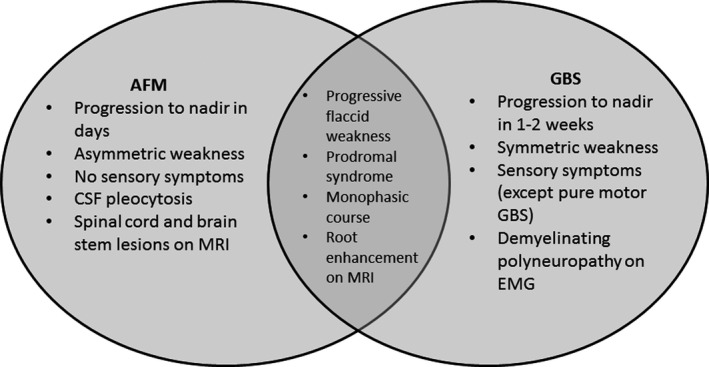
Results: Children with AFM compared to those with GBS had a shorter interval between onset of weakness and nadir (3 vs. 8 days, p < 0.001), more often had asymmetric limb weakness (58% vs. 0%, p < 0.001), and less frequently had sensory deficits (0% vs. 40%, p < 0.001). In AFM, cerebrospinal fluid leukocyte counts were higher, whereas protein concentrations were lower. Spinal cord lesions on magnetic resonance imaging were only found in AFM patients. No GBS case fulfilled CDC criteria for definite AFM. Of the AFM cases, 8% fulfilled the Brighton criteria for GBS, when omitting the criterion of excluding an alternate diagnosis.
Conclusions: Despite the overlap in clinical presentation, we found distinctive early clinical and diagnostic characteristics for differentiating AFM from GBS in children. Diagnostic criteria for AFM and GBS usually perform well, but some AFM cases may fulfill clinical diagnostic criteria for GBS. This underlines the need to perform diagnostic tests early to exclude AFM in children suspected of atypical GBS.
Keywords: Brighton criteria; Guillain-Barré syndrome; acute flaccid myelitis.
© 2021 The Authors. European Journal of Neurology published by John Wiley & Sons Ltd on behalf of European Academy of Neurology.
Conflict of interest statement
M.C.d.W. has received honoraria paid to her institution by Novartis for serving on a steering committee and presenting at a conference, and has received research funding from the Epilepsiefonds (Dutch Epilepsy Foundation), Hersenstichting, and Sophia Foundation. B.C.J. has received funding for travel from Baxter International, and has received research funding from the Netherlands Organization for Health Research and Development, Erasmus MC, Prinses Beatrix Spierfonds, Stichting Spieren voor Spieren, CSL‐Behring, Grifols, Annexon, Hansa Biopharma, and the GBS‐CIDP Foundation International. None of the other authors has any conflict of interest to disclose.
Figures
References
-
- Williams CJ, Thomas RH, Pickersgill TP, et al. Cluster of atypical adult Guillain‐Barre syndrome temporally associated with neurological illness due to EV‐D68 in children, South Wales, United Kingdom, October 2015 to January 2016. Euro Surveill Bull Eur Mal Transm Eur Commun Dis Bull. 2016;21(4):26‐32. doi:10.2807/1560-7917.ES.2016.21.4.30119 - DOI - PubMed
-
- CSTE . Revision to the standardized case definition, case classification, and Public Health Reporting for Acute Flaccid Myelitis.
Publication types
MeSH terms
Supplementary concepts
LinkOut - more resources
Full Text Sources
Medical
Miscellaneous
