Effectiveness of a Multifaceted Intervention for Prevention of Obesity in Primary School Children in China: A Cluster Randomized Clinical Trial
- PMID: 34747972
- PMCID: PMC8576631
- DOI: 10.1001/jamapediatrics.2021.4375
Effectiveness of a Multifaceted Intervention for Prevention of Obesity in Primary School Children in China: A Cluster Randomized Clinical Trial
Abstract
Importance: A rapid nutritional transition has caused greater childhood obesity prevalence in many countries, but the repertoire of effective preventive interventions remains limited.
Objective: To determine the effectiveness of a novel multifaceted intervention for obesity prevention in primary school children.
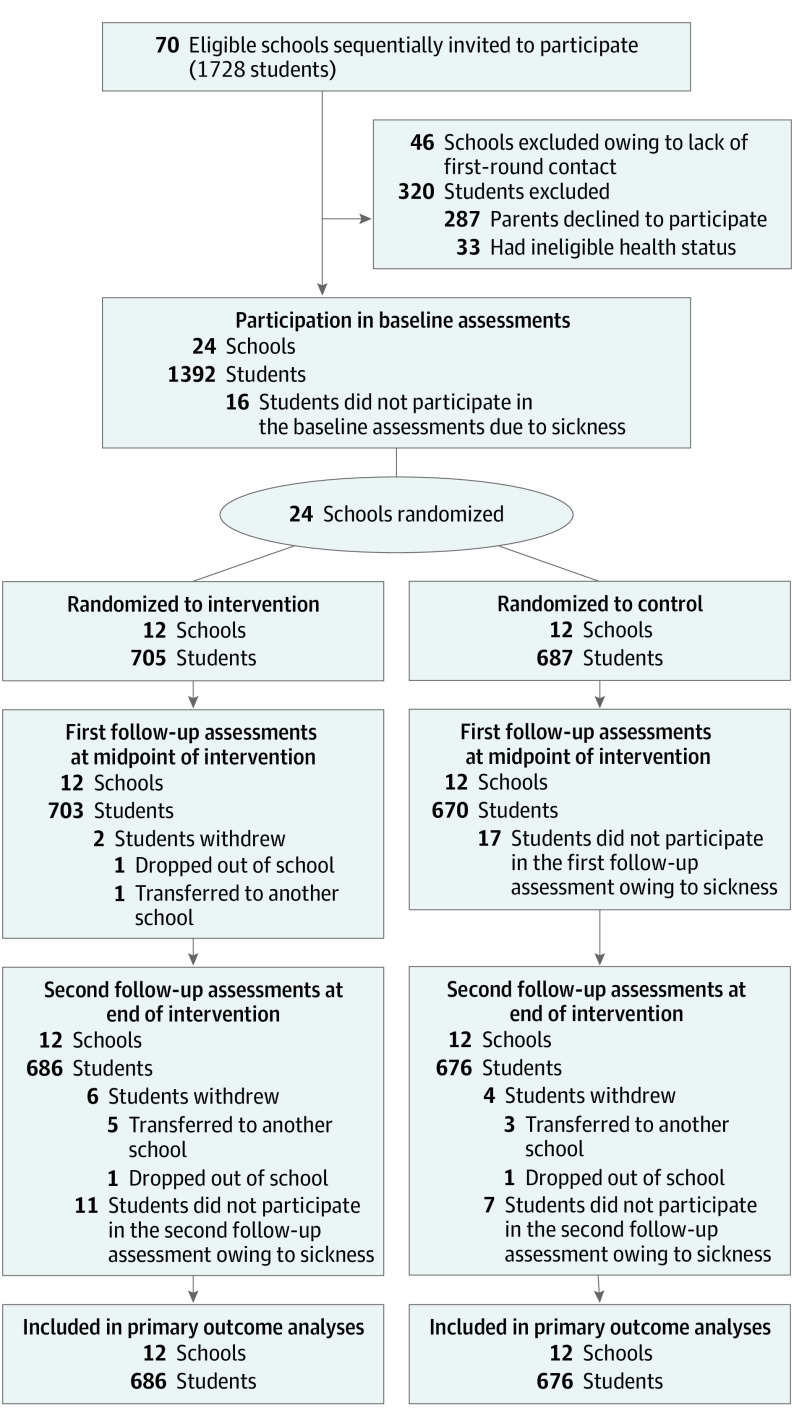
Design, setting, and participants: A cluster randomized clinical trial was conducted during a single school year (from September 11, 2018, to June 30, 2019) across 3 socioeconomically distinct regions in China according to a prespecified trial protocol. Twenty-four schools were randomly allocated (1:1) to the intervention or the control group, with 1392 eligible children aged 8 to 10 years participating. Data from the intent-to-treat population were analyzed from October 1 to December 31, 2019.
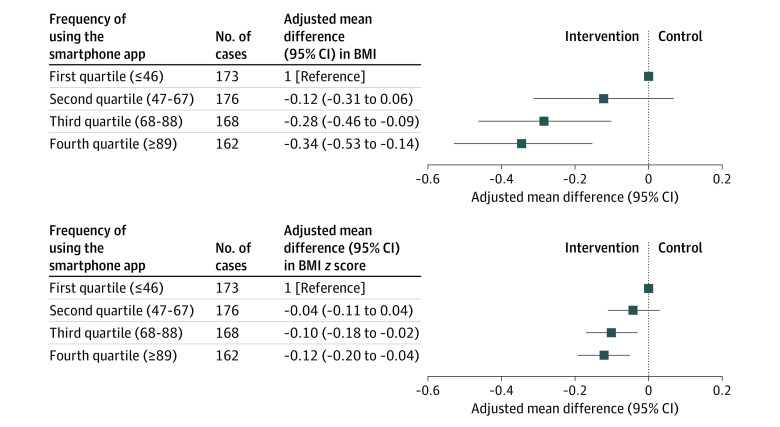
Interventions: A multifaceted intervention targeted both children (promoting healthy diet and physical activity) and their environment (engaging schools and families to support children's behavioral changes). The intervention was novel in its strengthening of family involvement with the assistance of a smartphone app. The control schools engaged in their usual practices.
Main outcomes and measures: The primary outcome was the change in body mass index (BMI; calculated as weight in kilograms divided by height in square meters) from baseline to the end of the trial. Secondary outcomes included changes in adiposity outcomes (eg, BMI z score, prevalence of obesity), blood pressure, physical activity and dietary behaviors, obesity-related knowledge, and physical fitness. Generalized linear mixed models were used in the analyses.
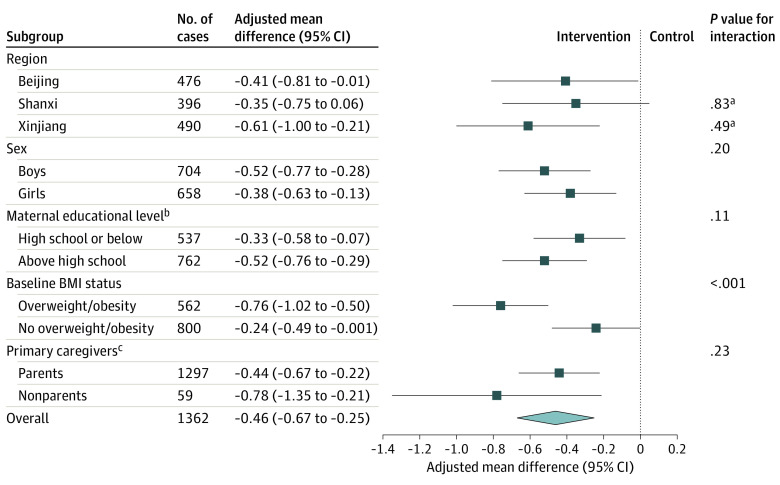
Results: Among the 1392 participants (mean [SD] age, 9.6 [0.4] years; 717 boys [51.5%]; mean [SD] BMI, 18.6 [3.7]), 1362 (97.8%) with follow-up data were included in the analyses. From baseline to the end of the trial, the mean BMI decreased in the intervention group, whereas it increased in the control group; the mean between-group difference in BMI change was -0.46 (95% CI, -0.67 to -0.25; P < .001), which showed no evidence of difference across different regions, sexes, maternal education levels, and primary caregivers (parents vs nonparents). The prevalence of obesity decreased by 27.0% of the baseline figure (a relative decrease) in the intervention group, compared with 5.6% in the control group. The intervention also improved other adiposity outcomes, dietary, sedentary, and physical activity behaviors, and obesity-related knowledge, but it did not change moderate- to vigorous-intensity physical activity, physical fitness, or blood pressure. No adverse events were observed during the intervention.
Conclusions and relevance: The multifaceted intervention effectively reduced the mean BMI and obesity prevalence in primary school children across socioeconomically distinct regions in China, suggesting its potential for national scaling.
Trial registration: ClinicalTrials.gov Identifier: NCT03665857.
Conflict of interest statement
Figures
Comment in
-
Childhood Obesity Interventions-Going Beyond the Individual.JAMA Pediatr. 2022 Jan 1;176(1):e214388. doi: 10.1001/jamapediatrics.2021.4388. Epub 2022 Jan 4. JAMA Pediatr. 2022. PMID: 34747988 No abstract available.
References
-
- NCD Risk Factor Collaboration (NCD-RisC) . Worldwide trends in body-mass index, underweight, overweight, and obesity from 1975 to 2016: a pooled analysis of 2416 population-based measurement studies in 128·9 million children, adolescents, and adults. Lancet. 2017;390(10113):2627-2642. doi:10.1016/S0140-6736(17)32129-3 - DOI - PMC - PubMed