Noncontrast Computed Tomography vs Computed Tomography Perfusion or Magnetic Resonance Imaging Selection in Late Presentation of Stroke With Large-Vessel Occlusion
- PMID: 34747975
- PMCID: PMC8576630
- DOI: 10.1001/jamaneurol.2021.4082
Noncontrast Computed Tomography vs Computed Tomography Perfusion or Magnetic Resonance Imaging Selection in Late Presentation of Stroke With Large-Vessel Occlusion
Erratum in
-
Error in Author Name.JAMA Neurol. 2022 Jan 1;79(1):93. doi: 10.1001/jamaneurol.2021.4854. JAMA Neurol. 2022. PMID: 35006268 Free PMC article. No abstract available.
Abstract
Importance: Advanced imaging for patient selection in mechanical thrombectomy is not widely available.
Objective: To compare the clinical outcomes of patients selected for mechanical thrombectomy by noncontrast computed tomography (CT) vs those selected by computed tomography perfusion (CTP) or magnetic resonance imaging (MRI) in the extended time window.
Design, setting, and participants: This multinational cohort study included consecutive patients with proximal anterior circulation occlusion stroke presenting within 6 to 24 hours of time last seen well from January 2014 to December 2020. This study was conducted at 15 sites across 5 countries in Europe and North America. The duration of follow-up was 90 days from stroke onset.
Exposures: Computed tomography with Alberta Stroke Program Early CT Score, CTP, or MRI.
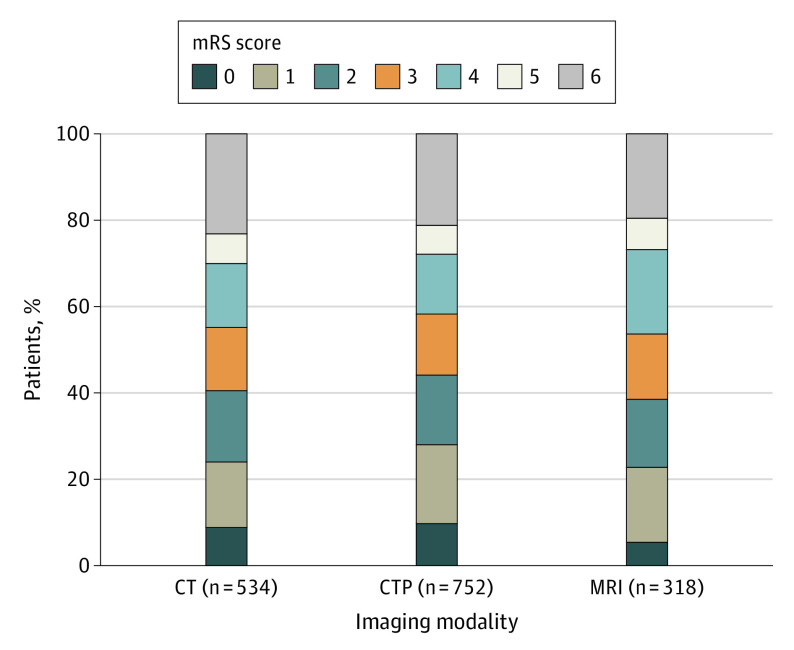
Main outcomes and measures: The primary end point was the distribution of modified Rankin Scale (mRS) scores at 90 days (ordinal shift). Secondary outcomes included the rates of 90-day functional independence (mRS scores of 0-2), symptomatic intracranial hemorrhage, and 90-day mortality.
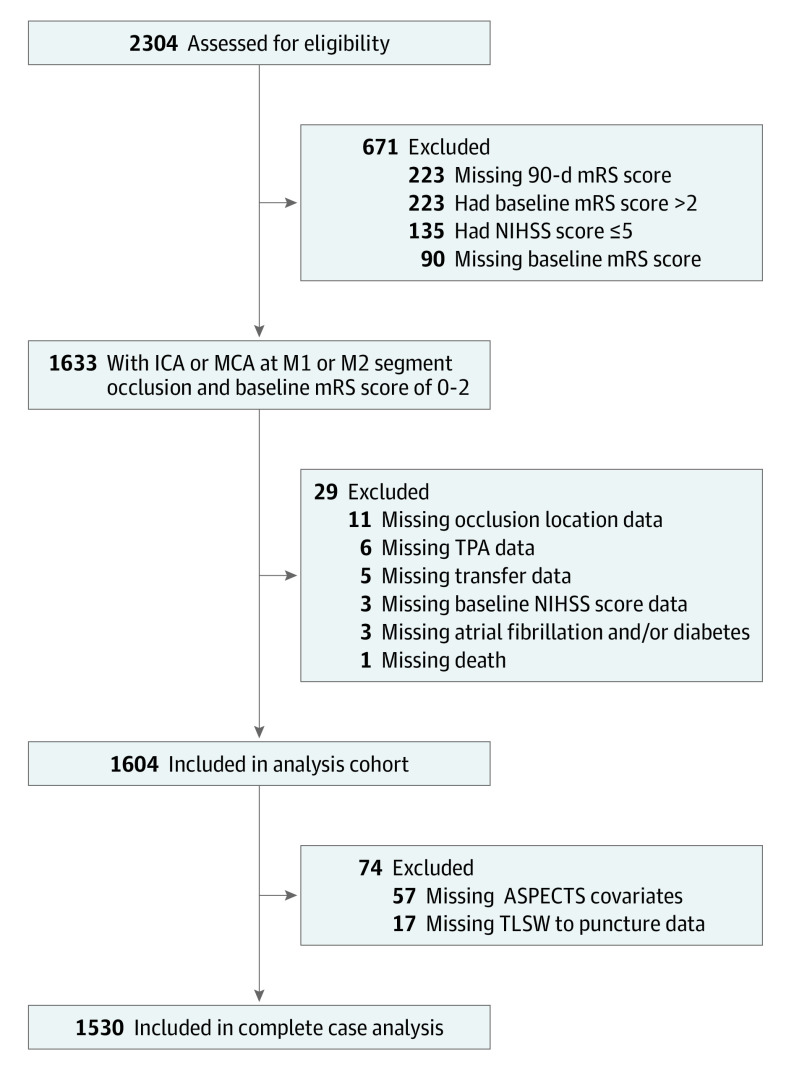
Results: Of 2304 patients screened for eligibility, 1604 patients were included, with a median (IQR) age of 70 (59-80) years; 848 (52.9%) were women. A total of 534 patients were selected to undergo mechanical thrombectomy by CT, 752 by CTP, and 318 by MRI. After adjustment of confounders, there was no difference in 90-day ordinal mRS shift between patients selected by CT vs CTP (adjusted odds ratio [aOR], 0.95 [95% CI, 0.77-1.17]; P = .64) or CT vs MRI (aOR, 0.95 [95% CI, 0.8-1.13]; P = .55). The rates of 90-day functional independence (mRS scores 0-2 vs 3-6) were similar between patients selected by CT vs CTP (aOR, 0.90 [95% CI, 0.7-1.16]; P = .42) but lower in patients selected by MRI than CT (aOR, 0.79 [95% CI, 0.64-0.98]; P = .03). Successful reperfusion was more common in the CT and CTP groups compared with the MRI group (474 [88.9%] and 670 [89.5%] vs 250 [78.9%]; P < .001). No significant differences in symptomatic intracranial hemorrhage (CT, 42 [8.1%]; CTP, 43 [5.8%]; MRI, 15 [4.7%]; P = .11) or 90-day mortality (CT, 125 [23.4%]; CTP, 159 [21.1%]; MRI, 62 [19.5%]; P = .38) were observed.
Conclusions and relevance: In patients undergoing proximal anterior circulation mechanical thrombectomy in the extended time window, there were no significant differences in the clinical outcomes of patients selected with noncontrast CT compared with those selected with CTP or MRI. These findings have the potential to widen the indication for treating patients in the extended window using a simpler and more widespread noncontrast CT-only paradigm.
Conflict of interest statement
Figures
Comment in
-
Beyond the AJR: Comparable Clinical Outcomes When Using Noncontrast CT, CT Perfusion Imaging, or MRI to Select Patients With Stroke for Mechanical Thrombectomy.AJR Am J Roentgenol. 2022 Oct;219(4):684. doi: 10.2214/AJR.22.27481. Epub 2022 Feb 9. AJR Am J Roentgenol. 2022. PMID: 35138131 No abstract available.
References
-
- Powers WJ, Rabinstein AA, Ackerson T, et al. ; American Heart Association Stroke Council . 2018 guidelines for the early management of patients with acute ischemic stroke: a guideline for healthcare professionals from the American Heart Association/American Stroke Association. Stroke. 2018;49(3):e46-e110. doi:10.1161/STR.0000000000000158 - DOI - PubMed
-
- Turc G, Bhogal P, Fischer U, et al. . European Stroke Organisation (ESO)—European Society for Minimally Invasive Neurological Therapy (ESMINT) guidelines on mechanical thrombectomy in acute ischaemic stroke endorsed by Stroke Alliance for Europe (SAFE). Eur Stroke J. 2019;4(1):6-12. doi:10.1177/2396987319832140 - DOI - PMC - PubMed