. 2021 Dec:139:105002.
doi: 10.1016/j.compbiomed.2021.105002. Epub 2021 Oct 30.

COVID-19 infection localization and severity grading from chest X-ray images

Affiliations

COVID-19 infection localization and severity grading from chest X-ray images

Anas M Tahir et al. Comput Biol Med. 2021 Dec.

Abstract

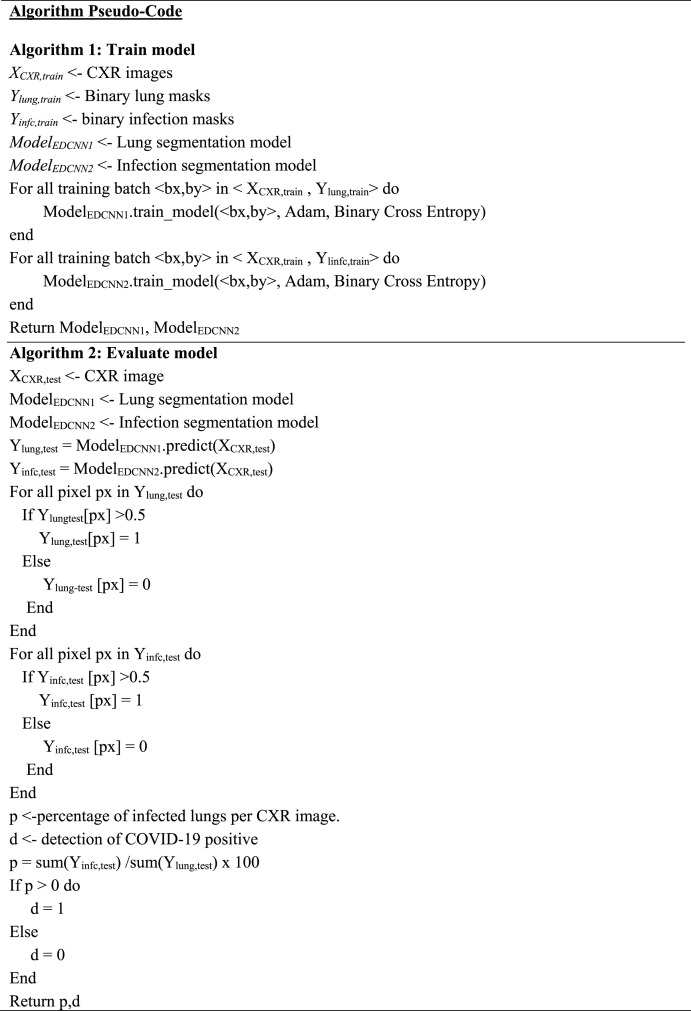
The immense spread of coronavirus disease 2019 (COVID-19) has left healthcare systems incapable to diagnose and test patients at the required rate. Given the effects of COVID-19 on pulmonary tissues, chest radiographic imaging has become a necessity for screening and monitoring the disease. Numerous studies have proposed Deep Learning approaches for the automatic diagnosis of COVID-19. Although these methods achieved outstanding performance in detection, they have used limited chest X-ray (CXR) repositories for evaluation, usually with a few hundred COVID-19 CXR images only. Thus, such data scarcity prevents reliable evaluation of Deep Learning models with the potential of overfitting. In addition, most studies showed no or limited capability in infection localization and severity grading of COVID-19 pneumonia. In this study, we address this urgent need by proposing a systematic and unified approach for lung segmentation and COVID-19 localization with infection quantification from CXR images. To accomplish this, we have constructed the largest benchmark dataset with 33,920 CXR images, including 11,956 COVID-19 samples, where the annotation of ground-truth lung segmentation masks is performed on CXRs by an elegant human-machine collaborative approach. An extensive set of experiments was performed using the state-of-the-art segmentation networks, U-Net, U-Net++, and Feature Pyramid Networks (FPN). The developed network, after an iterative process, reached a superior performance for lung region segmentation with Intersection over Union (IoU) of 96.11% and Dice Similarity Coefficient (DSC) of 97.99%. Furthermore, COVID-19 infections of various shapes and types were reliably localized with 83.05% IoU and 88.21% DSC. Finally, the proposed approach has achieved an outstanding COVID-19 detection performance with both sensitivity and specificity values above 99%.

Keywords: COVID-19; Chest X-ray; Convolutional Neural Networks; Deep Learning; Infection Segmentation; Lung Segmentation.


Figures

Fig. 1
Fig. 1
Sample chest X-ray images from the COVID-QU-Ex dataset for Normal, Non-COVID, and COVID-19 classes. All images are rescaled with the same factor to illustrate the diversity of the dataset.
Fig. 2
Fig. 2
Collaborative human-machine approach to create ground-truth lung segmentation masks for COVID-QU-Ex CXR dataset. Stage Ⅰ: Three segmentation networks are trained on a repository of 704 CXR lung segmentation masks, and the best network in terms of DSC is selected for the subsequent stages. Stage Ⅱ: An iterative training is utilized to create lung masks for a subset of 3000 CXR samples from the COVID-QU-Ex dataset. Firstly, A subset of 500 samples is inferred by the CXR segmentation model and the outputs are evaluated manually as accept, reject, modify, or exclude. Next, the modified masks are added to the lung repository and the network is re-trained on the extended dataset. These steps are repeated until generating ground-truth masks for the 3000 CXR samples is completed. Stage Ⅲ: six deep segmentation networks are trained using the 3000 ground-truth masks generated in the previous stage. The trained networks are used to predict segmentation masks for the rest of the COVID-QU-Ex dataset (30,920 images). Stage Ⅳ: a final verification is performed by MDs on randomly selected 6788 CXR samples (20% of the full dataset) that well presents the diversity of the COVID-QU-Ex dataset.
Fig. 3
Fig. 3
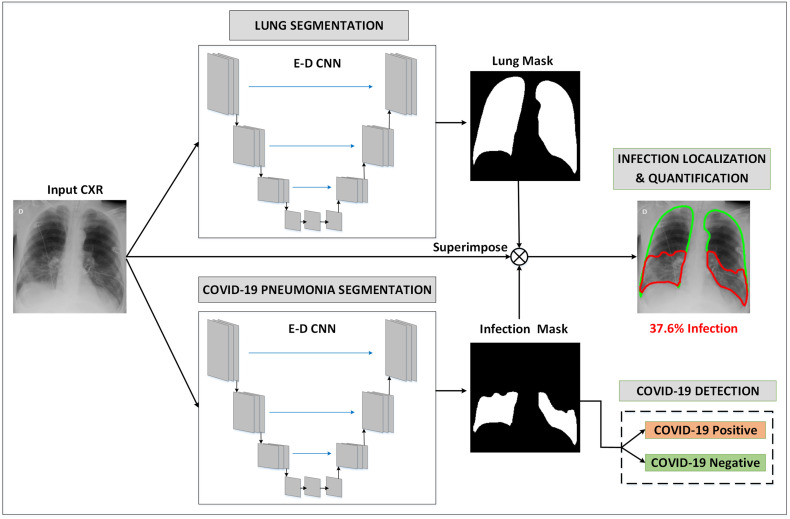
Schematic representation of the pipeline of the proposed system. The input CXR image is fed to two ED-CNNs in parallel, to generate two binary masks: lung, and COVID-19 infection masks. Next, the generated masks are superimposed with the CXR image to localize and quantify COVID-19 infected lung regions. Finally, the generated infection mask is used to detect COVID-19 positive cases from COVID-19 negative cases.
Fig. 4
Fig. 4
Sample qualitative evaluation of generated lung masks by the three top-performing networks. Column 1 shows the CXR image, Column 2 shows ground truths, and the lung masks of the top three networks are shown in Columns 3–5, respectively.
Fig. 5
Fig. 5
(a) Sample qualitative evaluation of generated infection masks by the three top-performing networks. Column 1 shows the CXR image, Column 2 shows ground truths, and the lung masks of the top three networks are shown in Columns 3–5, respectively. (b) Infection localization and severity grading of COVID-19 pneumonia for a 42-year female patient on the 1st, 2nd, and 3rd days of admission using the proposed system.
Image 1

References

    1. World Health Organization WHO coronavirus disease (COVID-19) Dashboard. 2020. https://covid19.who.int/?gclid=Cj0KCQjwtZH7BRDzARIsAGjbK2ZXWRpJROEl97HGm... Available.
    1. Shastri S., Singh K., Kumar S., Kour P., Mansotra V. Time series forecasting of Covid-19 using deep learning models: India-USA comparative case study. Chaos, Solit. Fractals. 2020;140:110227. 2020/11/01/ - PMC - PubMed
    1. Shastri S., Singh K., Deswal M., Kumar S., Mansotra V. Spatial Information Research, 2021/06/12. 2021. CoBiD-net: a tailored deep learning ensemble model for time series forecasting of covid-19.
    1. Pormohammad A., et al. Comparison of confirmed COVID-19 with SARS and MERS cases - clinical characteristics, laboratory findings, radiographic signs and outcomes: a systematic review and meta-analysis. Rev. Med. Virol. 2020;30(4) doi: 10.1002/rmv.2112. p. e2112, 2020/07/01. - DOI - PMC - PubMed
    1. Singhal T. 2020. A Review of Coronavirus Disease-2019 (COVID-19) pp. 1–6. - PMC - PubMed

Publication types