


Comparing information diffusion mechanisms by matching on cascade size
- PMID: 34750252
- PMCID: PMC8609637
- DOI: 10.1073/pnas.2100786118
Comparing information diffusion mechanisms by matching on cascade size
Abstract
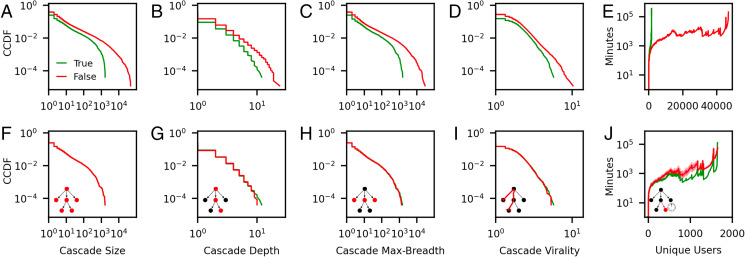
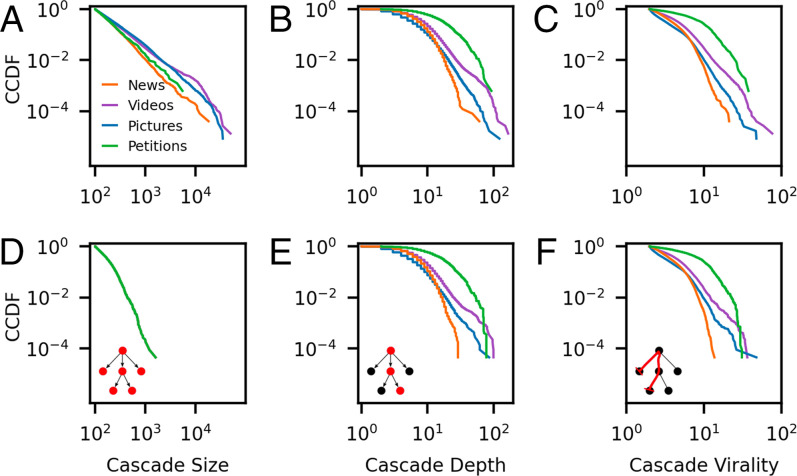
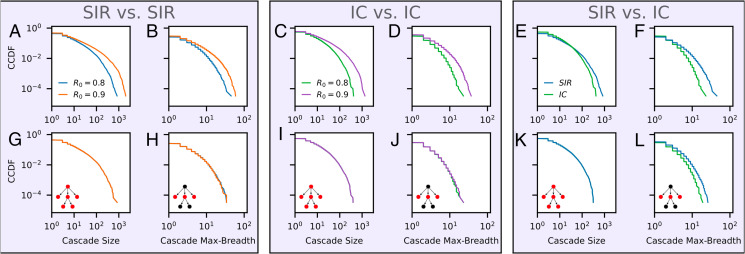
Do some types of information spread faster, broader, or further than others? To understand how information diffusions differ, scholars compare structural properties of the paths taken by content as it spreads through a network, studying so-called cascades. Commonly studied cascade properties include the reach, depth, breadth, and speed of propagation. Drawing conclusions from statistical differences in these properties can be challenging, as many properties are dependent. In this work, we demonstrate the essentiality of controlling for cascade sizes when studying structural differences between collections of cascades. We first revisit two datasets from notable recent studies of online diffusion that reported content-specific differences in cascade topology: an exhaustive corpus of Twitter cascades for verified true- or false-news content by Vosoughi et al. [S. Vosoughi, D. Roy, S. Aral. Science 359, 1146-1151 (2018)] and a comparison of Twitter cascades of videos, pictures, news, and petitions by Goel et al. [S. Goel, A. Anderson, J. Hofman, D. J. Watts. Manage. Sci. 62, 180-196 (2016)]. Using methods that control for joint cascade statistics, we find that for false- and true-news cascades, the reported structural differences can almost entirely be explained by false-news cascades being larger. For videos, images, news, and petitions, structural differences persist when controlling for size. Studying classical models of diffusion, we then give conditions under which differences in structural properties under different models do or do not reduce to differences in size. Our findings are consistent with the mechanisms underlying true- and false-news diffusion being quite similar, differing primarily in the basic infectiousness of their spreading process.
Keywords: information diffusion; misinformation; network analysis; social media.
Conflict of interest statement
The authors declare no competing interest.
Figures
References
-
- F. S. Chapin, Cultural Change (The Century Company, New York, 1928).
-
- Ryan B., Gross N. C., The diffusion of hybrid seed corn in two Iowa communities. Rural Sociol. 8, 15 (1943).
-
- Rogers E. M., Diffusion of Innovations (Free Press of Glencoe, New York, 1962).
-
- Gruhl D., Guha R., Liben-Nowell D., Tomkins A., “Information diffusion through blogspace” in Proceedings of the 13th International Conference on World Wide Web (Association for Computing Machinery, New York, 2004), pp. 491–501.
-
- Adar E., Adamic L. A., “Tracking information epidemics in blogspace” in 2005 ACM International Conference on Web Intelligence (WI’05) (IEEE, 2005), pp. 207–214.
Publication types
MeSH terms
LinkOut - more resources
Full Text Sources
