


Prognostic value of soluble programmed cell death-1 (sPD-1) and soluble programmed cell death ligand-1 (sPD-L1) for hepatocellular carcinoma: a systematic review and meta-analysis
- PMID: 34750662
- PMCID: PMC10992106
- DOI: 10.1007/s00262-021-03103-2
Prognostic value of soluble programmed cell death-1 (sPD-1) and soluble programmed cell death ligand-1 (sPD-L1) for hepatocellular carcinoma: a systematic review and meta-analysis
Abstract
Background: Preliminary studies have suggested that soluble programmed death-1 (sPD-1) and soluble programmed cell death ligand-1 (sPD-L1) have prognostic implications in many malignant tumors. However, the correlation between sPD-1/sPD-L1 level and prognosis of hepatocellular carcinoma (HCC) is still unclear.
Methods: We searched several electronic databases from database inception to October 7, 2021. Meta-analyses were performed separately for overall survival (OS), disease-free survival (DFS), recurrence-free survival (RFS), time to progression (TTP), and tumor-free survival (TFS). Random effects were introduced to this meta-analysis. The correlation between sPD-1/sPD-L1 level and prognosis was evaluated using hazard ratios (HRs) with 95% confidence intervals (95%CIs).
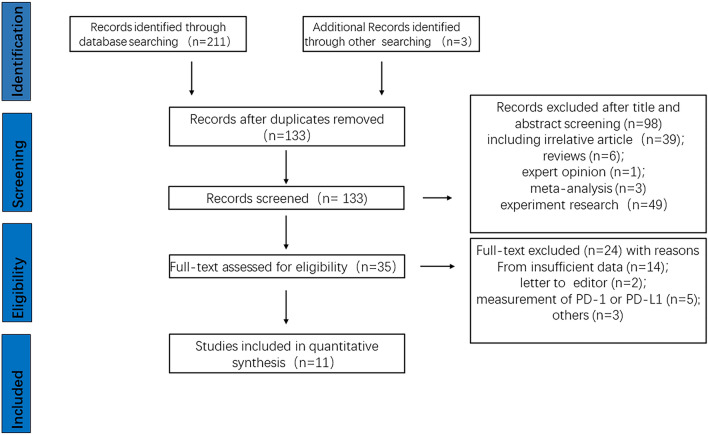
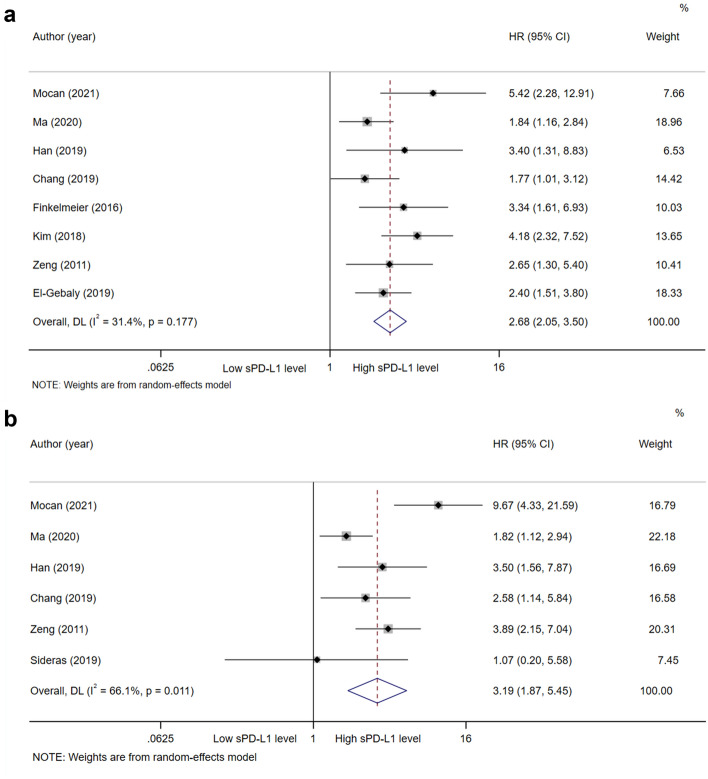
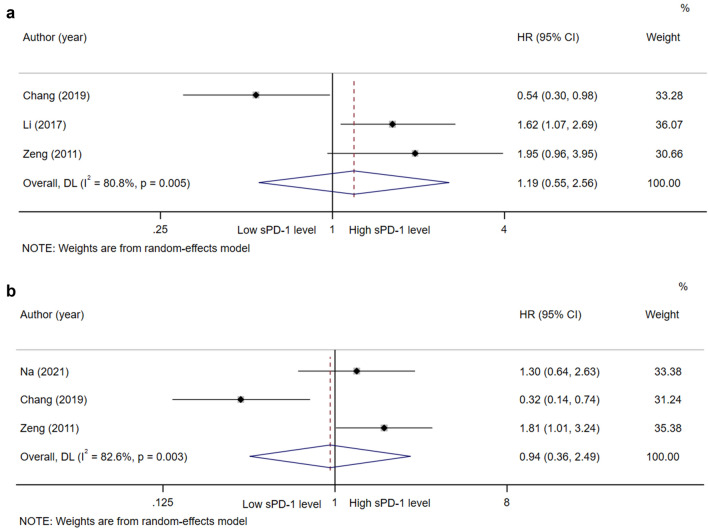
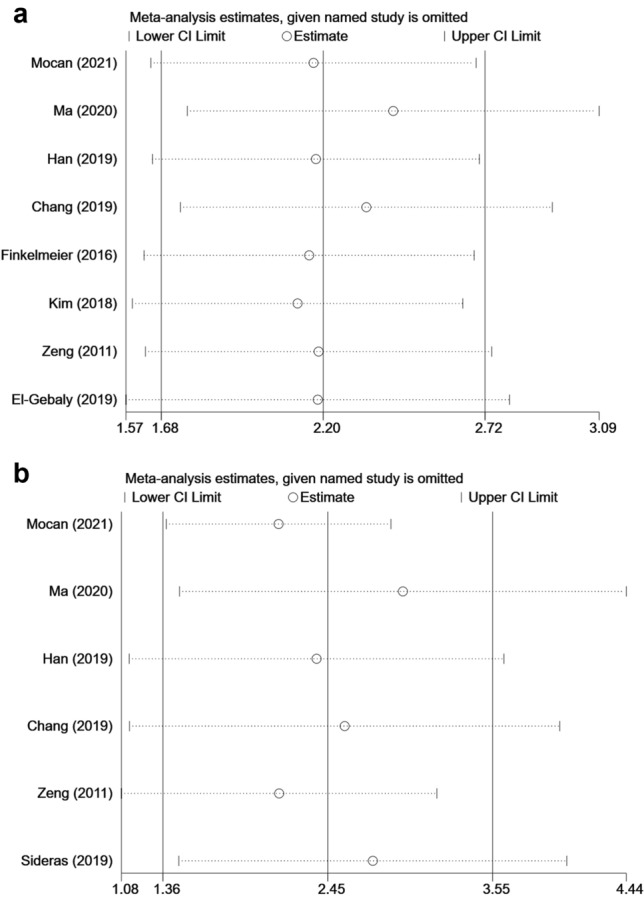
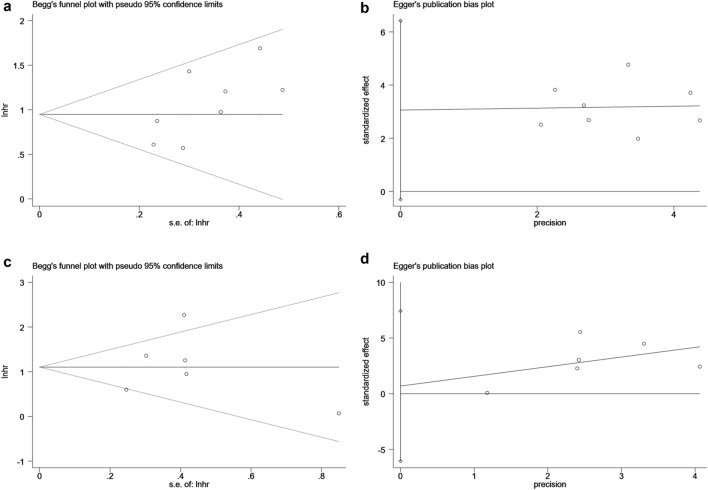
Results: A total of 11 studies (1291 patients) were incorporated into this meta-analysis, including seven on sPD-L1, two on sPD-1, and two about both factors. The pooled results showed that high sPD-L1 level was associated with worse OS (HR = 2.46, 95%CI 1.74-3.49, P < 0.001; I2 = 31.4, P = 0.177) and poorer DFS/RFS/TTP/TFS of patients with HCC (HR = 2.22, 95%CI 1.47-3.35, P < 0.001; I2 = 66.1, P = 0.011), irrespective of method of detection, study type, treatment, cut-off value and follow-up time. In contrast, the level of sPD-1 was not correlated to the OS (HR = 1.19, 95%CI 0.55-2.56, P = 0.657) and DFS/TFS of patients with HCC (HR = 0.94, 95%CI 0.36-2.49, P = 0.906).
Conclusion: sPD-L1 rather than sPD-1 could be a good predictor for recurrence and survival after treatment for HCC. More high-quality prospective studies are warranted to assess the prognostic value of sPD-1 or sPD-L1 for HCC.
Keywords: Hepatocellular carcinoma; Meta-analysis; Prognosis; sPD-1; sPD-L1.
© 2021. The Author(s), under exclusive licence to Springer-Verlag GmbH Germany, part of Springer Nature.
Conflict of interest statement
The authors declare that they do not have any conflicts of interest.
Figures
References
-
- Shigeta K, Datta M, Hato T, Kitahara S, Chen IX, Matsui A, et al. Dual Programmed Death Receptor-1 and Vascular Endothelial Growth Factor Receptor-2 Blockade Promotes Vascular Normalization and Enhances Antitumor Immune Responses in Hepatocellular Carcinoma. Hepatology. 2020;71:1247–1261. doi: 10.1002/hep.30889. - DOI - PMC - PubMed
Publication types
MeSH terms
Substances
Grants and funding
LinkOut - more resources
Full Text Sources
Medical
Research Materials
