Review
. 2022 Jan 24:17:345-365.
doi: 10.1146/annurev-pathmechdis-032521-102529. Epub 2021 Nov 9.

Role of the Inflammasome in Liver Disease

Affiliations
Review

Role of the Inflammasome in Liver Disease

Marcelle de Carvalho Ribeiro et al. Annu Rev Pathol. .

Abstract

The involvement of inflammasomes in the proinflammatory response observed in chronic liver diseases, such as alcohol-associated liver disease (ALD) and nonalcoholic fatty liver disease (NAFLD), is widely recognized. Although there are different types of inflammasomes, most studies to date have given attention to NLRP3 (nucleotide-binding oligomerization domain-like receptor family, pyrin domain containing 3) in the pathogenesis of ALD, NAFLD/nonalcoholic steatohepatitis, and fibrosis. Canonical inflammasomes are intracellular multiprotein complexes that are assembled after the sensing of danger signals and activate caspase-1, which matures interleukin (IL)-1β, IL-18, and IL-37 and also induces a form of cell death called pyroptosis. Noncanonical inflammasomes activate caspase-11 to induce pyroptosis. We discuss the different types of inflammasomes involved in liver diseases with a focus on (a) signals and mechanisms of inflammasome activation, (b) the role of different types of inflammasomes and their products in the pathogenesis of liver diseases, and (c) potential therapeutic strategies targeting components of the inflammasomes or cytokines produced upon inflammasome activation.

Keywords: GSDMD; IL-18; IL-1β; alcohol-associated liver diseases; canonical inflammasomes; hepatocyte; macrophage; nonalcoholic steatohepatitis; noncanonical inflammasomes; pyroptosis.


Figures

Figure 1
Figure 1
Roles of the canonical and noncanonical inflammasomes. Activation of the canonical inflammasomes results in CASP1 activation. Members of the NLR family of receptors including NLRP3, NLRP1, NLRP6, and NLRP12 and the ALR family member AIM2, activate CASP1 in the presence of the adaptor protein ASC. NLRC4 activates CASP1 in the absence of ASC. The activation of CASP1 culminates in the cleavage of cytokine precursors pro-IL-1β, pro-IL-18, and pro-IL-37 into their mature forms IL-1β, IL-18, and IL-37. The noncanonical pathway culminates in CASP11 activation. NLRP6 also activates CASP11. CASP1 and CASP11 cleave the inactive protein GSDMD into the pyroptotic membrane pore protein GSDMD-N. Abbreviations: AIM2, absent in melanoma 2; ALR, absent in melanoma-like receptor; ASC, apoptosis-associated speck-like protein containing a CARD; CARD, caspase recruitment domain; CASP1, caspase-1; CASP11, caspase-11; dsDNA, double-stranded DNA; FIIND, function-to-find domain; GSDMD, gasdermin D; HIN, hematopoietic, interferon-inducible, and nuclear localization; IL, interleukin; LPS, lipopolysaccharide; LRR, leucine-rich repeats; NAIP, NLR family apoptosis inhibitory protein; NEK, NIMA-related kinase; NF-κB, nuclear factor κB; NLR, nucleotide-binding domain, leucine-rich repeat containing receptor; NLRC, NOD-like receptor family, CARD domain; NLRP, NOD-like receptor family, pyrin domain; oxAPC, oxidized phospholipid; PPARγ, peroxisome proliferator-activated receptor-gamma; PYD, pyrin domain; ROS, reactive oxygen species; T3SS, type three secretion system; TNF-α, tumor necrosis factor alpha; TLR, Toll-like receptor; TXNIP, thioredoxin-interacting protein. Data from References , , and .
Figure 2
Figure 2
Inflammasomes involved in NASH. Inflammasomes are activated in NASH in different organs. In the liver, palmitic acid triggers (①) the activation of NLRP3 in macrophages and (②) the activation of NLRP3, NLRC4, and NLRP6 in hepatocytes. (③) The intracellular mechanisms of NLRP3 activation in macrophages involve HIF-1α, cathepsin B, mtDNA, ROS, and impaired autophagic flux, and the NLRP3 negative regulator is TXNIP. (④) In hepatocytes, the bile acid receptors TGR5 and FXR inhibit NLRP3 activation. (⑤) AIM2 is activated in both macrophages and hepatocytes in a TLR/MyD88-dependent manner. The mechanism of NLRP1 activation in the liver is not well described. (⑥) Extracellular ATP contributes to IL-1β production by endothelial cells in an NLRP3-dependent manner. (⑦) IL-1β induces TG accumulation in hepatocytes and induces liver injury through TNF-α activation. (⑧) In adipocytes, NLRP1–mediated IL-18 production inhibits adiposity. (⑨) In intestines, downregulation of NLRP3 and NLRP6 amplifies bacteremia. (⑩) IL-37 decreases steatosis and adiposity. Abbreviations: AIM2, absent in melanoma 2; ASC, apoptosis-associated speck-like protein containing a CARD; CARD, caspase recruitment domain; ER, endoplasmic reticulum; FXR, farnesoid X receptor; GSDMD, gasdermin D; HIF-1α, hypoxia-inducible factor 1-alpha; IL, interleukin; LPS, lipopolysaccharide; mtDNA, mitochondrial DNA; NASH, nonalcoholic steatohepatitis; NLRC, NOD-like receptor family, CARD domain; NLRP, NOD-like receptor family, pyrin domain; ROS, reactive oxygen species; TG, triglyceride; TLR, Toll-like receptor; TNF-α, tumor necrosis factor alpha; TXNIP, thioredoxin-interacting protein.
Figure 3
Figure 3
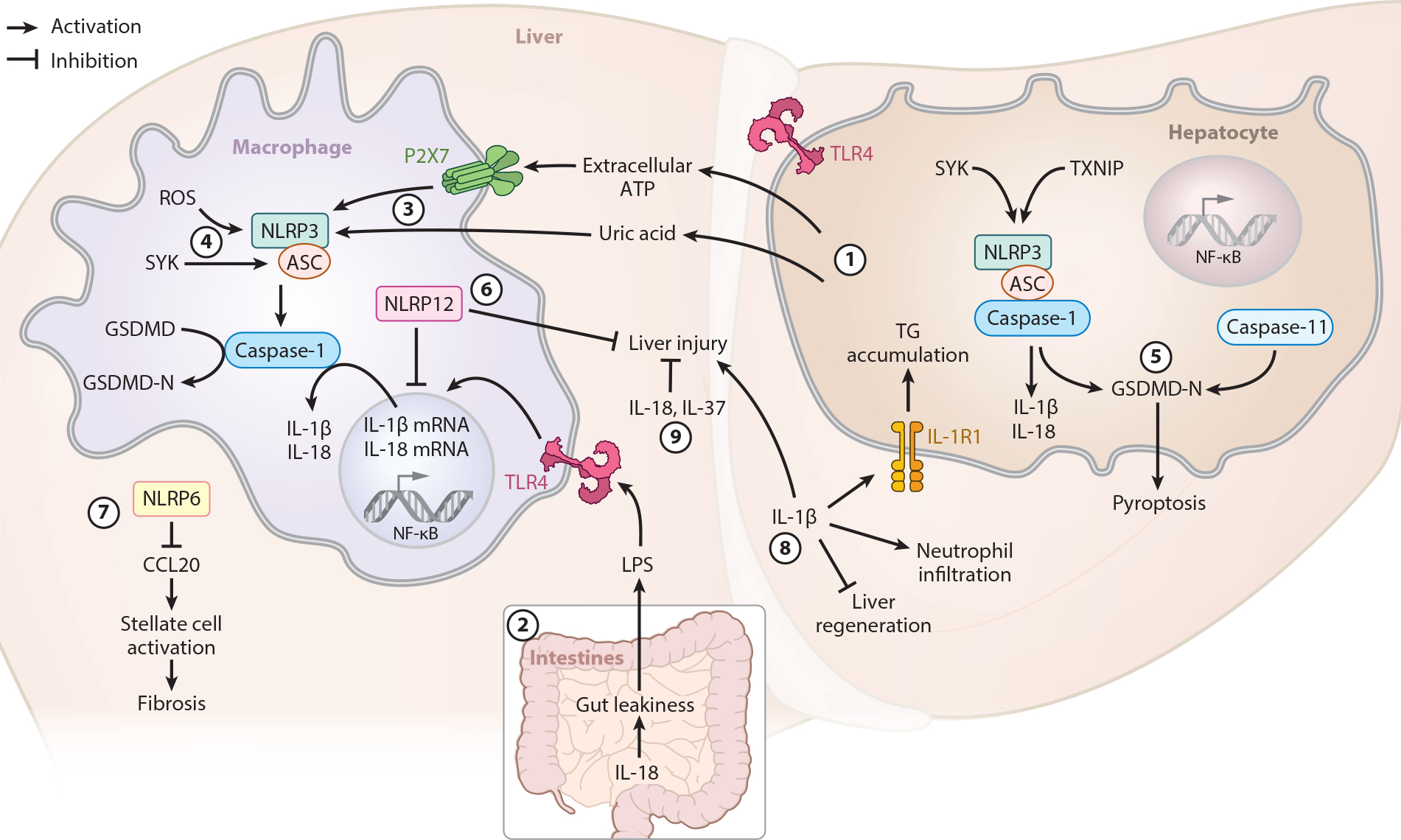
Inflammasomes involved in ALD. Alcohol consumption (①) induces the release of extracellular ATP and uric acid from damaged hepatocytes and (②) increases the transport of gut-derived LPS to the liver due to increased gut permeability partially mediated by IL-18. (③) Extracellular ATP and uric acid induce NLRP3 activation in macrophages. (④) The intracellular mechanisms of NLRP3 activation in macrophages involve ROS and SYK. (⑤) Pyroptosis is induced in hepatocytes by caspase-1 and caspase-11. (⑥) NLRP12 activation in macrophages inhibits NF-κB signaling and decreases liver injury. (⑦) Liver activation of NLRP6 inhibits CCL20 and stellate cell activation. (⑧) IL-1β induces TG accumulation in hepatocytes, leading to liver injury and neutrophil infiltration and inhibiting liver regeneration. (⑨) IL-18 and IL-37 inhibit liver injury. Abbreviations: ALD, alcohol-associated liver disease; ASC, apoptosis-associated speck-like protein containing a CARD; CARD, caspase recruitment domain; GSDMD, gasdermin D; IL, interleukin; LPS, lipopolysaccharide; NF-κB, nuclear factor κB; NLRP, NOD-like receptor family, pyrin domain; ROS, reactive oxygen species; SYK, spleen tyrosine kinase; TG, triglyceride; TLR, Toll-like receptor; TXNIP, thioredoxin-interacting protein.

References

    1. Asrani SK, Devarbhavi H, Eaton J, Kamath PS. 2019. Burden of liver diseases in the world. J. Hepatol. 70:151–71 - PubMed
    1. Sharma A, Nagalli S. 2021. Chronic Liver Disease. Treasure Island, FL: StatPearls - PubMed
    1. Ohashi K, Pimienta M, Seki E. 2018. Alcoholic liver disease: a current molecular and clinical perspective. Liver Res. 2:161–72 - PMC - PubMed
    1. Del Campo JA, Gallego P, Grande L. 2018. Role of inflammatory response in liver diseases: therapeutic strategies. World J. Hepatol. 10:1–7 - PMC - PubMed
    1. Tanwar S, Rhodes F, Srivastava A, Trembling PM, Rosenberg WM. 2020. Inflammation and fibrosis in chronic liver diseases including non-alcoholic fatty liver disease and hepatitis C. World J. Gastroenterol. 26:109–33 - PMC - PubMed

Publication types

MeSH terms

Substances