Review
. 2021 Nov 9;6(1):387.
doi: 10.1038/s41392-021-00796-w.

The way of SARS-CoV-2 vaccine development: success and challenges

Affiliations
Review

The way of SARS-CoV-2 vaccine development: success and challenges

Yetian Dong et al. Signal Transduct Target Ther. .

Abstract

Severe acute respiratory syndrome coronavirus 2 (SARS-CoV-2) is the causative agent of coronavirus disease 2019 (COVID-19). To halt the pandemic, multiple SARS-CoV-2 vaccines have been developed and several have been allowed for emergency use and rollout worldwide. With novel SARS-CoV-2 variants emerging and circulating widely, whether the original vaccines that were designed based on the wild-type SARS-CoV-2 were effective against these variants has been a contentious discussion. Moreover, some studies revealed the long-term changes of immune responses post SARS-CoV-2 infection or vaccination and the factors that might impact the vaccine-induced immunity. Thus, in this review, we have summarized the influence of mutational hotspots on the vaccine efficacy and characteristics of variants of interest and concern. We have also discussed the reasons that might result in discrepancies in the efficacy of different vaccines estimated in different trials. Furthermore, we provided an overview of the duration of immune responses after natural infection or vaccination and shed light on the factors that may affect the immunity induced by the vaccines, such as special disease conditions, sex, and pre-existing immunity, with the aim of aiding in combating COVID-19 and distributing SARS-CoV-2 vaccines under the prevalence of diverse SARS-CoV-2 variants.


Conflict of interest statement

The authors declare no competing financial interests.

Figures
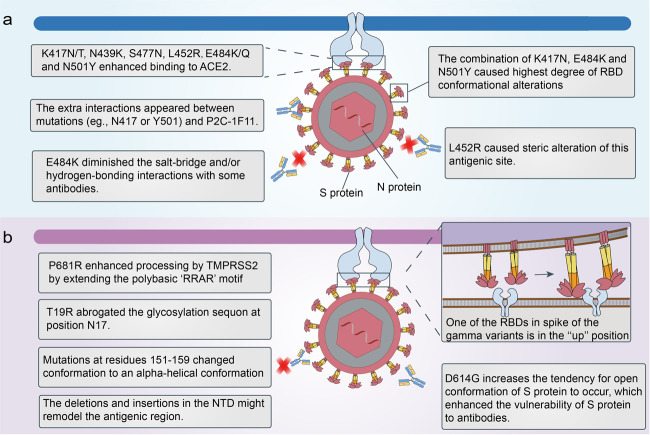
Fig. 1
Fig. 1
Possible neutralization evasion mechanisms of severe acute respiratory syndrome coronavirus 2 (SARS-CoV-2) variants. a The mechanisms of mutations in the receptor-binding domain (RBD) to influence the binding of spike protein to antibodies. b The mechanisms of mutations in an N-terminal domain (NTD) to influence the binding of S protein to antibodies. Besides, the gamma variants adopted a conformation with one of RBDs in the “up” position, promoting binding to ACE2 and evasion of some antibodies
Fig. 2
Fig. 2
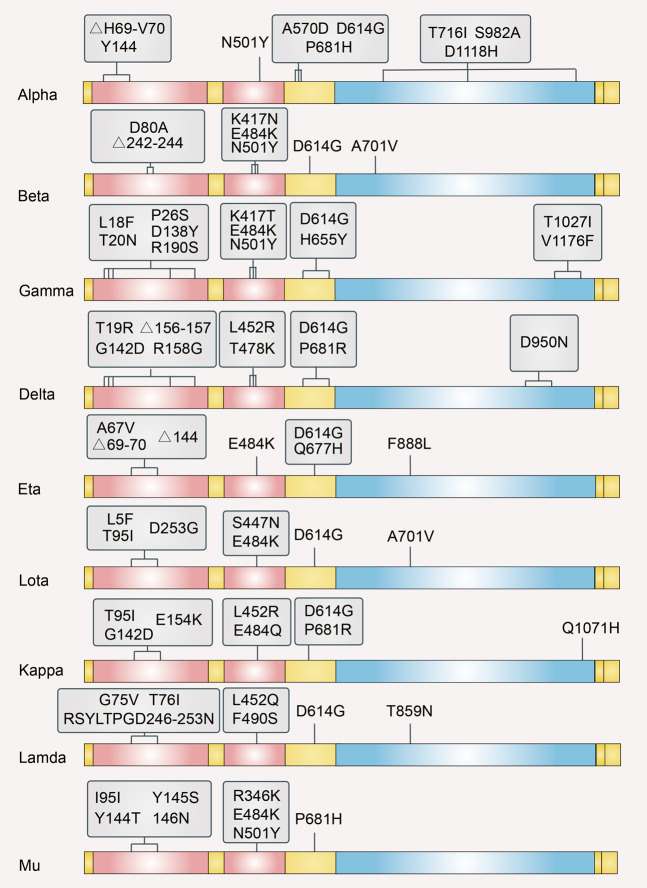
Illustration of common mutations in the S protein sequence of different SARS-CoV-2 variants of concern and interest
Fig. 3
Fig. 3
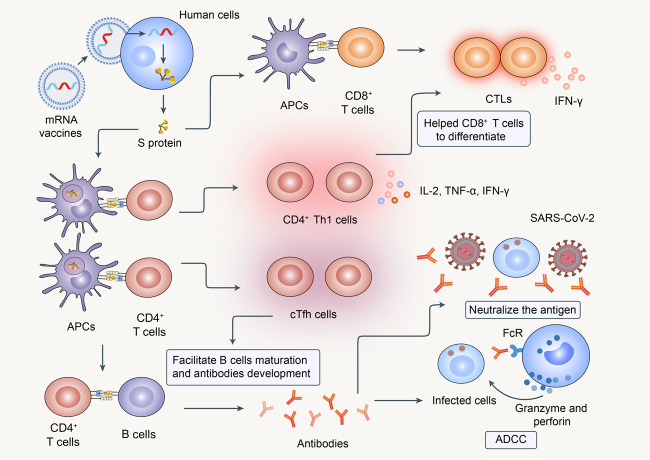
The immune responses induced by mRNA vaccines. The mRNA vaccines encoding the S protein were inserted into human cells and recognized by antigen-presenting cells (APCs). They elicited robust CD8+ and Th1-type CD4+ T-cell responses. CD4+ Th1 cells promoted CD8+ T-cell expansion and differentiation through cytokine (e.g., interleukin [IL]−2) production and expressed interferon (IFN)-γ, tumor necrosis factor (TNF)-α, and IL-2. CD8+ T cells also expressed IFN-γ. The circulating T follicular helper (cTfh) cells facilitated B-cell maturation and high-affinity antibody production. The vaccines also elicited robust immune responses and promoted antibody-dependent cellular cytotoxicity (ADCC) activity
Fig. 4
Fig. 4
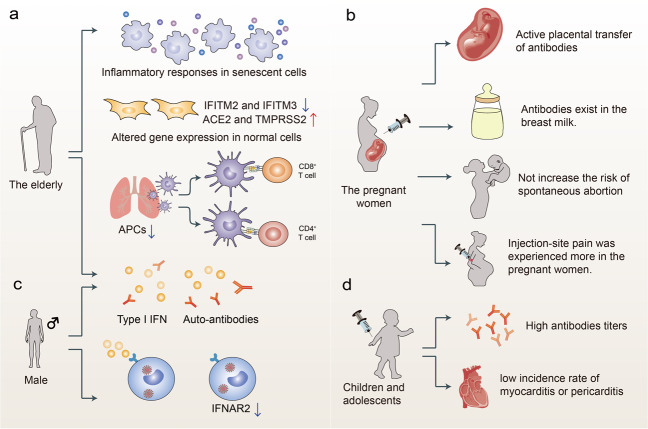
Factors that may affect the immunity induced by the vaccines. a The immune responses in the elderly. Inflammatory responses were robust in senescent cells and gene expression changed in normal cells. Immunosenescence reduces the levels of APCs and induces anti-type I interferon (IFN) autoantibodies in the elderly. b Vaccination for pregnant women. Vaccination in pregnant women is safe, with injection-site pain being frequently observed and without increasing the risk of spontaneous abortion. Moreover, vaccine-induced antibodies existed in the cord blood of infants and in the mothers’ breast milk. c The immune responses in males. Males are prone to elicit anti-type I IFN autoantibodies, and the expression of IFNAR2 reduces. d Vaccination for children and adolescents. Vaccination for children and adolescents induced high titers of antibodies, although myocarditis and pericarditis were noticed in some young individuals
Fig. 5
Fig. 5
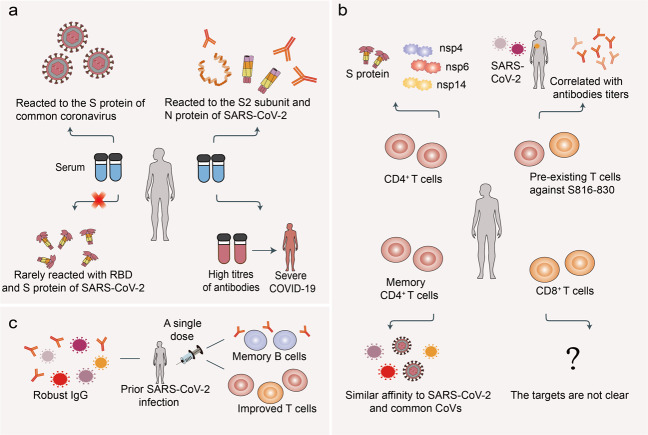
a The target of pre-existing antibodies in SARS-CoV-2 unexposed individuals. The serum from SARS-CoV-2 unexposed individuals reacted to the S proteins of common coronavirus, with some antibodies against S2 subunit and N protein of SARS-CoV-2 and rarely against RBD. Moreover, high titers of pre-existing antibodies might correlate with severe COVID-19. b The target of pre-existing T cells. The cross-reactive CD4+ T cells mainly recognized the S protein and some non-structural proteins, but target proteins of CD8+ T cells are unknown. Pre-existing T cells against S816-830 correlated with levels of anti-SARS-CoV-2 antibodies. Furthermore, memory CD4+ T cells had a similar affinity to SARS-CoV-2 and common cold coronavirus. c Vaccination for individuals with prior-SARS-CoV-2 infection. A single dose of SARS-CoV-2 vaccine induced robust humoral and cellular immune responses in previously SARS-CoV-2-infected individuals

References

    1. Guan WJ, et al. Clinical characteristics of coronavirus disease 2019 in China. N. Engl. J. Med. 2020;382:1708–1720. - PMC - PubMed
    1. Wu Z, McGoogan JM. Characteristics of and important lessons from the Coronavirus Disease 2019 (COVID-19) outbreak in china: summary of a report of 72 314 cases from the chinese center for disease control and prevention. JAMA. 2020;323:1239–1242. doi: 10.1001/jama.2020.2648. - DOI - PubMed
    1. Wang D, et al. Clinical characteristics of 138 hospitalized patients with 2019 novel coronavirus-infected pneumonia in Wuhan, China. Jama. 2020;323:1061–1069. - PMC - PubMed
    1. Orellana JDY, et al. Explosion in mortality in the Amazonian epicenter of the COVID-19 epidemic 19. Cad. Saude Publica. 2020;36:e00120020. - PubMed
    1. Wu A, et al. Genome composition and divergence of the novel coronavirus (2019-nCoV) originating in China. Cell Host Microbe. 2020;27:325–328. - PMC - PubMed

Publication types

Substances