Worldwide trends in the burden of asthma symptoms in school-aged children: Global Asthma Network Phase I cross-sectional study
- PMID: 34755626
- PMCID: PMC8573635
- DOI: 10.1016/S0140-6736(21)01450-1
Worldwide trends in the burden of asthma symptoms in school-aged children: Global Asthma Network Phase I cross-sectional study
Abstract
Background: Asthma is the most common chronic disease in children globally. The Global Asthma Network (GAN) Phase I study aimed to determine if the worldwide burden of asthma symptoms is changing.
Methods: This updated cross-sectional study used the same methods as the International study of Asthma and Allergies in Childhood (ISAAC) Phase III. Asthma symptoms were assessed from centres that completed GAN Phase I and ISAAC Phase I (1993-95), ISAAC Phase III (2001-03), or both. We included individuals from two age groups (children aged 6-7 years and adolescents aged 13-14 years) who self-completed written questionnaires at school. We estimated the 10-year rate of change in prevalence of current wheeze, severe asthma symptoms, ever having asthma, exercise wheeze, and night cough (defined by core questions in the questionnaire) for each centre, and we estimated trends across world regions and income levels using mixed-effects linear regression models with region and country income level as confounders.
Findings: Overall, 119 795 participants from 27 centres in 14 countries were included: 74 361 adolescents (response rate 90%) and 45 434 children (response rate 79%). About one in ten individuals of both age groups had wheeze in the preceding year, of whom almost half had severe symptoms. Most centres showed a change in prevalence of 2 SE or more between ISAAC Phase III to GAN Phase I. Over the 27-year period (1993-2020), adolescents showed a significant decrease in percentage point prevalence per decade in severe asthma symptoms (-0·37, 95% CI -0·69 to -0·04) and an increase in ever having asthma (1·25, 0·67 to 1·83) and night cough (4·25, 3·06 to 5·44), which was also found in children (3·21, 1·80 to 4·62). The prevalence of current wheeze decreased in low-income countries (-1·37, -2·47 to -0·27], in children and -1·67, -2·70 to -0·64, in adolescents) and increased in lower-middle-income countries (1·99, 0·33 to 3·66, in children and 1·69, 0·13 to 3·25, in adolescents), but it was stable in upper-middle-income and high-income countries.
Interpretation: Trends in prevalence and severity of asthma symptoms over the past three decades varied by age group, country income, region, and centre. The high worldwide burden of severe asthma symptoms would be mitigated by enabling access to effective therapies for asthma.
Funding: International Union Against Tuberculosis and Lung Disease, Boehringer Ingelheim New Zealand, AstraZeneca Educational Grant, National Institute for Health Research, UK Medical Research Council, European Research Council, and Instituto de Salud Carlos III.
Copyright © 2021 The Author(s). Published by Elsevier Ltd. This is an Open Access article under the CC BY 4.0 license. Published by Elsevier Ltd.. All rights reserved.
Conflict of interest statement
Declaration of interests KM reports receiving advisory board fees from AstraZeneca, outside the submitted work. GBM reports grants and non-financial support from AstraZeneca and grants from GlaxoSmithKline Australia and Novartis Australia, outside the submitted work. All other authors declare no competing interests.
Figures
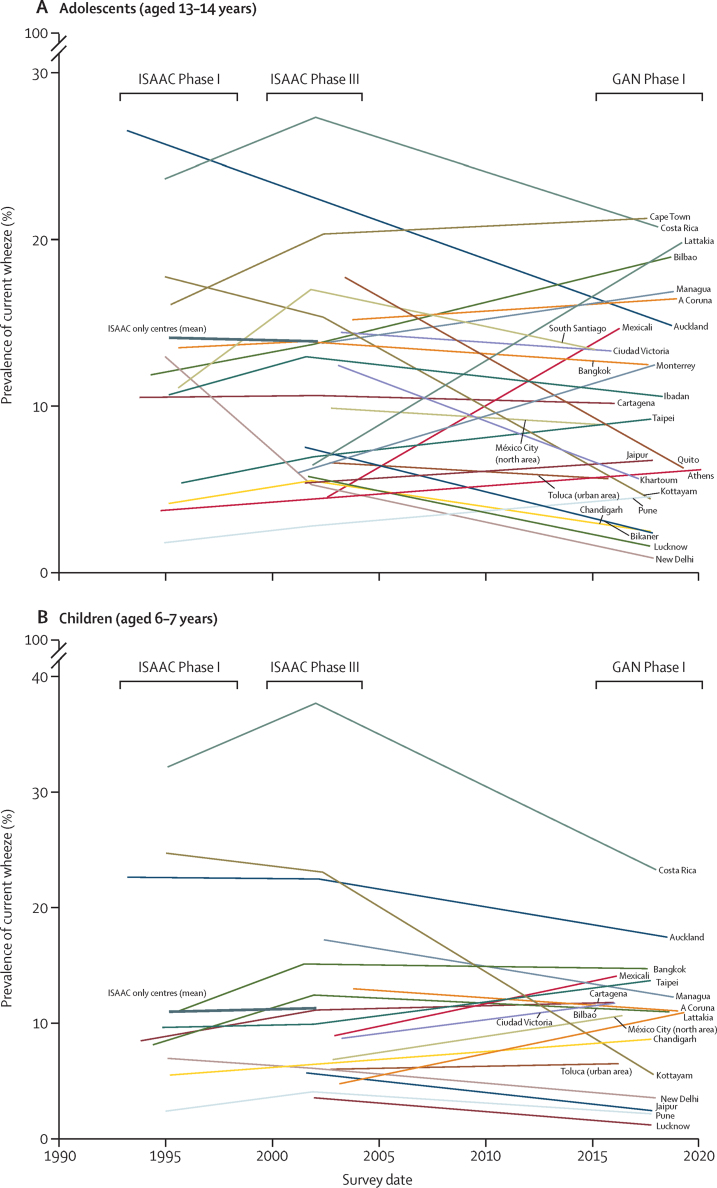
Comment in
-
Rising and falling prevalence of asthma symptoms.Lancet. 2021 Oct 30;398(10311):1542-1543. doi: 10.1016/S0140-6736(21)01823-7. Epub 2021 Oct 28. Lancet. 2021. PMID: 34755615 No abstract available.
References
-
- Asher I, Ellwood P, Gilchrist C. The Global Asthma Network; Auckland: 2018. The Global Asthma Report 2018.
-
- Meghji J, Mortimer K, Agusti A. Improving lung health in low-income and middle-income countries: from challenges to solutions. Lancet. 2021;397:928–940. - PubMed
-
- Kyu HH, Abate D, Abate KH. Global, regional, and national disability-adjusted life-years (DALYs) for 359 diseases and injuries and healthy life expectancy (HALE) for 195 countries and territories, 1990-2017: a systematic analysis for the Global Burden of Disease Study 2017. Lancet. 2018;392:1859–1922. - PMC - PubMed
-
- Asher I, Bissell K, Chiang C-Y. Calling time on asthma deaths in tropical regions-how much longer must people wait for essential medicines? Lancet Respir Med. 2019;7:13–15. - PubMed
MeSH terms
LinkOut - more resources
Full Text Sources
Medical
Miscellaneous