Review
. 2022 Aug 1;13(4):1131-1143.
doi: 10.1093/advances/nmab134.

Evaluation of Protein Quality in Humans and Insights on Stable Isotope Approaches to Measure Digestibility - A Review

Affiliations
Review

Evaluation of Protein Quality in Humans and Insights on Stable Isotope Approaches to Measure Digestibility - A Review

Sulagna Bandyopadhyay et al. Adv Nutr. .

Abstract

The recent Food and Agricultural Organization/World Health Organization/United Nations University expert consultations on protein requirements and quality have emphasized the need for the new Digestible Indispensable Amino Acid Score (DIAAS), as a measure of protein quality. This requires human measurements of the true ileal digestibility of individual indispensable amino acids (IAAs) until the end of the small intestine. Digestibility is measured using standard oro-ileal balance methods, which can only be achieved by an invasive naso-ileal intubation in healthy participants or fistulation at the terminal ileum. Significant efforts have been made over the last 2 decades to develop noninvasive or minimally invasive methods to measure IAA digestibility in humans. The application of intrinsically labeled (with stable isotopes like 13C, 15N, and 2H) dietary proteins has helped in circumventing the invasive oro-ileal balance techniques and allowed the differentiation between endogenous and exogenous protein. The noninvasive indicator amino acid oxidation (IAAO) technique, which is routinely employed to measure IAA requirements, has been modified to estimate metabolic availability (a sum of digestibility and utilization) of IAA in foods, but provides an estimate for a single IAA at a time and is burdensome for participants. The recently developed minimally invasive dual isotope tracer method measures small intestinal digestibility of multiple amino acids at once and is suitable for use in vulnerable groups and disease conditions. However, it remains to be validated against standard oro-ileal balance techniques. This review critically evaluates and compares the currently available stable isotope-based protein quality evaluation methods with a focus on the digestibility and metabolic availability measurements in humans. In view of building a reliable DIAAS database of various protein sources and subsequently supporting protein content claims in food labeling, a re-evaluation and harmonization of the available methods are necessary.

Keywords: dual isotope tracer technique; indicator amino acid oxidation; intrinsic labeling; metabolic availability; oro-ileal balance; protein digestibility; protein quality; stable isotopes.


Figures

FIGURE 1
FIGURE 1
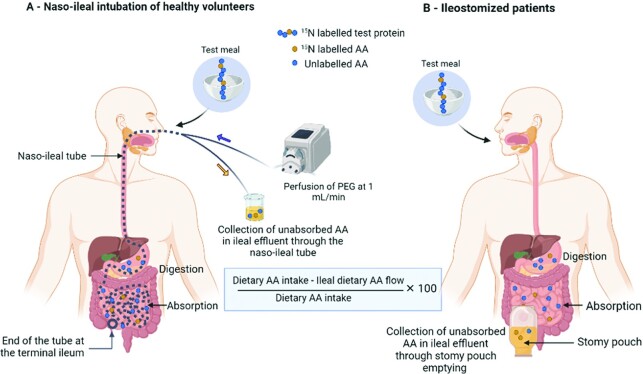
Schematic representation of the principle of the oro-ileal balance method to measure ileal AA digestibility with (A) intubated healthy volunteers or with (B) ileostomized patients using labeled protein. With the intubation method, the volunteers are equipped with a triple lumen naso-ileal tube. One lumen is dedicated to inflate a balloon at the end of the tube to facilitate the migration of the tube through the intestinal tract. When the tube is at the terminal ileum, a perfusion of PEG (unabsorbable marker) is started through the second lumen, in order to evaluate intestinal flow by the slow marker method. The test meal containing intrinsically 15N-labeled test protein undergoes digestion and absorption and ileal effluents containing nonabsorbed dietary AAs are continuously collected from the third lumen during the 8-h postprandial period. In ileostomates, where the colon and rectum have been partially or totally removed and the terminal ileum exteriorized, the ileal effluents are directly collected into the pouch. The digestibility of each AA is determined by the ratio of the absorbed AA to the intake. AA, amino acid; PEG, polyethylene glycol.
FIGURE 2
FIGURE 2
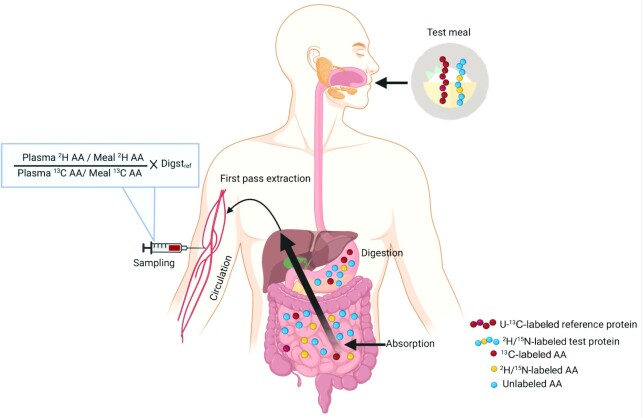
Schematic representation of the principle of the dual isotope tracer method to measure small intestinal AA digestibility. The test meal containing intrinsically 2H/15N-labeled test protein (yellow and blue circles) and uniformly 13C-labeled reference protein (red circles) undergoes digestion. After absorption and first-pass splanchnic extraction, AAs from both the proteins enter the systemic circulation. The plasma appearance of individual AAs from 2H/15N-labeled test protein is compared with that of 13C-labeled reference protein of known digestibility with respect to the test meal to determine the small intestinal AA digestibility in the test proteins. AA, amino acid; Digstref, digestibility of reference protein.
FIGURE 3
FIGURE 3
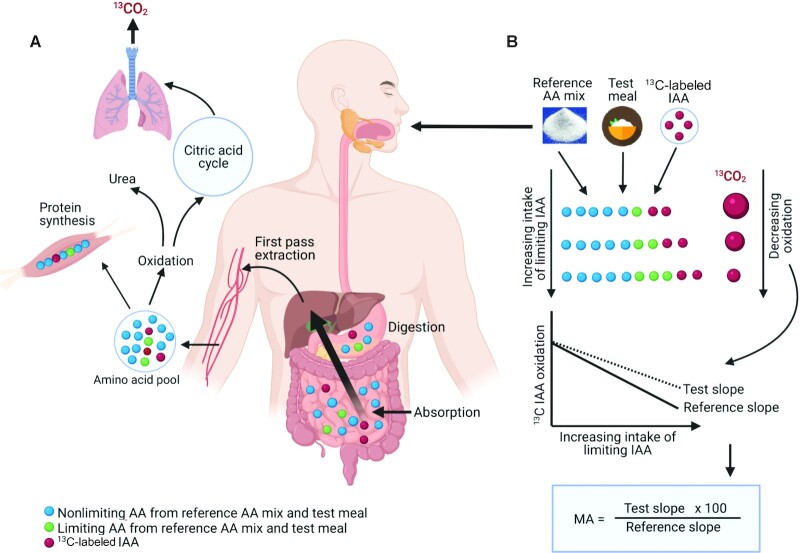
Schematic representation of the principle and application of the IAAO method to estimate MA of limiting AAs in test proteins. (A) Represents the digestion, absorption, and metabolic handling of free or protein-derived unlabeled nonlimiting (blue circles), limiting/test (green circles), and 13C-labeled indicator IAA (red circles). (B) Subjects are provided with increasing intakes of limiting IAA (green circles) at the subrequirement concentration from a reference AA mixture or a combination of reference AA mixture and test protein with constant intake of 13C-labeled indicator IAA (red circles) across the study days in a repeated measures design. With increasing intake of limiting/test IAA (green circles), the incorporation of 13C-labeled indicator IAA (red circles) into tissue protein synthesis increases with the subsequent reduction in its oxidation, which is measured as 13CO2 in breath. The IAAO response slopes are obtained by measuring both reference AA mixture and test protein at the same concentrations of limiting/test IAA intakes. The MA of limiting/test IAA in a test protein is computed by comparing the estimated IAAO response slope of test protein to the estimated slope of reference AA mixture, which is assumed to have 100% MA. AA, amino acid; IAA, indispensable amino acid; IAAO, indicator amino acid oxidation; MA, metabolic availability.

References

    1. Wu G. Functional amino acids in growth, reproduction, and health. Adv Nutr. 2010;1(1):31–7. - PMC - PubMed
    1. Tomé D. Criteria and markers for protein quality assessment – a review. Br J Nutr. 2012;108(S2):S222–9. - PubMed
    1. Kurpad AV. Protein: quality and sources. Encyclopedia of Human Nutrition. Amsterdam, Netherlands: Elsevier Inc; 2012. p. 123–30.
    1. FAO . Dietary protein quality evaluation in human nutrition: report of an FAO expert consultation. FAO Food and Nutrition Paper No. 92. Rome: FAO; 2013. - PubMed
    1. FAO/WHO . Protein quality evaluation in human diets. Report of a Joint FAO/WHO Expert Consultation (FAO Food Nutrition Paper No. 51). Rome (Italy): Food and Agriculture Organization of the United Nations; 1991.

Publication types