


Reexamining Social Media and Socioemotional Well-Being Among Adolescents Through the Lens of the COVID-19 Pandemic: A Theoretical Review and Directions for Future Research
- PMID: 34756118
- PMCID: PMC9081105
- DOI: 10.1177/17456916211014189
Reexamining Social Media and Socioemotional Well-Being Among Adolescents Through the Lens of the COVID-19 Pandemic: A Theoretical Review and Directions for Future Research
Abstract
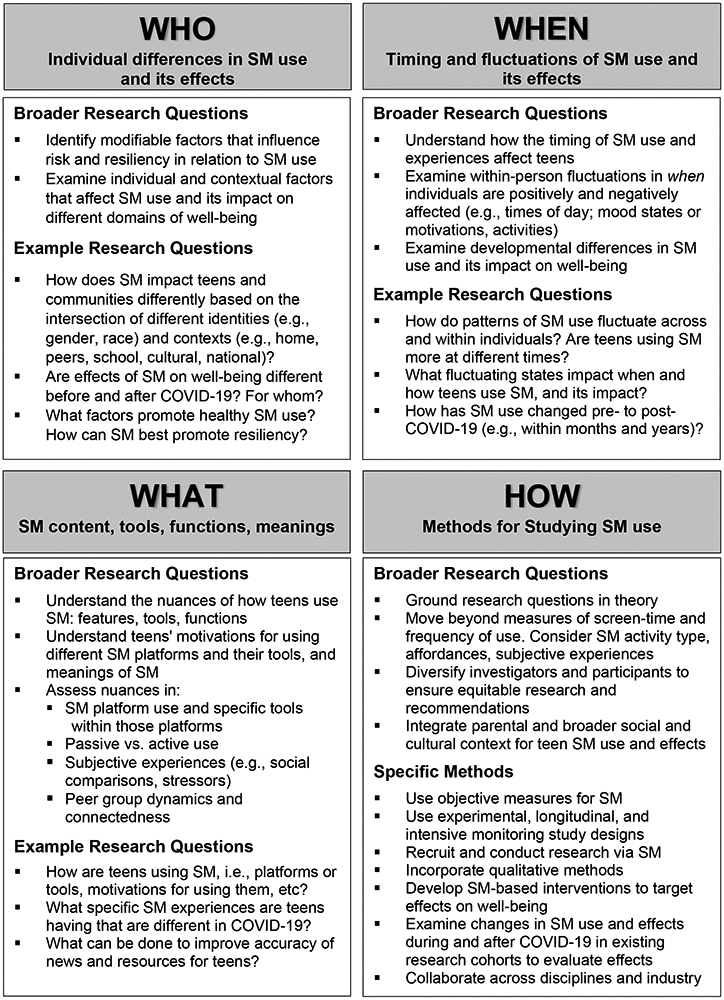
Social media has rapidly transformed the ways in which adolescents socialize and interact with the world, which has contributed to ongoing public debate about whether social media is helping or harming adolescents. The COVID-19 pandemic has magnified both the challenges and opportunities of adolescents' social-media use, which necessitates revisiting the conversation around teens and social media. In this article, we discuss key aspects of adolescent social-media use and socioemotional well-being and outline how these issues may be amplified in the context of the COVID-19 pandemic. We use this as a springboard to outline key future research directions for the field, with the goal of moving away from reductionist approaches and toward a more nuanced perspective to understand the who, what, and when of social-media use and its impact on adolescent well-being. We conclude with a commentary on how psychological science can inform the translation of research to provide evidence-based recommendations for adolescent social-media use.
Keywords: COVID-19 pandemic; adolescence; mental health; social media; well-being.
Figures
Similar articles
-
Social media as a bridge and a window: The changing relationship of adolescents with social media and digital platforms.Curr Opin Psychol. 2023 Aug;52:101633. doi: 10.1016/j.copsyc.2023.101633. Epub 2023 Jun 13. Curr Opin Psychol. 2023. PMID: 37454640 Free PMC article. Review.
-
Real-Time Communication: Creating a Path to COVID-19 Public Health Activism in Adolescents Using Social Media.J Med Internet Res. 2020 Dec 1;22(12):e21886. doi: 10.2196/21886. J Med Internet Res. 2020. PMID: 33226956 Free PMC article.
-
Smartphone and social media use contributed to individual tendencies towards social media addiction in Italian adolescents during the COVID-19 pandemic.Addict Behav. 2022 Mar;126:107204. doi: 10.1016/j.addbeh.2021.107204. Epub 2021 Dec 1. Addict Behav. 2022. PMID: 34875508
-
Digital Media Use and Adolescents' Mental Health During the Covid-19 Pandemic: A Systematic Review and Meta-Analysis.Front Public Health. 2022 Feb 1;9:793868. doi: 10.3389/fpubh.2021.793868. eCollection 2021. Front Public Health. 2022. PMID: 35186872 Free PMC article.
-
Emotions of COVID-19: Content Analysis of Self-Reported Information Using Artificial Intelligence.J Med Internet Res. 2021 Apr 30;23(4):e27341. doi: 10.2196/27341. J Med Internet Res. 2021. PMID: 33819167 Free PMC article.
Cited by
-
Cyber victimization and well-being in adolescents: The sequential mediation role of forgiveness and coping with cyberbullying.Front Psychol. 2022 Nov 18;13:819049. doi: 10.3389/fpsyg.2022.819049. eCollection 2022. Front Psychol. 2022. PMID: 36467151 Free PMC article.
-
The Digital Media-use Effects (d-MUsE) Model: A comprehensive framework for exploring/studying functional and dysfunctional effects on adolescent wellbeing.J Behav Addict. 2025 Mar 12;14(1):100-113. doi: 10.1556/2006.2025.00007. Print 2025 Mar 28. J Behav Addict. 2025. PMID: 40072514 Free PMC article. Review.
-
The Perfect Storm: A Developmental-Sociocultural Framework for the Role of Social Media in Adolescent Girls' Body Image Concerns and Mental Health.Clin Child Fam Psychol Rev. 2022 Dec;25(4):681-701. doi: 10.1007/s10567-022-00404-5. Epub 2022 Jul 16. Clin Child Fam Psychol Rev. 2022. PMID: 35841501 Free PMC article. Review.
-
Association Between Social Media Use and Substance Use Among Middle and High School-Aged Youth.Subst Use Misuse. 2024;59(7):1039-1046. doi: 10.1080/10826084.2024.2320372. Epub 2024 Feb 28. Subst Use Misuse. 2024. PMID: 38419151 Free PMC article.
-
Using Social Media for Social Motives Moderates the Relationship between Post-Traumatic Symptoms during a COVID-19-Related Lockdown and Improvement of Distress after Lockdown.Behav Sci (Basel). 2023 Jan 6;13(1):53. doi: 10.3390/bs13010053. Behav Sci (Basel). 2023. PMID: 36661625 Free PMC article.
References
-
- Ahn J (2012). Teenagers’ experiences with social network sites: Relationships to bridging and bonding social capital. The Information Society, 28, 99–109. 10.1080/01972243.2011.649394 - DOI
-
- Alonso C, & Romero E (2019). Sexting behaviors in adolescents: Personality predictors and psychosocial consequences in a one-year follow-up. Annals of Psychology, 35, 214–224. 10.6018/analesps.35.2.339831 - DOI
-
- Anderson M, & Jiang J (2018). Teens, social media, and technology. Pew Research Center. pewresearch.org
-
- Blakemore S (2018). Avoiding social risk in adolescence. Current Directions in Psychological Science, 27, 116–122. 10.1177/0963721417738144 - DOI
Publication types
MeSH terms
Grants and funding
LinkOut - more resources
Full Text Sources
Medical
