


How effective are Fatigue Risk Management Systems (FRMS)? A review
- PMID: 34756484
- PMCID: PMC8806333
- DOI: 10.1016/j.aap.2021.106398
How effective are Fatigue Risk Management Systems (FRMS)? A review
Abstract
Objective: Fatigue Risk Management Systems (FRMS) are a data-driven set of management practices for identifying and managing fatigue-related safety risks. This approach also considers sleep and work time, and is based on ongoing risk assessment and monitoring. This narrative review addresses the effectiveness of FRMS, as well as barriers and enablers in the implementation of FRMS. Furthermore, this review draws on the literature to provide evidence-based policy guidance regarding FRMS implementation.
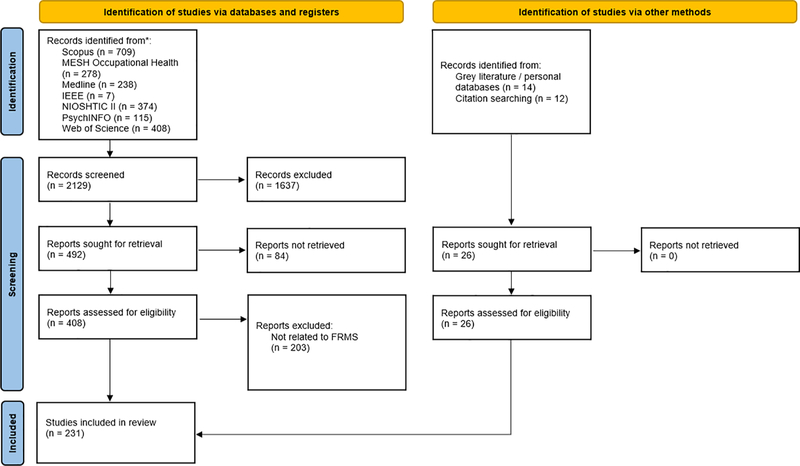
Methods: Seven databases were drawn on to identify relevant peer-reviewed literature. Relevant grey literature was also reviewed based on the authors' experience in the area. In total, 2129 records were screened based on the search strategy, with 231 included in the final review.
Results: Few studies provide an evidence-base for the effectiveness of FRMS as a whole. However, FRMS components (e.g., bio-mathematical models, self-report measures, performance monitoring) have improved key safety and fatigue metrics. This suggests FRMS as a whole are likely to have positive safety outcomes. Key enablers of successful implementation of FRMS include organisational and worker commitment, workplace culture, and training.
Conclusions: While FRMS are likely to be effective, in organisations where safety cultures are insufficiently mature and resources are less available, these systems may be challenging to implement successfully. We propose regulatory bodies consider a hybrid model of FRMS, where organisations could choose to align with tight hours of work (compliance) controls. Alternatively, where organisational flexibility is desired, a risk-based approach to fatigue management could be implemented.
Keywords: FRMS; Fatigue; Fatigue risk management systems; Risk; Safety; Sleep.
Copyright © 2021 The Authors. Published by Elsevier Ltd.. All rights reserved.
Conflict of interest statement
Declaration of Competing Interest
The authors declare that they have no known competing financial interests or personal relationships that could have appeared to influence the work reported in this paper.
Figures
References
-
- Acton S, 2014. Developing a fatigue risk management system: Case studies on education and mitigation strategies. In: Proceedings of the SPE Annual Technical Conference and Exhibition.
-
- Arnaldo RM, Comendador FG, Sanz LP, Sanz AR (2016). Friendly Fatigue Alert Mobile Apps to Help Aviation Workers Prevent, Identify and Manage Alertness and Fatigue. In Arezes P (Ed.), Advances in Safety Management and Human Factors (Vol. 491, pp. 421–432). 10.1007/978-3-319-41929-9_39.. - DOI
Publication types
MeSH terms
Grants and funding
LinkOut - more resources
Full Text Sources
