


Neurological Complications in COVID-19 Patients With ECMO Support: A Systematic Review and Meta-Analysis
- PMID: 34756659
- PMCID: PMC8553269
- DOI: 10.1016/j.hlc.2021.10.007
Neurological Complications in COVID-19 Patients With ECMO Support: A Systematic Review and Meta-Analysis
Abstract
Background: Patients with Coronavirus disease 2019 (COVID-19)-related acute respiratory disease (ARDS) increasingly receive extracorporeal membrane oxygenation (ECMO) support. While ECMO has been shown to increase risk of stroke, few studies have examined this association in COVID-19 patients.
Objective: We conducted a systematic review to characterise neurological events during ECMO support in COVID-19 patients.
Design: Systematic review of cohort and large case series of COVID-19 patients who received ECMO support.
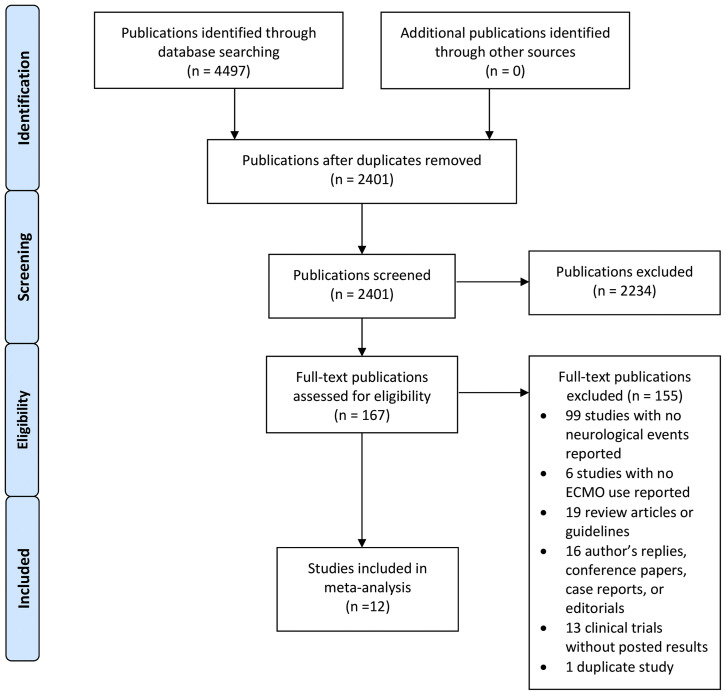
Data sources: Studies retrieved from PubMed, EMBASE, Cochrane, Cochrane COVID-19 Study Register, Web of Science, Scopus, Clinicaltrials.gov, and medRχiv from inception to November 11, 2020.
Eligibility criteria: Inclusion criteria were a) Adult population (>18 year old); b) Positive PCR test for SARS-CoV-2 with active COVID-19 disease; c) ECMO therapy due to COVID-19 ARDS; and d) Neurological events and outcome described while on ECMO support. We excluded articles when no details of neurologic events were available.
Results: 1,322 patients from 12 case series and retrospective cohort studies were included in our study. The median age was 49.2, and 75% (n=985) of the patients were male. Diabetes mellitus and dyslipidaemia were the most common comorbidities (24% and 20%, respectively). Most (95%, n=1,241) patients were on venovenous ECMO with a median P:F ratio at the time of ECMO cannulation of 69.1. The prevalence of intracranial haemorrhage (ICH), ischaemic stroke, and hypoxic ischaemic brain injury (HIBI) was 5.9% (n=78), 1.1% (n=15), and 0.3% (n=4), respectively. The overall mortality of the 1,296 ECMO patients in the 10 studies that reported death was 36% (n=477), and the mortality of the subset of patients who had a neurological event was 92%.
Conclusions: Neurological injury is a concern for COVID-19 patients who receive ECMO. Further research is required to explore how neuromonitoring protocols can inform tailored anticoagulation management and improve survival in COVID-19 patients with ECMO support.
Keywords: COVID-19; ECMO; Intracranial haemorrhage; Stroke.
Copyright © 2021 Australian and New Zealand Society of Cardiac and Thoracic Surgeons (ANZSCTS) and the Cardiac Society of Australia and New Zealand (CSANZ). Published by Elsevier B.V. All rights reserved.
Figures
References
-
- Migdady I., Rice C., Deshpande A., Hernandez A.V., Price C., Whitman G.J., et al. Brain injury and neurologic outcome in patients undergoing extracorporeal cardiopulmonary resuscitation: a systematic review and meta-analysis. Crit Care Med. 2020;48(7):e611. - PubMed
-
- Shoskes A., Migdady I., Rice C., Hassett C., Deshpande A., Price C., et al. Brain injury is more common in venoarterial extracorporeal membrane oxygenation than venovenous extracorporeal membrane oxygenation: a systematic review and meta-analysis. Crit Care Med. 2020;48(12):1799–1808. - PubMed
Publication types
MeSH terms
Grants and funding
LinkOut - more resources
Full Text Sources
Medical
Miscellaneous
