


Progress Toward Regional Measles Elimination - Worldwide, 2000-2020
- PMID: 34758014
- PMCID: PMC8580203
- DOI: 10.15585/mmwr.mm7045a1
Progress Toward Regional Measles Elimination - Worldwide, 2000-2020
Abstract
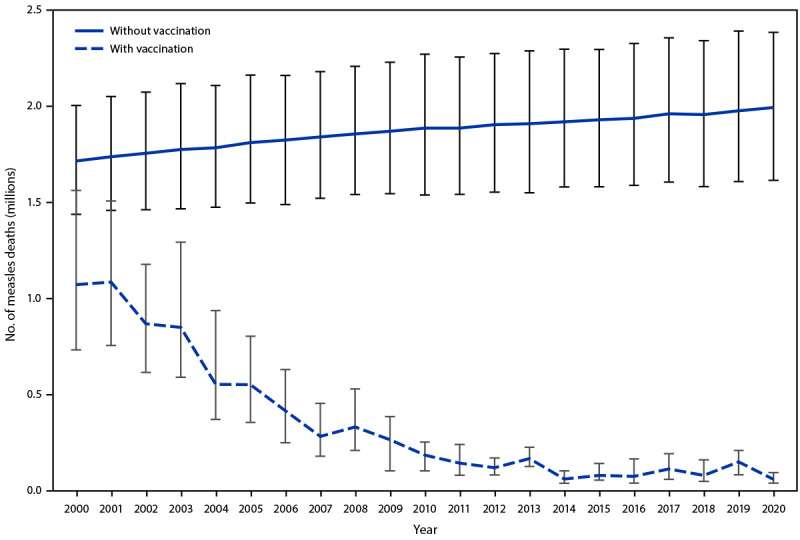
In 2012, the World Health Assembly endorsed the Global Vaccine Action Plan,* with the objective of eliminating measles† in five of the six World Health Organization (WHO) regions by 2020 (1). The Immunization Agenda 2021-2030 (IA2030)§ uses measles incidence as an indicator of the strength of immunization systems. The Measles-Rubella Strategic Framework 2021-2030¶ and the Measles Outbreaks Strategic Response Plan 2021-2023** are aligned with the IA2030 and highlight robust measles surveillance systems to document immunity gaps, identify root causes of undervaccination, and develop locally tailored solutions to ensure administration of 2 doses of measles-containing vaccine (MCV) to all children. This report describes progress toward World Health Assembly milestones and measles elimination objectives during 2000-2020 and updates a previous report (2). During 2000-2010, estimated MCV first dose (MCV1) coverage increased globally from 72% to 84%, peaked at 86% in 2019, but declined to 84% in 2020 during the COVID-19 pandemic. All countries conducted measles surveillance, although fewer than one third achieved the sensitivity indicator target of ≥2 discarded†† cases per 100,000 population in 2020. Annual reported measles incidence decreased 88% during 2000-2016, from 145 to 18 cases per 1 million population, rebounded to 120 in 2019, before falling to 22 in 2020. During 2000-2020, the annual number of estimated measles deaths decreased 94%, from 1,072,800 to 60,700, averting an estimated 31.7 million measles deaths. To achieve regional measles elimination targets, enhanced efforts are needed to reach all children with 2 MCV doses, implement robust surveillance, and identify and close immunity gaps.
Conflict of interest statement
All authors have completed and submitted the International Committee of Medical Journal Editors form for disclosure of potential conflicts of interest. Matt Ferrari reports grants from the Bill and Melinda Gates Foundation, the World Health Organization (WHO), and Gavi, the Vaccine Alliance, to develop measles models and travel support from WHO to attend the Strategic Advisory Group of Experts on Vaccines (SAGE) meeting in 2019 and the Measles and Rubella SAGE working group. Allison Portnoy reports grant support from The Pennsylvania State University for time and analytic contributions to this manuscript. No other potential conflicts of interest were disclosed.
Figures
References
-
- World Health Organization. Global Vaccine Action Plan 2011–2020. Geneva, Switzerland: World Health Organization; 2013. https://www.who.int/teams/immunization-vaccines-and-biologicals/strategi...
-
- Santos H, Eilertson KE, Lambert B, et al. Ensemble model estimates of the global burden of measles morbidity and mortality from 2000 to 2019: a modeling study. medRxiv [Preprint posted online October 26, 2021]. https://www.medrxiv.org/content/10.1101/2021.08.31.21262916v3.full.pdf - DOI
MeSH terms
Substances
LinkOut - more resources
Full Text Sources
Medical
