


Caught in vicious circles: a perspective on dynamic feed-forward loops driving oxidative stress in schizophrenia
- PMID: 34759358
- PMCID: PMC9126811
- DOI: 10.1038/s41380-021-01374-w
Caught in vicious circles: a perspective on dynamic feed-forward loops driving oxidative stress in schizophrenia
Abstract
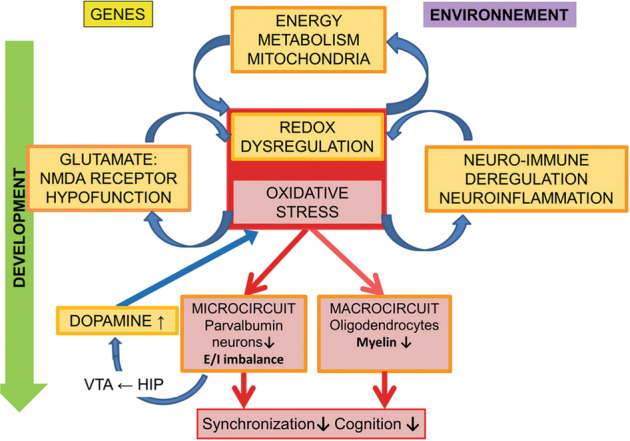
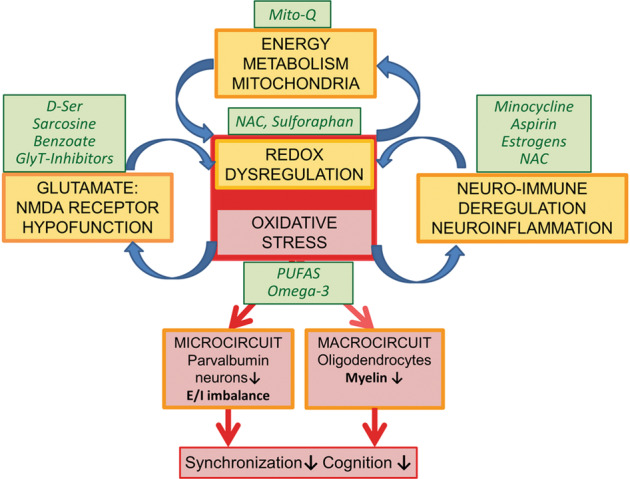
A growing body of evidence has emerged demonstrating a pathological link between oxidative stress and schizophrenia. This evidence identifies oxidative stress as a convergence point or "central hub" for schizophrenia genetic and environmental risk factors. Here we review the existing experimental and translational research pinpointing the complex dynamics of oxidative stress mechanisms and their modulation in relation to schizophrenia pathophysiology. We focus on evidence supporting the crucial role of either redox dysregulation, N-methyl-D-aspartate receptor hypofunction, neuroinflammation or mitochondria bioenergetics dysfunction, initiating "vicious circles" centered on oxidative stress during neurodevelopment. These processes would amplify one another in positive feed-forward loops, leading to persistent impairments of the maturation and function of local parvalbumin-GABAergic neurons microcircuits and myelinated fibers of long-range macrocircuitry. This is at the basis of neural circuit synchronization impairments and cognitive, emotional, social and sensory deficits characteristic of schizophrenia. Potential therapeutic approaches that aim at breaking these different vicious circles represent promising strategies for timely and safe interventions. In order to improve early detection and increase the signal-to-noise ratio for adjunctive trials of antioxidant, anti-inflammatory and NMDAR modulator drugs, a reverse translation of validated circuitry approach is needed. The above presented processes allow to identify mechanism based biomarkers guiding stratification of homogenous patients groups and target engagement required for successful clinical trials, paving the way towards precision medicine in psychiatry.
© 2021. The Author(s).
Conflict of interest statement
A European Patent application has been filed (EP19218841.5) in relation to the development of diagnostic test concerning mitochondrial impairments. KQD and DD have received grant support not related to this review from Boehringer-Ingelheim. The remaining authors declared no competing interests.
Figures
Comment in
-
Adaptive changes to oxidative stress in schizophrenia.Mol Psychiatry. 2022 Sep;27(9):3565-3566. doi: 10.1038/s41380-022-01550-6. Epub 2022 Apr 8. Mol Psychiatry. 2022. PMID: 35396349 No abstract available.
-
Caught in vicious circles: a perspective on dynamic feed-forward loops driving oxidative stress in schizophrenia; Response to "Adaptive changes to oxidative stress in schizophrenia by Lena Palaniyappan".Mol Psychiatry. 2022 Sep;27(9):3567-3568. doi: 10.1038/s41380-022-01553-3. Epub 2022 Apr 28. Mol Psychiatry. 2022. PMID: 35484238 Free PMC article. No abstract available.
References
-
- Fusar-Poli P, Salazar de Pablo G, Correll CU, Meyer-Lindenberg A, Millan MJ, Borgwardt S, et al. Prevention of psychosis: advances in detection, prognosis, and intervention. JAMA Psychiatry. 2020;77:755–65. - PubMed
-
- Weinberger DR. Implications of normal brain development for the pathogenesis of schizophrenia. Arch Gen Psychiatry. 1987;44:660–9. - PubMed
Publication types
MeSH terms
Substances
LinkOut - more resources
Full Text Sources
Medical
