


Hematological Parameters, Lipid Profile, and Cardiovascular Risk Analysis Among Genotype-Controlled Indigenous Kiwcha Men and Women Living at Low and High Altitudes
- PMID: 34759840
- PMCID: PMC8573321
- DOI: 10.3389/fphys.2021.749006
Hematological Parameters, Lipid Profile, and Cardiovascular Risk Analysis Among Genotype-Controlled Indigenous Kiwcha Men and Women Living at Low and High Altitudes
Abstract
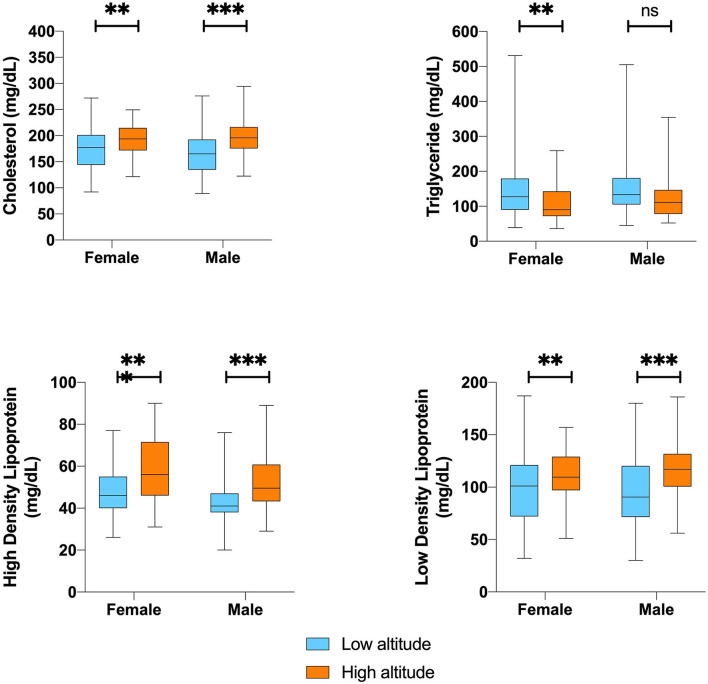
Introduction: Human adaptation to high altitude is due to characteristic adjustments at every physiological level. Differences in lipid profile and cardiovascular risk factors in altitude dwellers have been previously explored. Nevertheless, there are no reports available on genotype-controlled matches among different altitude-adapted indigenous populations. Objective: To explore the possible differences in plasma lipid profile and cardiovascular risk among autochthonous Kiwcha people inhabitants of low and high-altitude locations. Methodology: A cross-sectional analysis of plasmatic lipid profiles and cardiovascular risk factors in lowland Kiwchas from Limoncocha (230 m) and high-altitude Kiwchas from Oyacachi (3,800 m). Results: In the low altitude group, 66% were women (n = 78) and 34% (n = 40) were men, whereas in the high altitude group, 59% (n = 56) were women and 41% (n = 41%) were men. We found the proportion of overweight and obese individuals to be higher among low altitude dwellers (p < 0.05). Red blood cells (RBCs), hemoglobin concentration, and SpO2% were higher among high altitude dwellers and the erythrocyte size was found to be smaller at high altitude. The group located at low altitude also showed lower levels of plasma cholesterol, low-density lipoprotein (LDL), and high-density lipoprotein (HDL), but most of these differences are not influenced by gender or elevation. Conclusions: Living at an altitude elicits well-known adaptive physiological changes such as erythrocyte count, hemoglobin concentration, hematocrit level, and serum glucose level. We also report clinical differences in the plasma lipid profile, with higher levels of cholesterol, HDL, and LDL in inhabitants of the Andes Mountain vs. their Amazonian basin peers. Despite this, we did not find significant differences in cardiovascular risk.
Keywords: adaptation; cardiovascular risk; hematological profile; high altitude; hypoxia; lipid profile.
Copyright © 2021 Ortiz-Prado, Portilla, Mosquera-Moscoso, Simbaña-Rivera, Duta, Ochoa, Burgos, Izquierdo-Condoy, Vásconez, Calvopiña and Viscor.
Conflict of interest statement
The authors declare that the research was conducted in the absence of any commercial or financial relationships that could be construed as a potential conflict of interest.
Figures



References
-
- Al-Shehri M. A., Abolfotouh M. A., Dalak M. A., Nwoye L. D. (2005). Birth anthropometric parameters in high and low altitude areas of Southwest Saudi Arabia. Saudi Med. J. 26, 560–565. - PubMed
-
- Aryal N., Weatherall M., Bhatt Y. K. D., Mann S. (2015). Are high altitude populations at high risk of heart disease? A cross-sectional study in Nepal. Heart Lung Circ. 24:S109. 10.1016/j.hlc.2015.04.150 - DOI
LinkOut - more resources
Full Text Sources
