


HIV-1 drug resistance among individuals who seroconverted in the ASPIRE dapivirine ring trial
- PMID: 34762770
- PMCID: PMC8583424
- DOI: 10.1002/jia2.25833
HIV-1 drug resistance among individuals who seroconverted in the ASPIRE dapivirine ring trial
Abstract
Introduction: A potential concern with the use of dapivirine (DPV) for HIV prevention is the selection of a drug-resistant virus that could spread and reduce the effectiveness of non-nucleoside reverse transcriptase (NNRTI)-based first-line antiretroviral therapy. We evaluated HIV-1 seroconversions in MTN-020/ASPIRE for selection of drug resistance and evaluated the genetic basis for observed reductions in susceptibility to DPV.
Methods: MTN-020/ASPIRE was a placebo-controlled, Phase III safety and effectiveness study of DPV ring for HIV-1 prevention conducted at 15 sites in South Africa, Zimbabwe, Malawi and Uganda between 2012 and 2015. Plasma from individuals who seroconverted in ASPIRE was analysed for HIV-1 drug resistance using both population Sanger sequencing and next-generation sequencing (NGS) with unique molecular identifiers to report mutations at ≥1% frequency. DPV susceptibility of plasma-derived recombinant HIV-1 containing bulk-cloned full-length reverse transcriptase sequences from MTN-020/ASPIRE seroconversions was determined in TZM-bl cells. Statistical significance was calculated using the Fisher's exact test.
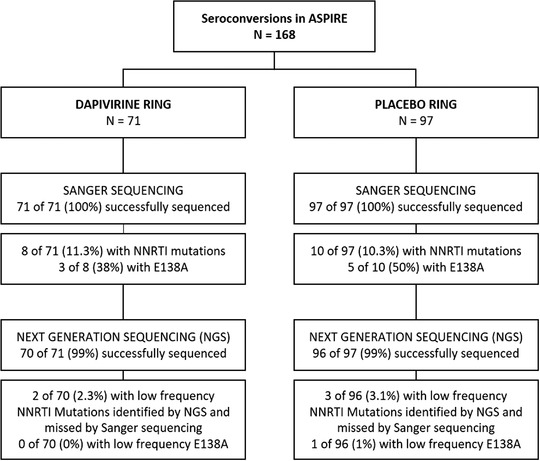
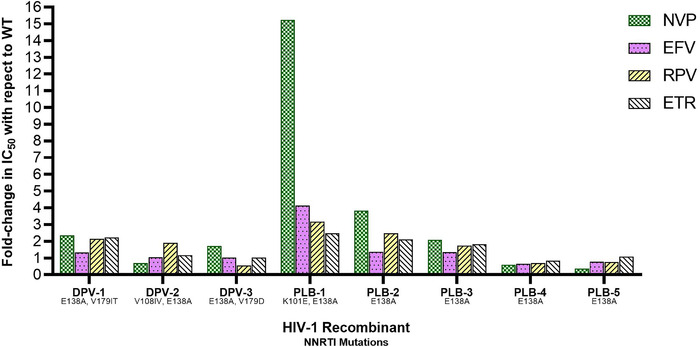
Results: Plasma from all 168 HIV seroconversions were successfully tested by Sanger sequencing; 57 of 71 DPV arm and 82 of 97 placebo (PLB) arm participants had NGS results at 1% sensitivity. Overall, 18/168 (11%) had NNRTI mutations including K101E, K103N/S, V106M, V108I, E138A/G, V179D/I/T and H221Y. Five samples from both arms had low-frequency NNRTI mutations that were not detected by Sanger sequencing. The frequency of NNRTI mutations from the DPV arm (11%) was not different from the PLB arm (10%; p = 0.80). The E138A mutation was detected in both the DPV (3 of 71 [4.2%]) and PLB arm (5 of 97 [5.2%]) and conferred modest reductions in DPV susceptibility in some reverse transcriptase backgrounds but not others.
Conclusions: HIV-1 drug resistance including NNRTI resistance did not differ between the DPV and placebo arms of the MTN-020/ASPIRE study, indicating that drug resistance was not preferentially acquired or selected by the DPV ring and that the preventive benefit of DPV ring outweighs resistance risk.
Keywords: HIV-1 drug resistance; HIV-1 prevention; dapivirine; next-generation sequencing; non-nucleoside reverse transcriptase inhibitors (NNRTI); pre-exposure prophylaxis (PrEP).
© 2021 The Authors. Journal of the International AIDS Society published by John Wiley & Sons Ltd on behalf of the International AIDS Society.
Conflict of interest statement
U.M.P, K.J.P, A.L.H, E.K.H, B.J.G, K.C.G, R.H, R.S, W.S., D.W.S., M.J.H., U.C. and T.P‐P. have no competing interests. J.B. reports personal fees from Gilead Sciences, outside the submitted work. J.W.M. reports consulting agreements from Gilead Sciences, Inc., Merck, Xi'an Yufan Biotechnologies, Accelevir DX, ID Connect, and share options from ID Connect, Cocrystal Pharma, Inc., and Abound Bio, outside the submitted work.
Figures
References
-
- WHO . WHO recommends the dapivirine vaginal ring as a new choice for HIV prevention for women at substantial risk of HIV infection. World Health Organization; 2021. https://www.who.int/news/item/26‐01‐2021‐who‐recommends‐the‐dapivirine‐v....
-
- Nel A, van Niekerk N, Kapiga S, Bekker LG, Gama C, Gill K, et al. Safety and efficacy of a dapivirine vaginal ring for HIV prevention in women. N Engl J Med. 2016;375(22):2133–43. - PubMed
-
- European Medicines Agency. Dapivirine Vaginal Ring 25 mg H‐W‐2168: summary of product characteristics. European Medicines Agency; 2020.
Publication types
MeSH terms
Substances
Grants and funding
LinkOut - more resources
Full Text Sources
Medical
Miscellaneous
