Review
. 2021 Dec 3;8(6):ENEURO.0315-21.2021.
doi: 10.1523/ENEURO.0315-21.2021. Print 2021 Nov-Dec.

Putting Together Pieces of the Lateral Septum: Multifaceted Functions and Its Neural Pathways

Affiliations
Review

Putting Together Pieces of the Lateral Septum: Multifaceted Functions and Its Neural Pathways

Candace A Rizzi-Wise et al. eNeuro. .

Abstract

The lateral septum (LS) is implicated as a hub that regulates a variety of affects, such as reward, feeding, anxiety, fear, sociability, and memory. However, it remains unclear how the LS, previously treated as a structure of homogeneity, exhibits such multifaceted functions. Emerging evidence suggests that different functions of the LS are mediated largely by its diverse input and output connections. It has also become clear that the LS is a heterogeneous region, where its dorsal and ventral poles play dissociable and often opposing roles. This functional heterogeneity can often be explained by distinct dorsal and ventral hippocampal inputs along the LS dorsoventral axis, as well as antagonizing connections between LS subregions. Similarly, outputs from LS subregions to respective downstream targets, such as hypothalamic, preoptic, and tegmental areas, also account for this functional heterogeneity. In this review, we provide an updated perspective on LS subregion classification, connectivity, and functions. We also identify key questions that have yet to be addressed in the field.

Keywords: anxiety; fear; feeding; hippocampus; lateral septum; memory.


Figures

Figure 1.
Figure 1.
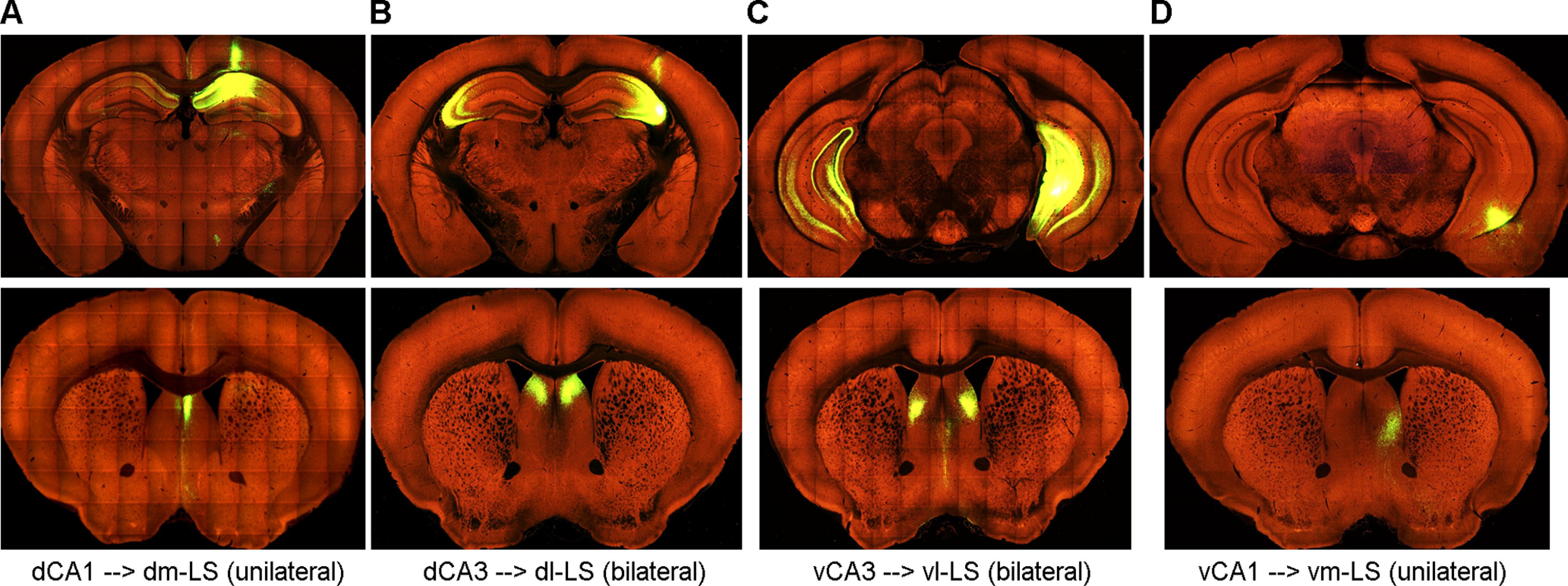
Subregion specific hippocampus→LS projections. A–D, top, Coronal brain sections from four individual mice showing unilateral injection (right hemisphere) of AAV-Syn-GFP in the dCA1 (A), dCA3 (B), vCA3/DG (C), and vCA1 (D), respectively. Bottom, Coronal brain sections from the same four mice showing the projection in the dm, dl, vl, and vm subregions of the LS, respectively. All brain section photographs are adapted from Allen Brain Atlas – Mouse Connectivity (Oh et al., 2014).
Figure 2.
Figure 2.
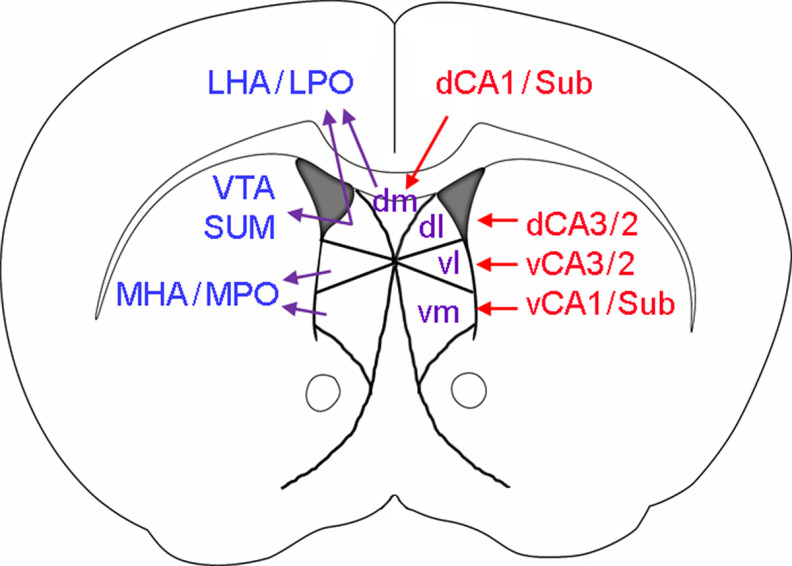
Major LS connections. LS subregions (dm, dl, vl, and vm) and their connections with hippocampal, hypothalamic, and other major areas. CA3/2, CA3 and CA2; d/v, dorsal/ventral; LHA, lateral hypothalamic area; LPO, lateral preoptic area; MHA, medial hypothalamic area; MPO, medial preoptic area; Sub, subiculum; SUM, supramammillary nucleus; VTA, ventral tegmental area.
Figure 3.
Figure 3.
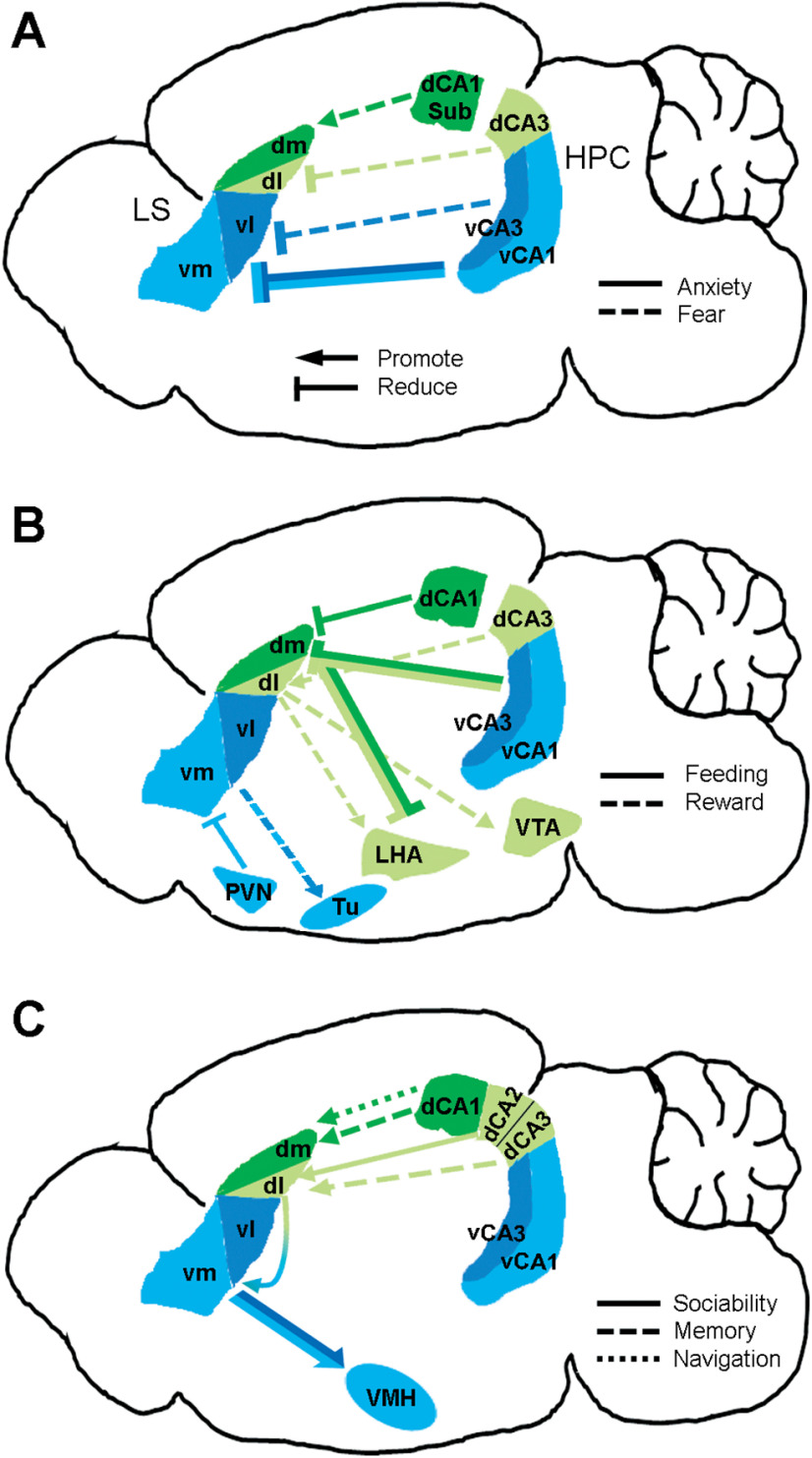
LS subregion associated neural circuits and functions. A–C, Major LS subregion connections in fear/anxiety (A), reward/feeding (B), and other functions (C). Note: results from studies that do not differentiate LS subregions are not shown. LS, lateral septum; LHA, lateral hypothalamic area; HPC, hippocampus; PVN, paraventricular nucleus of the hypothalamus; Sub, subiculum; Tu, hypothalamic tuberal nucleus; VMH, ventromedial hypothalamus; VTA, ventral tegmental area.

References

    1. Anthony TE, Dee N, Bernard A, Lerchner W, Heintz N, Anderson DJ (2014) Control of stress-induced persistent anxiety by an extra-amygdala septohypothalamic circuit. Cell 156:522–536. 10.1016/j.cell.2013.12.040 - DOI - PMC - PubMed
    1. Azevedo EP, Pomeranz L, Cheng J, Schneeberger M, Vaughan R, Stern SA, Tan B, Doerig K, Greengard P, Friedman JM (2019) A role of Drd2 hippocampal neurons in context-dependent food intake. Neuron 102:873–886.e5. 10.1016/j.neuron.2019.03.011 - DOI - PubMed
    1. Azevedo EP, Tan B, Pomeranz LE, Ivan V, Fetcho R, Schneeberger M, Doerig KR, Liston C, Friedman JM, Stern SA (2020) A limbic circuit selectively links active escape to food suppression. Elife 9:e58894. 10.7554/eLife.58894 - DOI - PMC - PubMed
    1. Bender F, Gorbati M, Cadavieco MC, Denisova N, Gao X, Holman C, Korotkova T, Ponomarenko A (2015) Theta oscillations regulate the speed of locomotion via a hippocampus to lateral septum pathway. Nat Commun 6:8521. 10.1038/ncomms9521 - DOI - PMC - PubMed
    1. Besnard A, Gao Y, TaeWoo Kim M, Twarkowski H, Reed AK, Langberg T, Feng W, Xu X, Saur D, Zweifel LS, Davison I, Sahay A (2019) Dorsolateral septum somatostatin interneurons gate mobility to calibrate context-specific behavioral fear responses. Nat Neurosci 22:436–446. 10.1038/s41593-018-0330-y - DOI - PMC - PubMed

LinkOut - more resources