


Current strategies of mechanical stimulation for maturation of cardiac microtissues
- PMID: 34765047
- PMCID: PMC8555032
- DOI: 10.1007/s12551-021-00841-6
Current strategies of mechanical stimulation for maturation of cardiac microtissues
Erratum in
-
Correction to: Current strategies of mechanical stimulation for maturation of cardiac microtissues.Biophys Rev. 2022 Mar 21;14(3):735. doi: 10.1007/s12551-022-00940-y. eCollection 2022 Jun. Biophys Rev. 2022. PMID: 35791385 Free PMC article.
Abstract
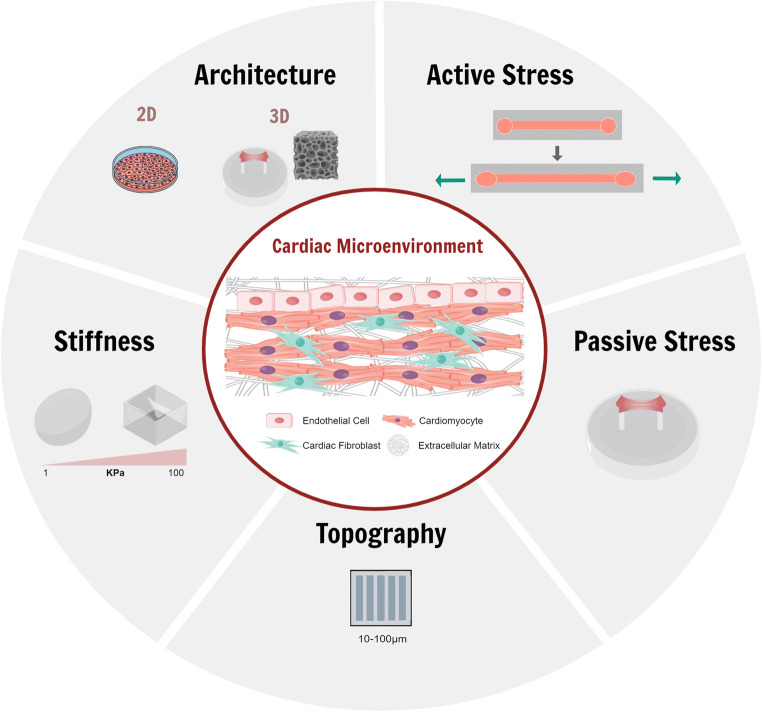
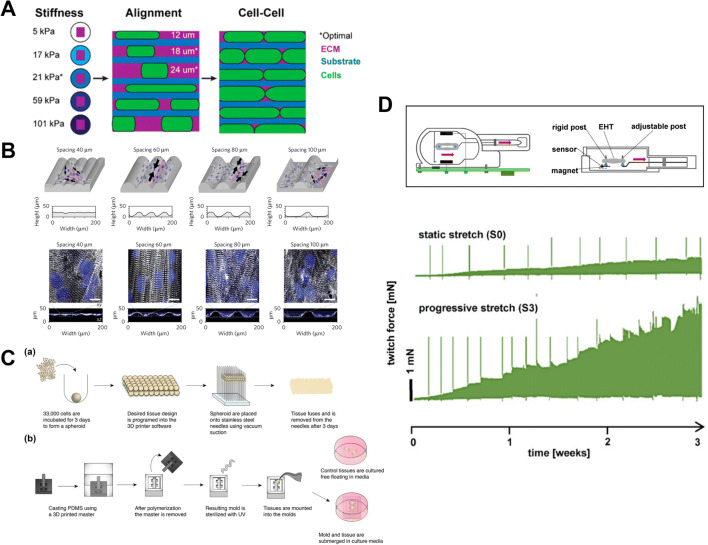
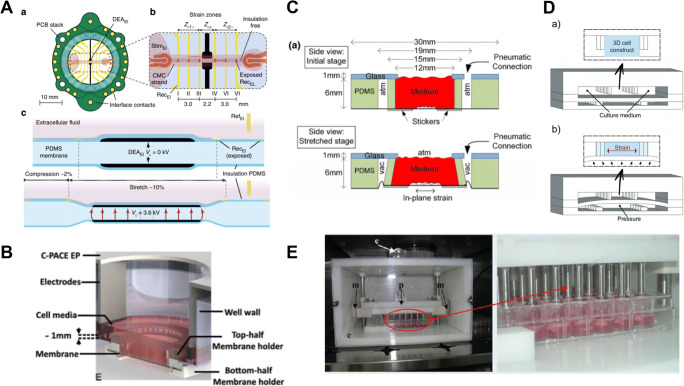
The most advanced in vitro cardiac models are today based on the use of induced pluripotent stem cells (iPSCs); however, the maturation of cardiomyocytes (CMs) has not yet been fully achieved. Therefore, there is a rising need to move towards models capable of promoting an adult-like cardiomyocytes phenotype. Many strategies have been applied such as co-culture of cardiomyocytes, with fibroblasts and endothelial cells, or conditioning them through biochemical factors and physical stimulations. Here, we focus on mechanical stimulation as it aims to mimic the different mechanical forces that heart receives during its development and the post-natal period. We describe the current strategies and the mechanical properties necessary to promote a positive response in cardiac tissues from different cell sources, distinguishing between passive stimulation, which includes stiffness, topography and static stress and active stimulation, encompassing cyclic strain, compression or perfusion. We also highlight how mechanical stimulation is applied in disease modelling.
Keywords: Cardiac microtissues; Maturation; Mechanical stimulation.
© The Author(s) 2021.
Figures

References
-
- Chang ACY, Pardon G, Chang ACH, Wu H, Ong SG, Eguchi A, Ancel S, Holbrook C, Ramunas J, Ribeiro AJS, LaGory EL, Wang H, Koleckar K, Giaccia A, Mack DL, Childers MK, Denning C, Day JW, Wu JC, Pruitt BL, Blau HM. Increased tissue stiffness triggers contractile dysfunction and telomere shortening in dystrophic cardiomyocytes. Stem Cell Rep. 2021;16:1–13. doi: 10.1016/j.stemcr.2021.04.018. - DOI - PMC - PubMed
Publication types
LinkOut - more resources
Full Text Sources
