


Educational Setting and SARS-CoV-2 Transmission Among Children With Multisystem Inflammatory Syndrome: A French National Surveillance System
- PMID: 34765576
- PMCID: PMC8576449
- DOI: 10.3389/fped.2021.745364
Educational Setting and SARS-CoV-2 Transmission Among Children With Multisystem Inflammatory Syndrome: A French National Surveillance System
Abstract
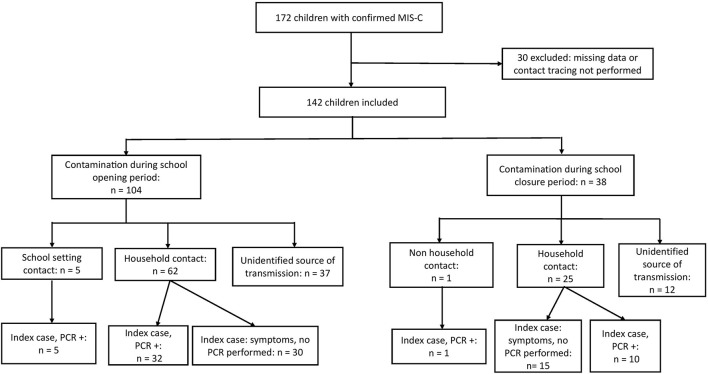
Background: Multisystem inflammatory syndrome in children (MIS-C) is the most severe form associated with SARS-CoV-2 infection in children. To reduce the spread of SARS-CoV-2 at the population level, educational setting closure have been implemented in many countries. However, the direct benefit of school closure on the MIS-C burden remains to be explored. We aimed to assess the role of educational settings in SARS-CoV-2 transmission among children with MIS-C. Methods: We conducted a French national prospective surveillance of MIS-C, coordinated by Public Health France, from April 2020 to March 2021. During this period, we included all children with MIS-C fulfilling the WHO definition who were reported to Public Health France. For each child, we traced the source of SARS-CoV-2 transmission. The main outcome was the proportion of children with MIS-C, with educational setting-related SARS-CoV-2 infection, during the period of school opening. Results: We included 142 children fulfilling WHO criteria for MIS-C: 104 (70%) cases occurred during school opening periods. In total, 62/104 children (60%, 95%CI [50; 69]) had been contaminated by a household contact and 5/104 in educational settings (5%, 95%CI [2; 11]). Among children with MIS-C occurring during school closure periods, the proportion of household transmission remained similar (66%, 25/38). Conclusion: Children with MIS-C were mainly infected by SARS-CoV-2 within their family environment, and the educational setting played a marginal role in this transmission. This suggests that mitigating school attendance may not reduce substantially the burden of MIS-C.
Keywords: SARS-CoV-2; educational setting; multisystem inflammatory syndrome in children (MIS-C); pediatrics-children; school.
Copyright © 2021 Guenver, Oualha, Levy, Antona, Madhi, Toubiana, Lachaume, Javouhey, Lorrot, Yang, Levy, Caseris, Galeotti, Ovaert, Wiedemann, Girardin, Rybak, Cohen, Belot, Angoulvant and Ouldali.
Conflict of interest statement
EJ reported receiving grants from CSL Behring. CL reported receiving grants from GlaxoSmithKline, Merck Sharp & Dohme, and Sanofi and personal fees from Pfizer and Merck. RC reported receiving personal fees from GlaxoSmithKline, Pfizer, Sanofi, and Merck Sharp & Dohme. NO report travel grants from GSK, Pfizer and Sanofi, outside the submitted work. The remaining authors declare that the research was conducted in the absence of any commercial or financial relationships that could be construed as a potential conflict of interest.
Figures
References
-
- UNICEF . COVID-19: Schools for more than 168 Million Children Globally have been Completely Closed for Almost a Full Year. (2021). Available online at: https://www.unicef.org/press-releases/schools-more-168-million-children-...
-
- Li Y, Campbell H, Kulkarni D, Harpur A, Nundy M, Wang X, et al. Network for COVID-19 evidence reviews (UNCOVER) group. The temporal association of introducing and lifting non-pharmaceutical interventions with the time-varying reproduction number (R) of SARS-CoV-2: a modelling study across 131 countries. Lancet Infect Dis. (2021) 21:193–202. 10.1016/S1473-3099(20)30785-4 - DOI - PMC - PubMed
LinkOut - more resources
Full Text Sources
Miscellaneous
