


Forearm segmental bone defect: Successful management using the Masquelet Technique with the aid of 3D printing technology
- PMID: 34765716
- PMCID: PMC8569702
- DOI: 10.1016/j.tcr.2021.100549
Forearm segmental bone defect: Successful management using the Masquelet Technique with the aid of 3D printing technology
Erratum in
-
Erratum regarding missing patient consent statement in previously published articles.Trauma Case Rep. 2023 Mar 1;45:100813. doi: 10.1016/j.tcr.2023.100813. eCollection 2023 Jun. Trauma Case Rep. 2023. PMID: 37234572 Free PMC article.
Abstract
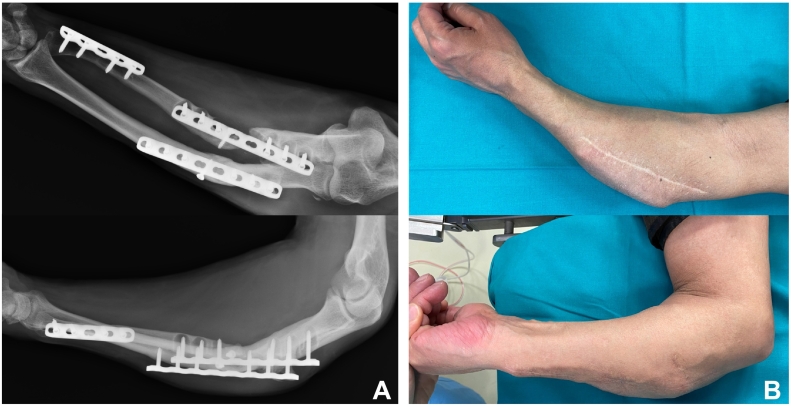
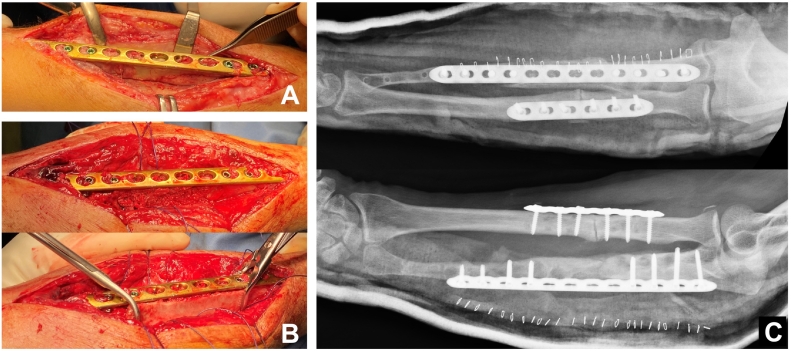
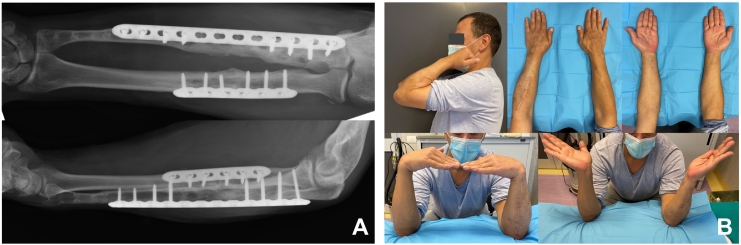
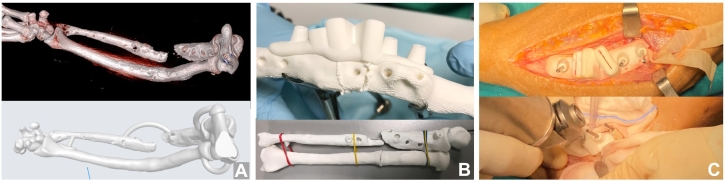
The management of forearm nonunion is challenging for orthopaedic surgeons because the forearm is a unique anatomical segment in which all the bones and structures involved embody a complex functional unit. Therefore, when treating such a complex condition, the surgeon must focus not only on bone healing but also on the restoration of the native anatomy in order to replicate the normal relationship between the bones and all the surrounding structures and thus the full function of the forearm, the elbow and the wrist. Here we report the case of a 53-year-old patient with a left forearm deformity due to an atrophic nonunion of the ulna and a malunion of the radius, which was successfully managed with the use of the Masquelet technique associated with a corrective osteotomy of the radius, performed with the aid of a 3D model.
Keywords: 3D model; 3D printing; Bone defect(s); Forearm; Masquelet technique; Non-union(s).
© 2021 The Authors. Published by Elsevier Ltd.
Conflict of interest statement
All authors declare no conflict of interest. No funding was received for the completion of this project.
Figures
References
-
- Micev A.J., Kalainov D.M., Soneru A.P. Masquelet technique for treatment of segmental bone loss in the upper extremity. J. Hand Surg. Am. 2015;40:593–598. - PubMed
-
- Giannoudis P.V., Harwood P.J., Tosounidis T., Kanakaris N.K. Restoration of long bone defects treated with the induced membrane technique: protocol and outcomes. Injury. 2016;47:S53–S61. - PubMed
Publication types
LinkOut - more resources
Full Text Sources
