Review
. 2020 Nov 5;1(3):302-310.
doi: 10.1002/mco2.37. eCollection 2020 Dec.

The biological role of metabolic reprogramming in pancreatic cancer

Affiliations
Review

The biological role of metabolic reprogramming in pancreatic cancer

Tatsunori Suzuki et al. MedComm (2020). .

Abstract

Pancreatic ductal adenocarcinoma (PDAC) is a lethal disease and highly resistant to all forms of therapy. PDAC cells reprogram their metabolism extensively to promote their survival and growth. Reflecting the vital role of altered metabolism, experimental and clinical trials targeting the rewired metabolism are currently underway. In this review, we summarize the vital role of metabolic reprogramming in the development of PDAC and the future of novel therapeutic applications.

Keywords: autophagy; macropinocytosis; metabolism; pancreatic cancer; tumor microenvironment.


Conflict of interest statement

The authors declare no conflict of interest.

Figures
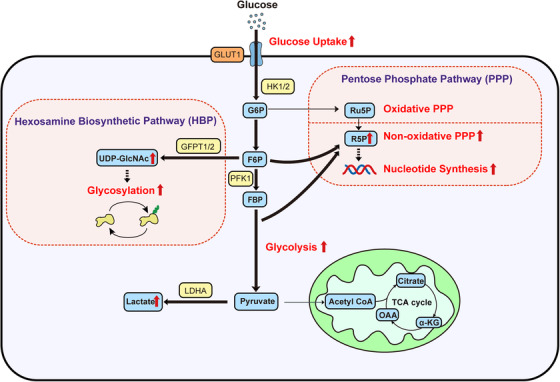
FIGURE 1
FIGURE 1
Glucose metabolism in PDAC cells. PDAC cells increase glucose uptake through oncogenic KRAS‐mediated upregulation of GLUT1. Oncogenic KRAS also upregulates other glycolytic enzymes, resulting in increased glycolytic flux. Glucose carbon is also important for anabolic metabolism in the HBP and the nonoxidative PPP phase. Bold arrows indicate accelerated metabolic pathways. α‐KG, α‐ketoglutarate; FBP, fructose 1,6‐bisphosphate; F6P, fructose 6‐phosphate; G6P, glucose 6‐phosphate; GLUT1, glucose transporter 1; GFPT1/2, glutamine fructose 6‐phosphate transamidase 1/2; HBP, hexosamine biosynthetic pathway; HK1/2, hexokinase 1/2; LDHA, lactate dehydrogenase A; OAA, oxaloacetate; PDAC, pancreatic ductal adenocarcinoma; PFK1, phosphofructokinase 1; R5P, ribose 5‐phosphate; Ru5P, ribulose 5‐phosphate; UDP‐GlcNAc, UDP‐N‐acetylglucosamine
FIGURE 2
FIGURE 2
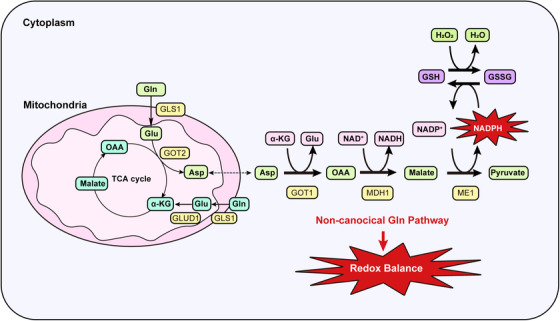
Glutamine metabolism in PDAC cells. PDAC cells depend on the noncanonical Gln pathway for redox balance. Gln‐derived Glu is metabolized to Asp by GOT2. This Asp is transported into the cytoplasm and then metabolized to OAA by GOT1. This OAA is metabolized to malate and then pyruvate, increasing the NADPH/NADP+ ratio. This sustains the reduced GSH levels needed for redox balance. α‐KG, α‐ketoglutarate; Asp, aspartate; GOT1, aspartate aminotransferase 1; GOT2, aspartate aminotransferase 2; Glu, glutamate; GLUD1, glutamate dehydrogenase 1; GLS1, glutaminase 1; Gln, glutamine; GSH, glutathione; MDH1, malate dehydrogenase 1; ME1, malic enzyme 1; OAA, oxaloacetate; GSSG, oxidized glutathione; PDAC, pancreatic ductal adenocarcinoma
FIGURE 3
FIGURE 3
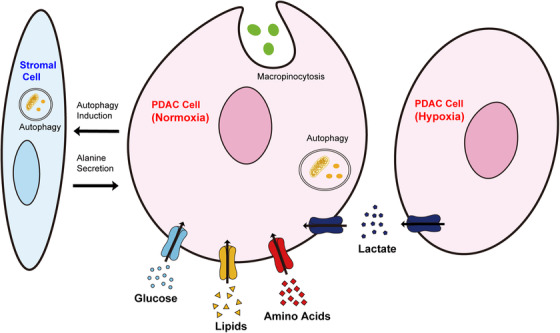
Nutrient acquisition strategies utilized by PDAC cells. PDAC cells acquire nutrients in various ways. The uptake of glucose, amino acids, and lipids is enhanced in PDAC cells. Macropinocytosis and autophagy are also promoted. PDAC cells undergo metabolic crosstalk with stromal cells. PDAC cells stimulate autophagy in stromal cells, inducing alanine secretion. Metabolic crosstalk also occurs among cancer cells. Lactate secreted by PDAC cells in the hypoxic region is taken up by PDAC cells in the normoxic region. These mechanisms cooperate to promote PDAC growth. PDAC, pancreatic ductal adenocarcinoma

References

    1. Campbell PJ, Yachida S, Mudie LJ, et al. The patterns and dynamics of genomic instability in metastatic pancreatic cancer. Nature. 2010;467:1109‐1113. - PMC - PubMed
    1. Notta F, Chan‐Seng‐Yue M, Lemire M, et al. A renewed model of pancreatic cancer evolution based on genomic rearrangement patterns. Nature. 2016;538:378‐382. - PMC - PubMed
    1. Siegel RL, Miller KD, Jemal A. Cancer statistics, 2019. CA Cancer J Clin. 2019;69:7‐34. - PubMed
    1. Ryan DP, Hong TS, Bardeesy N. Pancreatic adenocarcinoma. N Engl J Med. 2014;371:1039‐1049. - PubMed
    1. Singhi AD, Koay EJ, Chari ST, Maitra A. Early detection of pancreatic cancer: opportunities and challenges. Gastroenterology. 2019;156:2024‐2040. - PMC - PubMed