Review
. 2021 Jun 10;2(3):315-340.
doi: 10.1002/mco2.55. eCollection 2021 Sep.

Molecular mechanisms of chemo- and radiotherapy resistance and the potential implications for cancer treatment

Affiliations
Review

Molecular mechanisms of chemo- and radiotherapy resistance and the potential implications for cancer treatment

Ya-Ping Liu et al. MedComm (2020). .

Abstract

Cancer is a leading cause of death worldwide. Surgery is the primary treatment approach for cancer, but the survival rate is very low due to the rapid progression of the disease and presence of local and distant metastasis at diagnosis. Adjuvant chemotherapy and radiotherapy are important components of the multidisciplinary approaches for cancer treatment. However, resistance to radiotherapy and chemotherapy may result in treatment failure or even cancer recurrence. Radioresistance in cancer is often caused by the repair response to radiation-induced DNA damage, cell cycle dysregulation, cancer stem cells (CSCs) resilience, and epithelial-mesenchymal transition (EMT). Understanding the molecular alterations that lead to radioresistance may provide new diagnostic markers and therapeutic targets to improve radiotherapy efficacy. Patients who develop resistance to chemotherapy drugs cannot benefit from the cytotoxicity induced by the prescribed drug and will likely have a poor outcome with these treatments. Chemotherapy often shows a low response rate due to various drug resistance mechanisms. This review focuses on the molecular mechanisms of radioresistance and chemoresistance in cancer and discusses recent developments in therapeutic strategies targeting chemoradiotherapy resistance to improve treatment outcomes.

Keywords: cancer; chemoresistance; molecular mechanisms; radioresistance; targeted therapy.


Conflict of interest statement

The authors declare no conflict of interest. Author Ming‐Liang He is the Editorial Board Member of MedComm. Author Ming‐Liang He was not involved in the journal's review of, or decisions related to, this manuscript.

Figures
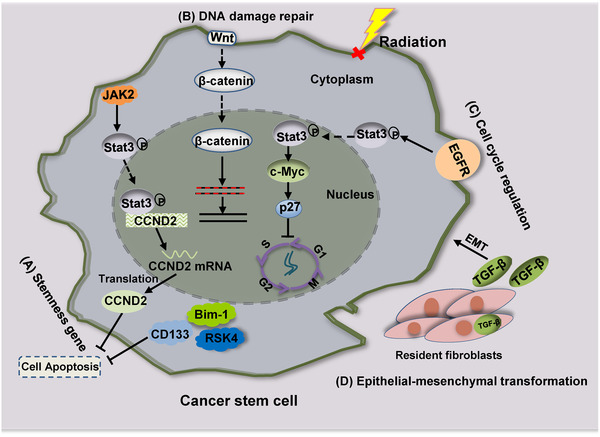
FIGURE 1
FIGURE 1
The abnormality of genes contributes to the formation of radiation resistance in CSCs. (A) High expression of Bim‐1, RSK4, CD133, and JAK2 induces cancer cells resistance to radiation. (B) Activation of the Wnt/β‐catenin signaling pathway not only enhances DNA damage repair in CSCs but also promotes the EMT, which induces radioresistance. (C) EGFR/Stat3/c‐Myc/p27 pathway contributes to the cell quiescence and lead to abnormal cell cycle in cancer. (D) TGF‐β secreted by resident fibroblasts promotes the EMT of CSCs, which may decrease radiosensitivity
FIGURE 2
FIGURE 2
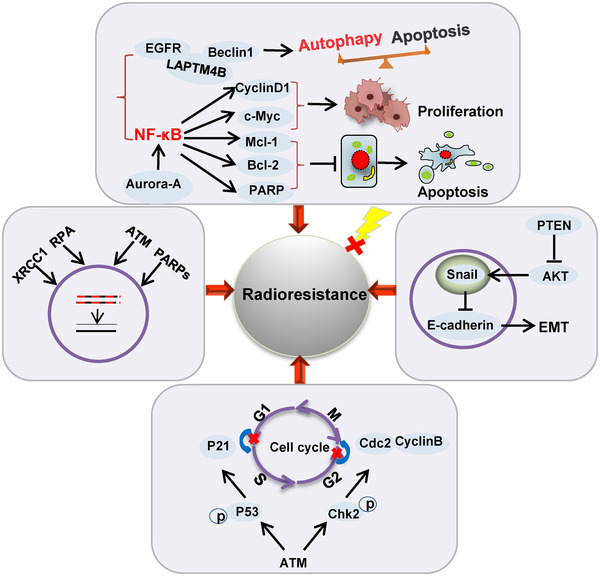
Roles of genes in radioresistant cancer cells. Enhanced DNA damage repair, cell cycle redistribution, EMT, and activation of signaling pathways that promote survival and proliferation contribute to forming radioresistance in cancer
FIGURE 3
FIGURE 3
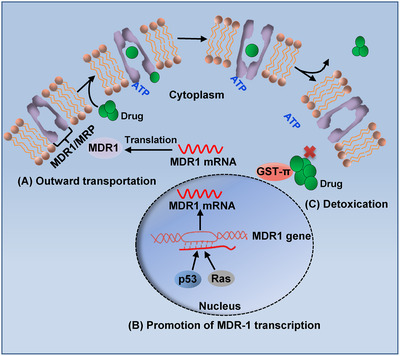
The mechanisms of multidrug resistance. (A) High transport capacity of MDR1 and MRP results in MDR. (B) The p53 and Ras upregulate the transiption MDR1 to increase drug excretion in cancer cells. (C) GST‐π activation of the detoxification system leads to multidrug resistance in cancer cells
FIGURE 4
FIGURE 4
Molecular mechanisms of tumor chemoresistance and radioresistance. (A) Abnormal expression of ABC family contribute to drugs being pumped out of the cell, which causes intracellular drug concentrations too low to sensitive to drugs. (B) Changes in the expression of transport proteins in drug absorption lead to a decreased drug absorption rate and chemoresistance. (C) DNA damaged by chemotherapy and radiotherapy is repaired quickly, which is closely related to the acquisition of chemoresistance and radioresistance. (D) Cell death is inhibited, indicating that the balance between apoptosis and cell growth is disrupted, affected by the major gene families such as p53 and Bcl. (E) The production of cellular EMT properties causes resistance to chemotherapy and radiotherapy. (F) The molecular targets of drugs can be altered in tumor cells. (G) Drug inactivation, some detoxification‐related proteins deactivate drugs in cells, which is followed by chemoresistance acquisition

References

    1. Bray F, Ferlay J, Soerjomataram I, Siegel RL, Torre LA, Jemal A. Global cancer statistics 2018: gLOBOCAN estimates of incidence and mortality worldwide for 36 cancers in 185 countries. CA Cancer J Clin. 2018;68(6):394‐424. - PubMed
    1. Chen GZ, Zhu HC, Dai WS, Zeng XN, Luo JH, Sun XC. The mechanisms of radioresistance in esophageal squamous cell carcinoma and current strategies in radiosensitivity. J Thorac Dis. 2017;9(3):849‐859. - PMC - PubMed
    1. Bao Y, Liu S, Zhou Q, et al. Three‐dimensional conformal radiotherapy with concurrent chemotherapy for postoperative recurrence of esophageal squamous cell carcinoma: clinical efficacy and failure pattern. Radiat Oncol. 2013;8:241. - PMC - PubMed
    1. Hayashi Y, Nishida T, Tsujii M, et al. Lymph node enlargement after definitive chemoradiotherapy for clinical stage I esophageal squamous cell carcinoma. BMC Cancer. 2014;14:706. - PMC - PubMed
    1. Yano T, Muto M, Minashi K, et al. Photodynamic therapy as salvage treatment for local failure after chemoradiotherapy in patients with esophageal squamous cell carcinoma: a phase II study. Int J Cancer. 2012;131(5):1228‐1234. - PubMed