


Twenty-Year Reflection on the Impact of World Trade Center Exposure on Pulmonary Outcomes in Fire Department of the City of New York (FDNY) Rescue and Recovery Workers
- PMID: 34766209
- PMCID: PMC8583580
- DOI: 10.1007/s00408-021-00493-z
Twenty-Year Reflection on the Impact of World Trade Center Exposure on Pulmonary Outcomes in Fire Department of the City of New York (FDNY) Rescue and Recovery Workers
Abstract
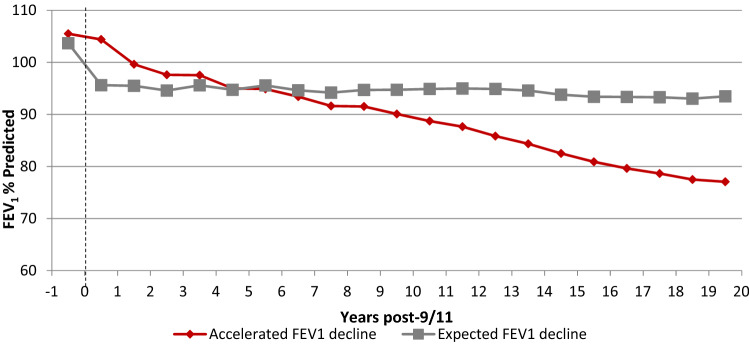
After the terrorist attacks on September 11, 2001 (9/11), many rescue/recovery workers developed respiratory symptoms and pulmonary diseases due to their extensive World Trade Center (WTC) dust cloud exposure. Nearly all Fire Department of the City of New York (FDNY) workers were present within 48 h of 9/11 and for the next several months. Since the FDNY had a well-established occupational health service for its firefighters and Emergency Medical Services workers prior to 9/11, the FDNY was able to immediately start a rigorous monitoring and treatment program for its WTC-exposed workers. As a result, respiratory symptoms and diseases were identified soon after 9/11. This focused review summarizes the WTC-related respiratory diseases that developed in the FDNY cohort after 9/11, including WTC cough syndrome, obstructive airways disease, accelerated lung function decline, airway hyperreactivity, sarcoidosis, and obstructive sleep apnea. Additionally, an extensive array of biomarkers has been identified as associated with WTC-related respiratory disease. Future research efforts will not only focus on further phenotyping/treating WTC-related respiratory disease but also on additional diseases associated with WTC exposure, especially those that take decades to develop, such as cardiovascular disease, cancer, and interstitial lung disease.
Keywords: 9/11; Lung injury; Obstructive airways disease; Occupational exposure; World trade center.
© 2021. The Author(s), under exclusive licence to Springer Science+Business Media, LLC, part of Springer Nature.
Conflict of interest statement
The authors declare that they have no conflict of interest.
Figures
References
-
- Heyder J, Svartengren M. Basic principles of particle behavior in the human respiratory tract. Boca Raton: CRC Press; 2001.
-
- Yip J, Webber MP, Zeig-Owens R, et al. FDNY and 9/11: clinical services and health outcomes in World Trade Center-exposed firefighters and EMS workers from 2001 to 2016. Am J Ind Med. 2016;59(9):695–708. - PubMed
Publication types
MeSH terms
Grants and funding
LinkOut - more resources
Full Text Sources
Medical
Research Materials
