


Towards compatibility of EUnetHTA JCA methodology and German HTA: a systematic comparison and recommendations from an industry perspective
- PMID: 34766242
- PMCID: PMC9170646
- DOI: 10.1007/s10198-021-01400-2
Towards compatibility of EUnetHTA JCA methodology and German HTA: a systematic comparison and recommendations from an industry perspective
Abstract
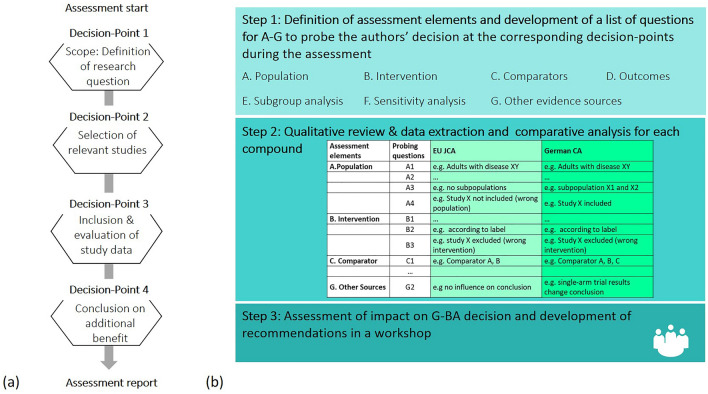
Objective: The transferability of the EU joint clinical assessment (JCA) reports for pharmaceuticals for the German benefit assessment was evaluated by systematically comparing EU JCA and German clinical assessments (CA) based on established assessment elements for HTA and assessing the potential impact of differences on Federal Joint Committee (Gemeinsamer Bundesausschuss, G-BA) ability to derive the therapeutic added value.
Methods: Identification of all pharmaceuticals undergoing both, EU JCA and German CA between January 2016-June 2020. Qualitative review and data extraction from the assessments, assessment of methodological differences using a hierarchical model. Recommendations for harmonisation were developed and consented with pharmaceutical industry stakeholders.
Results: Differences with potentially major impact: (1) View on differing treatment algorithms and definition of corresponding subpopulations/respective comparators. (2) Clinical relevance of surrogate/intermediate endpoints. Inclusion of different/surrogate morbidity endpoints resulting in different relative effectiveness conclusions. (3) Tolerance of study interventions not used according to marketing authorisation. (4) Different operationalisation and/or weighting of individual safety endpoints leading to differing relative safety conclusions. Differences with potentially minor impact: (1) Disagreement in risk of bias assessment for overall survival and its robustness against study limitations. (2) Use of patient-reported outcome symptom scales as measurements for health-related quality of life instruments.
Conclusion: While many synergies between EU JCA and German CA exist, we identified several aspects in HTA methodology that would benefit of harmonisation and ensure the transferability of future EU JCA to the German HTA process without duplicated evaluation requirements. For those, a set of recommendations was developed.
Keywords: Act on the Reform of the Market for Medicinal Products (AMNOG); EUnetHTA; Health technology assessment; Relative effectiveness assessment.
© 2021. The Author(s).
Conflict of interest statement
Financial Interests: AK is Pfizer Employee, JK is AbbVie Employee,
Non-financial interests: None.
Figures
References
-
- Kleijnen S, Fathallah M, van der Linden MW, Vancraeynest P, Dahmani B, Timoney A, et al. Can a joint assessment provide relevant information for national/local relative effectiveness assessments? an in-depth comparison of pazopanib assessments. Value Health. 2015;18(5):663–672. doi: 10.1016/j.jval.2015.03.1790. - DOI - PubMed
-
- Chassagnol F, Marcelli G, Wagle J, Giuliani G, Traub D, Schaub V, et al. Review of Relative effectiveness assessments (REAs) of pharmaceuticals at the European network for health technology assessment (EUnetHTA): a first step towards a consolidated European perspective on comparative effectiveness & safety? Health Policy. 2020;124(9):943–951. doi: 10.1016/j.healthpol.2020.06.013. - DOI - PubMed
-
- European Commission. Mapping of HTA methodologies in EU and Norway2018. Available from: https://ec.europa.eu/health/sites/health/files/technology_assessment/doc....
MeSH terms
Substances
LinkOut - more resources
Full Text Sources
