


Blood transfusion and the risk for infections in kidney transplant patients
- PMID: 34767576
- PMCID: PMC8589196
- DOI: 10.1371/journal.pone.0259270
Blood transfusion and the risk for infections in kidney transplant patients
Abstract
Background: Receipt of a red blood cell transfusion (RBCT) post-kidney transplantation may alter immunity which could predispose to subsequent infection.
Methods: We carried out a single-center, retrospective cohort study of 1,258 adult kidney transplant recipients from 2002 to 2018 (mean age 52, 64% male). The receipt of RBCT post-transplant (468 participants transfused, total 2,373 RBCT) was analyzed as a time-varying, cumulative exposure. Adjusted cox proportional hazards models were used to calculate hazard ratios (HR) for outcomes of bacterial or viral (BK or CMV) infection.
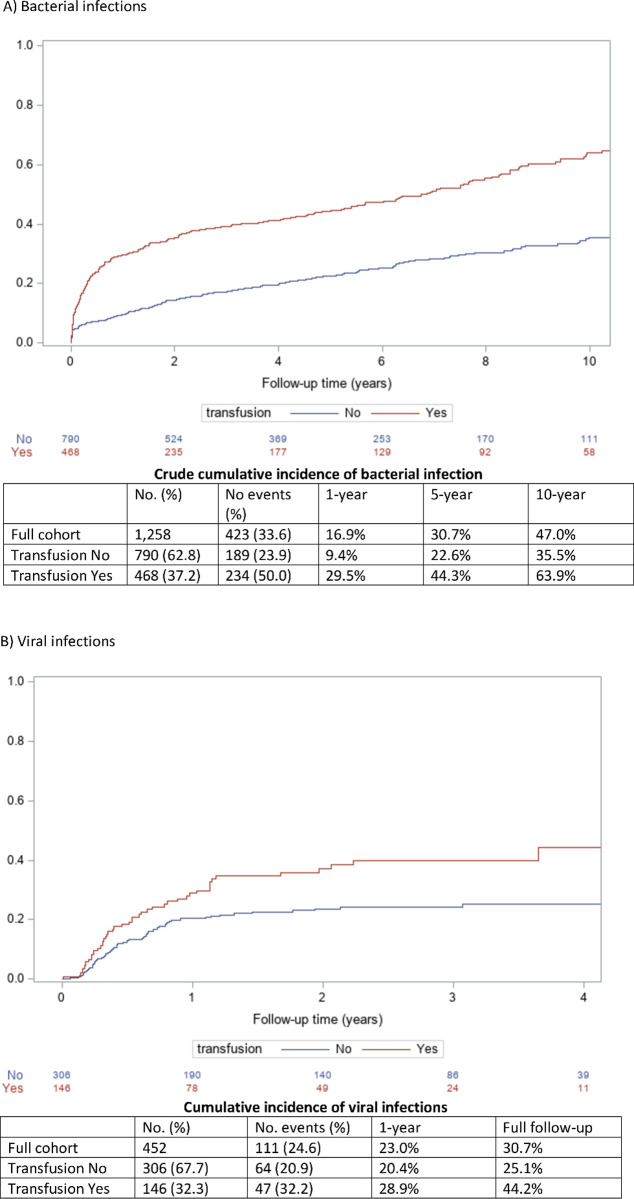
Results: Over a median follow-up of 3.8 years, bacterial infection occurred in 34% of participants at a median of 409 days post-transplant and viral infection occurred in 25% at a median of 154 days post-transplant. Transfusion was associated with a step-wise higher risk of bacterial infection (HR 1.35, 95%CI 0.95-1.91; HR 1.29, 95%CI 0.92-1.82; HR 2.63, 95%CI 1.94-3.56; HR 3.38, 95%CI 2.30-4.95, for 1, 2, 3-5 and >5 RBCT respectively), but not viral infection. These findings were consistent in multiple additional analyses, including accounting for reverse causality.
Conclusion: Blood transfusion after kidney transplant is associated with a higher risk for bacterial infection, emphasizing the need to use transfusions judiciously in this population already at risk for infections.
Conflict of interest statement
The authors have declared that no competing interests exist.
Figures
References
-
- Loubeau PR, Loubeau JM, Jantzen R. The economics of kidney transplantation versus hemodialysis. Prog Transplant. 2001;11(4):291–297. http://www.ncbi.nlm.nih.gov/pubmed/11871278. Accessed October 25, 2019. doi: 10.7182/prtr.11.4.n138851n77524hu1 - DOI - PubMed
MeSH terms
LinkOut - more resources
Full Text Sources
Medical
