


Treatment selection using prototyping in latent-space with application to depression treatment
- PMID: 34767577
- PMCID: PMC8589171
- DOI: 10.1371/journal.pone.0258400
Treatment selection using prototyping in latent-space with application to depression treatment
Abstract
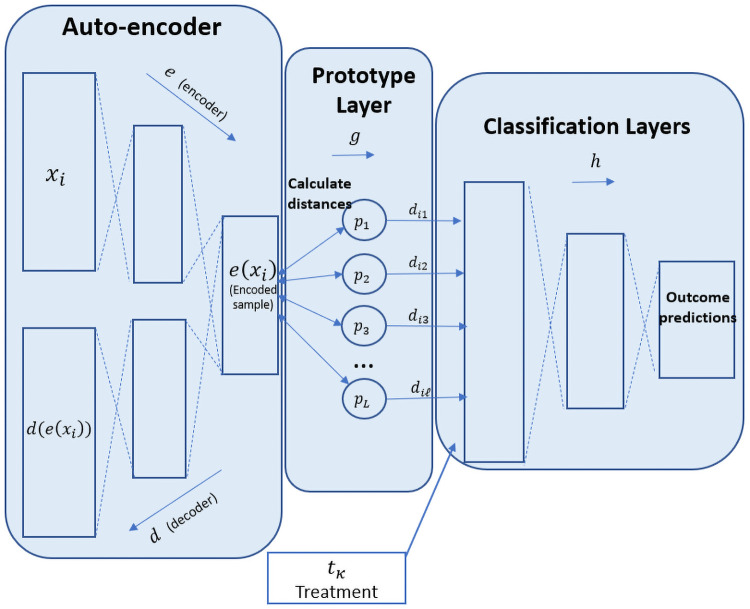
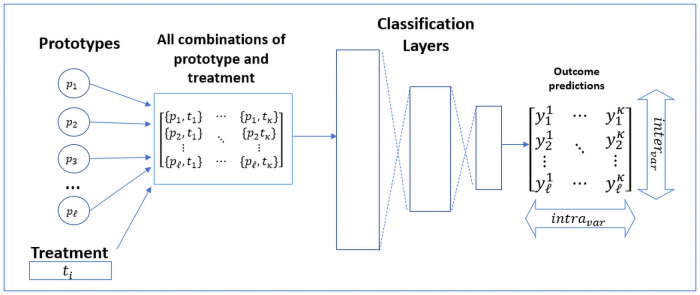
Machine-assisted treatment selection commonly follows one of two paradigms: a fully personalized paradigm which ignores any possible clustering of patients; or a sub-grouping paradigm which ignores personal differences within the identified groups. While both paradigms have shown promising results, each of them suffers from important limitations. In this article, we propose a novel deep learning-based treatment selection approach that is shown to strike a balance between the two paradigms using latent-space prototyping. Our approach is specifically tailored for domains in which effective prototypes and sub-groups of patients are assumed to exist, but groupings relevant to the training objective are not observable in the non-latent space. In an extensive evaluation, using both synthetic and Major Depressive Disorder (MDD) real-world clinical data describing 4754 MDD patients from clinical trials for depression treatment, we show that our approach favorably compares with state-of-the-art approaches. Specifically, the model produced an 8% absolute and 23% relative improvement over random treatment allocation. This is potentially clinically significant, given the large number of patients with MDD. Therefore, the model can bring about a much desired leap forward in the way depression is treated today.
Conflict of interest statement
AK, AK and AR have received honoraria from Aifred Health (https://www.aifredhealth.com/). Aifred Health was not the primary funder of this study, and honoraria were provided in connection to the support of the Aifred Health team during the IBM Watson AI XPRIZE competition. Aifred Health-affiliated co-authors collaborated with other co-authors in the conduct of this work. JK is a member of Aifred Health’s scientific advisory board and has received stock options from Aifred Health. DB, CA, RF, JM are shareholders, employees and/or officers of Aifred Health. AK, AK, AR, CA, JM, RF, and DB are co-inventors on a patent pending relating to this work.” This does not alter our adherence to PLOS ONE policies on sharing data and materials. Data is not owned by the authors, but information on how to request it is available via the data sharing statement. Sufficient information is available in the manuscript and in the associated appendices and code to reproduce the experiments described herein.
Figures
References
Publication types
MeSH terms
Substances
LinkOut - more resources
Full Text Sources
Medical
