


Carotid Artery Temperature Reduction with Statin Therapy in Patients with Familial Hyperlipidemia Syndromes
- PMID: 34768528
- PMCID: PMC8584884
- DOI: 10.3390/jcm10215008
Carotid Artery Temperature Reduction with Statin Therapy in Patients with Familial Hyperlipidemia Syndromes
Abstract
Background: Microwave radiometry (MWR) assesses non-invasive carotid artery temperatures reflecting inflammation. In the present study, we aimed to investigate the impact of hypolipidemic therapy either with simvastatin or with combination simvastatin plus ezetimibe on carotid artery temperatures of patients with familial hyperlipidemia syndromes (FHS).
Methods: Consecutive patients with diagnosis of either familial heterozygous hypercholesterolemia (heFH) or familial combined hyperlipidemia (FCH) were included in the study. Patients were assigned to either simvastatin 40 mg or simvastatin 40 mg plus ezetimibe 10 mg, according to the discretion of the physician. FHS patients who refused statin therapy were used as a control group. Common carotid intima-media thickness (ccIMT) was measured and ΔΤ (maximum-minimum) temperature measurements were performed across each carotid during MWR evaluation.
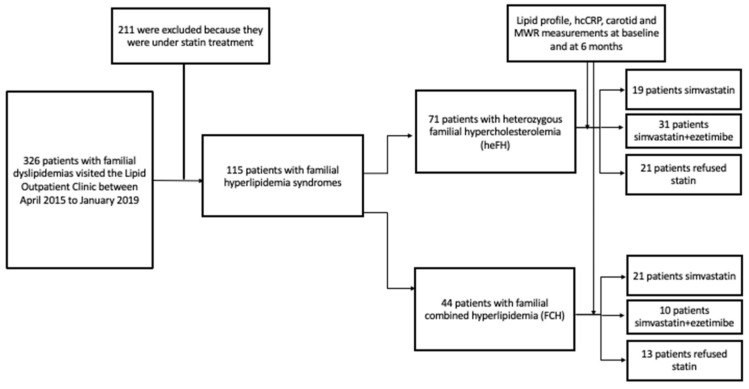
Results: In total, 115 patients were included in the study. Of them, 40 patients received simvastatin (19 heFH and 21 FCH), 41 simvastatin + ezetimibe (31 heFH and 10 FCH), and 34 (21 heFH and 13 FCH) no statin. Carotid artery temperatures were significantly reduced at 6 months in FH patients who received hypolipidemic treatment (0.83 ± 0.34 versus 0.63 ± 0.24 °C, p = 0.004 for simvastatin, 1.00 ± 0.38 versus 0.69 ± 0.23 °C, p < 0.001 for simvastatin + ezetimibe), but no change was recorded in controls (0.72 ± 0.26 versus 0.70 ± 0.26 °C, p = 0.86).
Conclusions: Hypolipidemic therapy reduced carotid temperatures in FHS patients.
Keywords: carotid; familial hypercholesterolemia; microwave radiometry; vulnerable plaque.
Conflict of interest statement
There is no conflict of interest to disclose.
Figures

References
-
- Toutouzas K., Skoumas J., Koutagiar I., Benetos G., Pianou N., Georgakopoulos A., Galanakos S., Antonopoulos A., Drakopoulou M., Oikonomou E.K., et al. Vascular inflammation and metabolic activity in hematopoietic organs and liver in familial combined hyperlipidemia and heterozygous familial hypercholesterolemia. J. Clin. Lipidol. 2018;12:33–43. doi: 10.1016/j.jacl.2017.10.019. - DOI - PubMed
-
- Sniderman A.D., Castro Cabezas M., Ribalta J., Carmena R., de Bruin T.W., de Graaf J., Erkelens D.W., Humphries S.E., Masana L., Real J.T., et al. A proposal to redefine familial combined hyperlipidaemia—Third workshop on FCHL held in Barcelona from 3 to 5 May 2001, during the scientific sessions of the European Society for Clinical Investigation. Eur. J. Clin. Investig. 2002;32:71–73. doi: 10.1046/j.1365-2362.2002.00941.x. - DOI - PubMed
-
- Toutouzas K., Benetos G., Koutagiar I., Barampoutis N., Mitropoulou F., Davlouros P., Sfikakis P.P., Alexopoulos D., Stefanadis C., Siores E., et al. Noninvasive detection of increased carotid artery temperature in patients with coronary artery disease predicts major cardiovascular events at one year: Results from a prospective multicenter study. Atherosclerosis. 2017;262:25–30. doi: 10.1016/j.atherosclerosis.2017.04.019. - DOI - PubMed
LinkOut - more resources
Full Text Sources
Miscellaneous
