


Effectiveness of Magnetic Stimulation in the Treatment of Urinary Incontinence: A Systematic Review and Results of Our Study
- PMID: 34768730
- PMCID: PMC8584787
- DOI: 10.3390/jcm10215210
Effectiveness of Magnetic Stimulation in the Treatment of Urinary Incontinence: A Systematic Review and Results of Our Study
Abstract
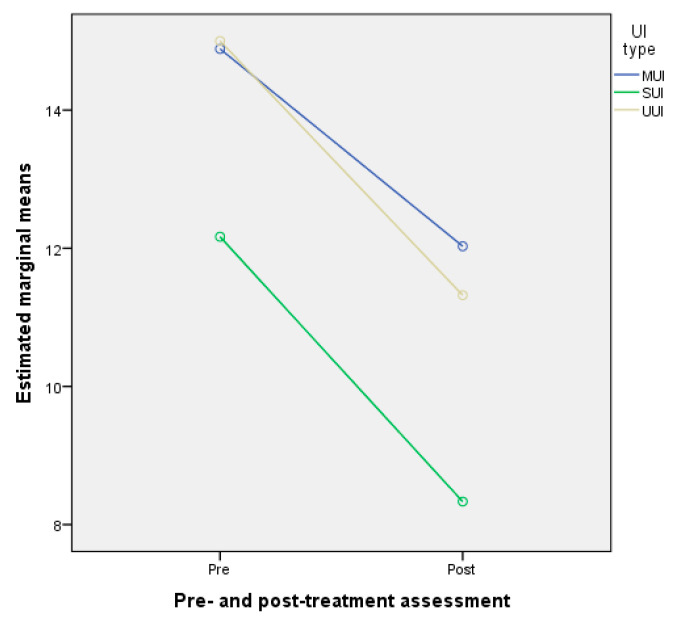
Urinary incontinence (UI) is becoming an increasingly common health problem. UI treatment can be conservative or surgical. This paper focuses on the effectiveness of magnetic stimulation (MS) in the treatment of UI. We performed a systematic review in order to combine and compare results with results from our clinical study. A clinical prospective non-randomized study was carried out at the Ljubljana University Medical Center's Gynecology Division. It included 82 randomly selected female patients, irrespective of their UI type. The success rate of using MS in treating UI was based on standardized ICIQ-UI SF questionnaires. Patients completed 10 therapy sessions on MS, and follow-up was performed 3 months after the last therapy session. UI improved after treatment with MS. The ICIQ-UI SF score improved in patients regardless of the type of UI. However, the greatest decrease in post-treatment assessment ICIQ-UI SF scores was seen in patients with stress urinary incontinence (SUI). Based on the findings described above, it can be concluded that MS is a successful non-invasive conservative method for treating UI. Future studies are necessary, all of which should include a large sample size, a control group, an optimal research protocol, pre-treatment analyses, standardization, and longer follow-ups.
Keywords: magnetic stimulation; treatment; urinary incontinence.
Conflict of interest statement
All the authors completed the ICMJE uniform disclosure form. The authors have no conflict of interest to declare.
Figures
References
-
- Haylen B.T., de Ridder D., Freeman R.M., Swift S.E., Berghmans B., Lee J., Monga A., Petri E., Rizk D.E., Sand P.K., et al. International Urogynecological Association; International Continence Society. An International Urogynecological Association (IUGA)/International Continence Society (ICS) joint report on the terminology for female pelvic floor dysfunction. Neurourol. Urodyn. 2010;29:4–20. doi: 10.1002/nau.20798. - DOI - PubMed
-
- Shamliyan T., Wyman J., Kane R.L. Nonsurgical Treatments for Urinary Incontinence in Adult Women: Diagnosis and Comparative Effectiveness. Agency for Healthcare Research and Quality; Rockville, MD, USA: 2012. - PubMed
-
- Lukanović D., Blaganje M., Barbic M. Urinary incontinence treatment algorithm. Zdrav Vestn. 2021;90:275–287.
-
- Abrams P., Andersson K.E., Birder L., Brubaker L., Cardozo L., Chapple C., Cottenden A., Davila W., De Ridder D., Dmochowski R., et al. Members of Committees; Fourth International Consultation on Incontinence. Fourth International Consultation on Incontinence Recommendations of the International Scientific Committee: Evaluation and treatment of urinary incontinence, pelvic organ prolapse, and fecal incontinence. Neurourol. Urodyn. 2010;29:213–240. doi: 10.1002/nau.20870. - DOI - PubMed
LinkOut - more resources
Full Text Sources
Medical
