Review
. 2021 Oct 20;22(21):11311.
doi: 10.3390/ijms222111311.

Bioluminescence and Photoreception in Unicellular Organisms: Light-Signalling in a Bio-Communication Perspective

Affiliations
Review

Bioluminescence and Photoreception in Unicellular Organisms: Light-Signalling in a Bio-Communication Perspective

Youri Timsit et al. Int J Mol Sci. .

Abstract

Bioluminescence, the emission of light catalysed by luciferases, has evolved in many taxa from bacteria to vertebrates and is predominant in the marine environment. It is now well established that in animals possessing a nervous system capable of integrating light stimuli, bioluminescence triggers various behavioural responses and plays a role in intra- or interspecific visual communication. The function of light emission in unicellular organisms is less clear and it is currently thought that it has evolved in an ecological framework, to be perceived by visual animals. For example, while it is thought that bioluminescence allows bacteria to be ingested by zooplankton or fish, providing them with favourable conditions for growth and dispersal, the luminous flashes emitted by dinoflagellates may have evolved as an anti-predation system against copepods. In this short review, we re-examine this paradigm in light of recent findings in microorganism photoreception, signal integration and complex behaviours. Numerous studies show that on the one hand, bacteria and protists, whether autotrophs or heterotrophs, possess a variety of photoreceptors capable of perceiving and integrating light stimuli of different wavelengths. Single-cell light-perception produces responses ranging from phototaxis to more complex behaviours. On the other hand, there is growing evidence that unicellular prokaryotes and eukaryotes can perform complex tasks ranging from habituation and decision-making to associative learning, despite lacking a nervous system. Here, we focus our analysis on two taxa, bacteria and dinoflagellates, whose bioluminescence is well studied. We propose the hypothesis that similar to visual animals, the interplay between light-emission and reception could play multiple roles in intra- and interspecific communication and participate in complex behaviour in the unicellular world.

Keywords: bioluminescence; communication; dinoflagellate; luciferase; lux operon; photoreceptors; rhizosphere; signalling; symbiosis.


Conflict of interest statement

The authors declare no conflict of interest.

Figures
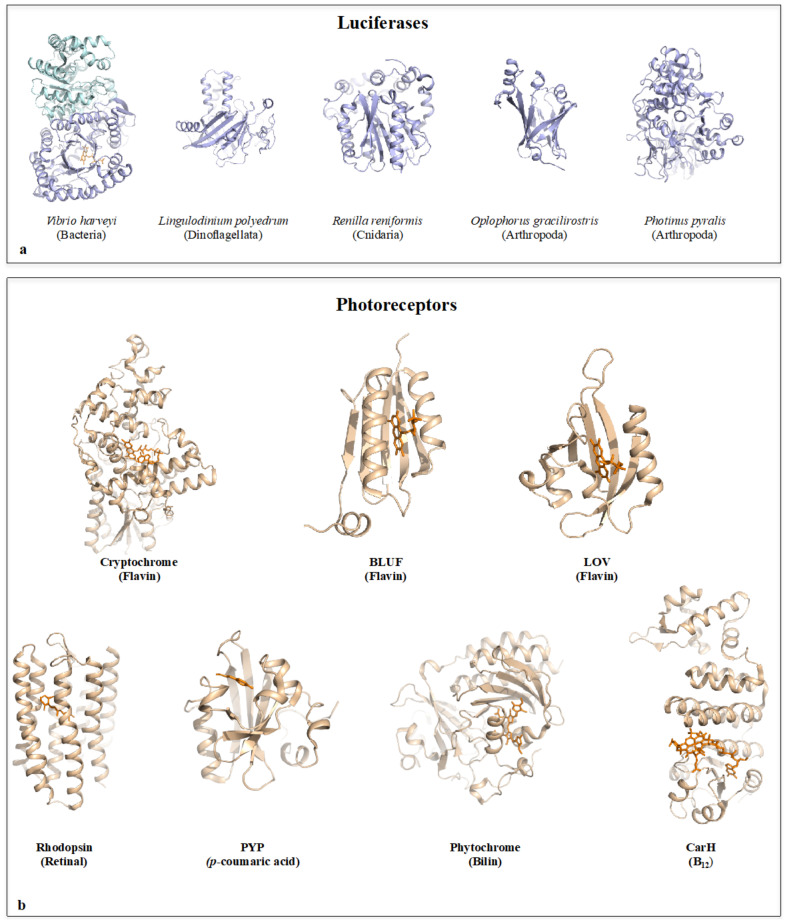
Figure 1
Figure 1
Structures of luciferases and photoreceptors. (a) the structures of the luciferases are depicted with blue cartoons. At the periphery, the various types of photoreceptors are represented with beige cartoons. The corresponding pdb codes for the luciferases are: Vibrio harveyi: 3fgc, Lingulodinium polyedrum: 1vpr; Oplophorus gracilirostris: 5b0u; Photinus pyralis: 1lci; Renilla reniformis: 2psh. (b) The structures of the main classes of photoreceptors are represented by wheat cartoons. The pdb codes for the photoreceptors are: Cryptochrome: 1np7; BLUF: 1yrx; LOV: 1g28; Phytochrome: 2o9c; CarH: 5c8f; PYP: 2phy; sensory rhodopsin: 1jgj. The co-factors and pigments are indicated and represented with orange sticks if present in the structures of both luciferases and photoreceptors. The pigments are written in parentheses.
Figure 2
Figure 2
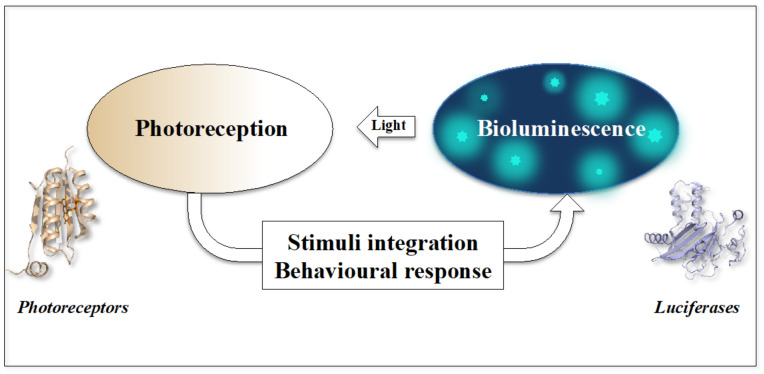
Interplay between photoreception and bioluminescence in microorganisms. Schematic diagram of the feed-back loop between light emission and light reception. During the night, in the non-photic zone or in the rhizosphere (soil), light emission by luciferases (symbolised here by dinoflagellate luciferase) and light reception by photoreceptors (symbolised here by BLUF) has the potential to mediate intra- or inter-species light-communication.
Figure 3
Figure 3
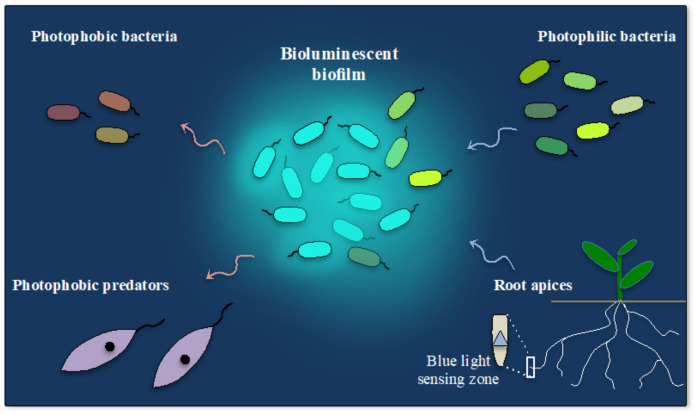
Light signalling in the bacterial world. Schematic representation of the hypothesis that bioluminescent bacteria may shape the bacterial communities in their luminous biofilm (represented by a cyan halo). They can attract different species of photophilic bacteria (green) or repell photophobic bacteria (brown) and eukaryotes (violet). Thin, wavy arrows symbolise cell motility. Light emission may also influence the plant roots that possess blue-light photoreceptors (blue triangle) (see [314]).
Figure 4
Figure 4
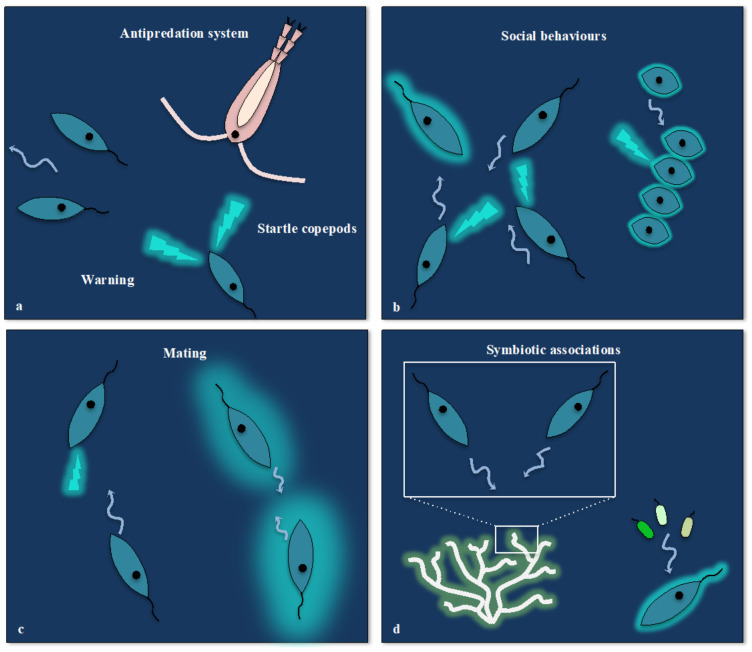
Schematic representations of the multiple potential functions of dinoflagellate bioluminescence and photoreception. (a) The intense emitted flashes play an anti-predation role such as startling copepod predators. They can also alert other cells to danger and provide information about the location and the nature of predators (warning). (b) Flashes and glowing (cyan halo) can contribute to cell signalling in complex social behaviours such as blooms (left) or chain formation (right). (c) Glowing and the modulation of flash intensities and durations may contribute to communication for mating. (d) Light can also mediate symbiotic associations with coral (left) or bacteria (right).

References

    1. Haddock S.H.D., Moline M.A., Case J.F. Bioluminescence in the Sea. Ann. Rev. Mar. Sci. 2010;2:443–493. doi: 10.1146/annurev-marine-120308-081028. - DOI - PubMed
    1. Widder E.A. Bioluminescence in the Ocean: Origins of Biological, Chemical, and Ecological Diversity. Science. 2010;328:704–708. doi: 10.1126/science.1174269. - DOI - PubMed
    1. Herring P.J. How to Survive in the Dark: Bioluminescence in the Deep Sea. Symp. Soc. Exp. Biol. 1985;39:323–350. - PubMed
    1. Wilson T., Hastings J.W. Bioluminescence. Annu. Rev. Cell Dev. Biol. 1998;14:197–230. doi: 10.1146/annurev.cellbio.14.1.197. - DOI - PubMed
    1. Hegemann P. Algal Sensory Photoreceptors. Annu. Rev. Plant. Biol. 2008;59:167–189. doi: 10.1146/annurev.arplant.59.032607.092847. - DOI - PubMed

LinkOut - more resources