Review
. 2021 Oct 21;22(21):11365.
doi: 10.3390/ijms222111365.

Microbiota-Immune Interactions in Ulcerative Colitis and Colitis Associated Cancer and Emerging Microbiota-Based Therapies

Affiliations
Review

Microbiota-Immune Interactions in Ulcerative Colitis and Colitis Associated Cancer and Emerging Microbiota-Based Therapies

Jelena Popov et al. Int J Mol Sci. .

Abstract

Ulcerative colitis (UC) is a chronic autoimmune disorder affecting the colonic mucosa. UC is a subtype of inflammatory bowel disease along with Crohn's disease and presents with varying extraintestinal manifestations. No single etiology for UC has been found, but a combination of genetic and environmental factors is suspected. Research has focused on the role of intestinal dysbiosis in the pathogenesis of UC, including the effects of dysbiosis on the integrity of the colonic mucosal barrier, priming and regulation of the host immune system, chronic inflammation, and progression to tumorigenesis. Characterization of key microbial taxa and their implications in the pathogenesis of UC and colitis-associated cancer (CAC) may present opportunities for modulating intestinal inflammation through microbial-targeted therapies. In this review, we discuss the microbiota-immune crosstalk in UC and CAC, as well as the evolution of microbiota-based therapies.

Keywords: CAC; CRC; FMT; antibiotics; colitis-associated cancer; colorectal cancer; dysbiosis; fecal microbiota transplant; inflammatory bowel diseases; pediatrics; prebiotics; probiotics; synbiotics; ulcerative colitis.


Conflict of interest statement

The authors disclose no relevant conflict of interest.

Figures
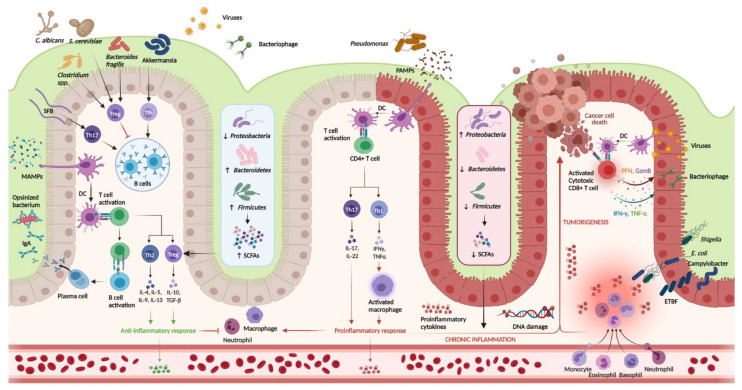
Figure 1
Figure 1
Host-immune interactions in ulcerative colitis. Intestinal microbiota interact with the immune system through various pathways. In the healthy colon, DCs sample MAMPs and present antigens on major histocompatibility complex class II to naive CD4+ T cells. Naive CD4+ T cells become activated and differentiate into various T cell subtypes depending on the presence of specific cytokines within the local microenvironment. Anti-inflammatory Th subtypes comprise Th2 and Treg cells. CD4+ T cells also activate plasma cells which secrete immunoglobulin A (IgA) which is essential for microbial opsonization. Proinflammatory Th subtypes consist of Th1 cells and Th17 cells, which are upregulated in the diseased colon via interactions between DCs and PAMPs. Chronic inflammation contributes to DNA damage and tumorigenesis. Invading viruses stimulate CD8+ cytotoxic T cell activation via antigen-MHC I interactions. However, CD8+ T cells can also assist in cancer cell death. Disruptions in the mucosal barrier provides avenues for microbial translocation, including ETBF, which has been implicated in colitis-associated cancer. Finally, the production of SCFA is increased in the healthy colon (mediated by increased density of Firmicutes and Bacteroidetes phyla), while increased density of the Proteobacterium phylum is associated with lower concentrations of SCFA and colonic inflammation. DC, dendritic cell; DNA, deoxyribonucleic acid; ETBF, enterotoxigenic Bacteroides fragilis; IFN-γ, interferon-gamma; IgA, immunoglobulin A; MAMPs, microbe-associated molecular patterns; PAMPs, pathogen-associated molecular patterns; SCFAs, short chain fatty acids; SFB, segmented filamentous bacteria; Th, T helper; Treg, T regulatory; TNF-α, tumor necrosis factor-alpha. Created in Biorender.com (accessed: 1 August 2021) [16].
Figure 2
Figure 2
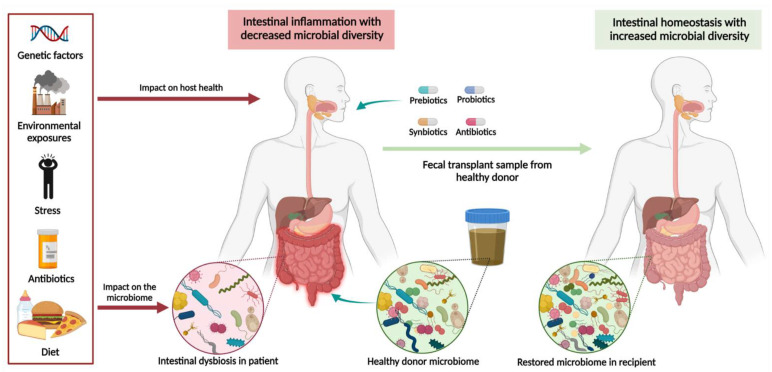
Microbiota-based therapeutic approaches in ulcerative colitis. Various factors have been implicated in contributing to intestinal dysbiosis including a high-fat or low-fiber diet, exposure to antibiotics in early life, psychological stress, environmental pollutants, and genetic factors. Profound disruptions to intestinal microbiota increase an individual’s susceptibility to developing autoimmune disease, including UC. Increasing research is focusing on the role of prebiotics, probiotics, synbiotics, antibiotics, and fecal microbiota transplantation in restoring intestinal homeostasis. While antibiotic exposure in early life increases the risk of developing UC, certain classes of antibiotics may also be used as a therapy once disease is established. Created in Biorender.com (accessed: 1 August 2021) [16].

References

    1. Yamamoto-Furusho J.K., Martínez-Benítez B., Sánchez-Morales G.E. Histopathologic Parameters at Diagnosis as Early Predictors of Histologic Remission along the Course of Ulcerative Colitis. Gastroenterol. Res. Pract. 2020;2020:1–5. doi: 10.1155/2020/8891937. - DOI - PMC - PubMed
    1. Jairath V., Feagan B.G. Global Burden of Inflammatory Bowel Disease. Lancet Gastroenterol. Hepatol. 2020;5:2–3. doi: 10.1016/S2468-1253(19)30358-9. - DOI - PubMed
    1. Ye B.D., McGovern D.P.B. Genetic Variation in IBD: Progress, Clues to Pathogenesis and Possible Clinical Utility. Expert Rev. Clin. Immunol. 2016;12:1091–1107. doi: 10.1080/1744666X.2016.1184972. - DOI - PMC - PubMed
    1. Pigneur B., Ruemmele F.M. Nutritional Interventions for the Treatment of IBD: Current Evidence and Controversies. Ther. Adv. Gastroenterol. 2019;12:175628481989053. doi: 10.1177/1756284819890534. - DOI - PMC - PubMed
    1. Saidel-Odes L., Odes S. Hygiene Hypothesis in Inflammatory Bowel Disease. Ann. Gastroenterol. 2014;27:189–190. - PMC - PubMed