


Stem Cells and Their Derivatives-Implications for Alveolar Bone Regeneration: A Comprehensive Review
- PMID: 34769175
- PMCID: PMC8583713
- DOI: 10.3390/ijms222111746
Stem Cells and Their Derivatives-Implications for Alveolar Bone Regeneration: A Comprehensive Review
Abstract
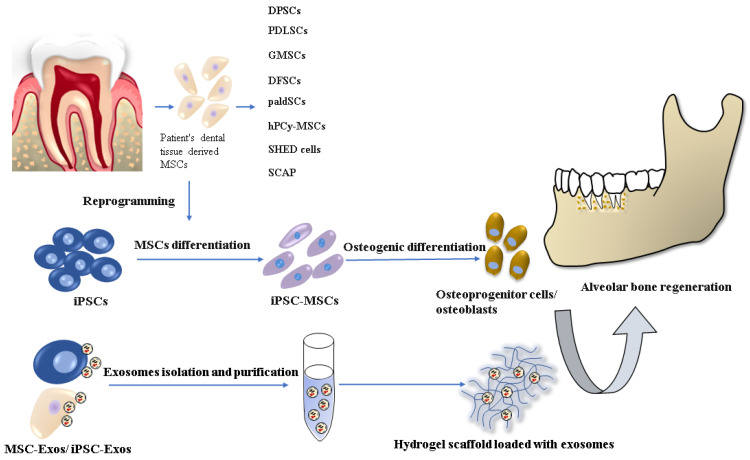
Oral and craniofacial bone defects caused by congenital disease or trauma are widespread. In the case of severe alveolar bone defect, autologous bone grafting has been considered a "gold standard"; however, the procedure has several disadvantages, including limited supply, resorption, donor site morbidity, deformity, infection, and bone graft rejection. In the last few decades, bone tissue engineering combined with stem cell-based therapy may represent a possible alternative to current bone augmentation techniques. The number of studies investigating different cell-based bone tissue engineering methods to reconstruct alveolar bone damage is rapidly rising. As an interdisciplinary field, bone tissue engineering combines the use of osteogenic cells (stem cells/progenitor cells), bioactive molecules, and biocompatible scaffolds, whereas stem cells play a pivotal role. Therefore, our work highlights the osteogenic potential of various dental tissue-derived stem cells and induced pluripotent stem cells (iPSCs), the progress in differentiation techniques of iPSCs into osteoprogenitor cells, and the efforts that have been made to fabricate the most suitable and biocompatible scaffold material with osteoinductive properties for successful bone graft generation. Moreover, we discuss the application of stem cell-derived exosomes as a compelling new form of "stem-cell free" therapy.
Keywords: alveolar bone regeneration; exosomes; stem cell-based therapy; tissue engineering.
Conflict of interest statement
The authors declare no conflict of interest.
Figures
References
-
- Tetè G., D’Orto B., Nagni M., Agostinacchio M., Polizzi E., Agliardi E. Role of induced pluripotent stem cells (IPSCS) in bone tissue regeneration in dentistry: A narrative review. J. Biol. Regul. Homeost. Agents. 2021;34:1–10. - PubMed
-
- Fernandez De Grado G., Keller L., Idoux-Gillet Y., Wagner Q., Musset A.-M., Benkirane-Jessel N., Bornert F., Offner D. Bone substitutes: A review of their characteristics, clinical use, and perspectives for large bone defects management. J. Tissue Eng. 2018;9:2041731418776819. doi: 10.1177/2041731418776819. - DOI - PMC - PubMed
-
- Zhang Y., Wu D., Zhao X., Pakvasa M., Tucker A.B., Luo H., Qin K.H., Hu D.A., Wang E.J., Li A.J., et al. Stem Cell-Friendly Scaffold Biomaterials: Applications for Bone Tissue Engineering and Regenerative Medicine. Front. Bioeng. Biotechnol. 2020;8:598607. doi: 10.3389/fbioe.2020.598607. - DOI - PMC - PubMed
Publication types
MeSH terms
Grants and funding
LinkOut - more resources
Full Text Sources
Research Materials
