Review
. 2021 Oct 29;22(21):11754.
doi: 10.3390/ijms222111754.

Survey of Molecular Mechanisms of Hyperbaric Oxygen in Tissue Repair

Affiliations
Review

Survey of Molecular Mechanisms of Hyperbaric Oxygen in Tissue Repair

Joerg Lindenmann et al. Int J Mol Sci. .

Abstract

For more than six decades, hyperbaric oxygen (HBO) has been used for a variety of indications involving tissue repair. These indications comprise a wide range of diseases ranging from intoxications to ischemia-reperfusion injury, crush syndrome, central nervous injury, radiation-induced tissue damage, burn injury and chronic wounds. In a systematic review, the molecular mechanisms triggered by HBO described within the last two decades were compiled. They cover a wide range of pathways, including transcription, cell-to-cell contacts, structure, adhesion and transmigration, vascular signaling and response to oxidative stress, apoptosis, autophagy and cell death, as well as inflammatory processes. By analyzing 71 predominantly experimental publications, we established an overview of the current concepts regarding the molecular mechanisms underlying the effects of HBO. We considered both the abovementioned pathways and their role in various applications and indications.

Keywords: cell death; cell structure; hyperbaric oxygenation (HBO); inflammation; molecular mechanism; oxidative stress; reactive oxygen species (ROS); tissue repair; transcription; vascular signaling.


Conflict of interest statement

The authors declare no conflict of interest.

Figures
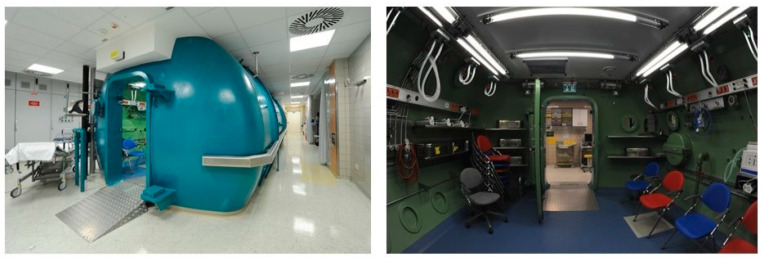
Figure 1
Figure 1
External and internal view of the hyperbaric chamber located at the Division of Thoracic and Hyperbaric Surgery, Department of Surgery, Medical University of Graz, Austria. Clearly visible are the white lines for the oxygen supply during the hyperbaric treatment in the internal space of the chamber. (Author’s pictures).
Figure 2
Figure 2
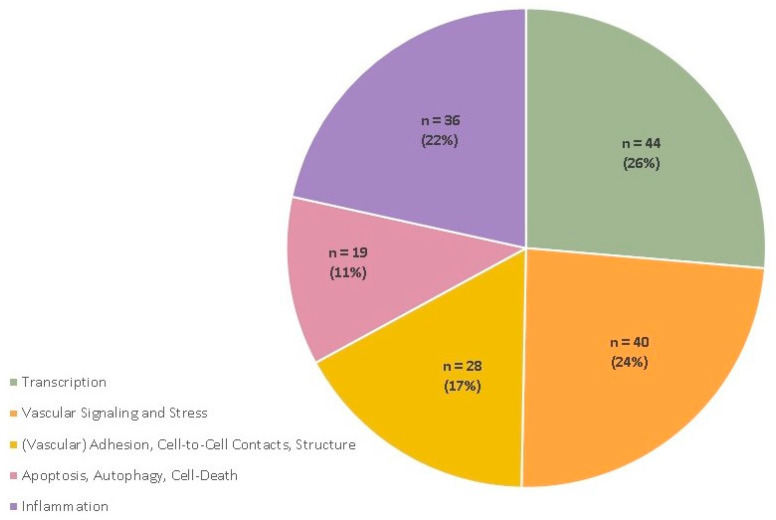
Number of papers per topic. Note that several papers provided input on multiple topics—therefore the absolute number is higher than number of references.
Figure 3
Figure 3
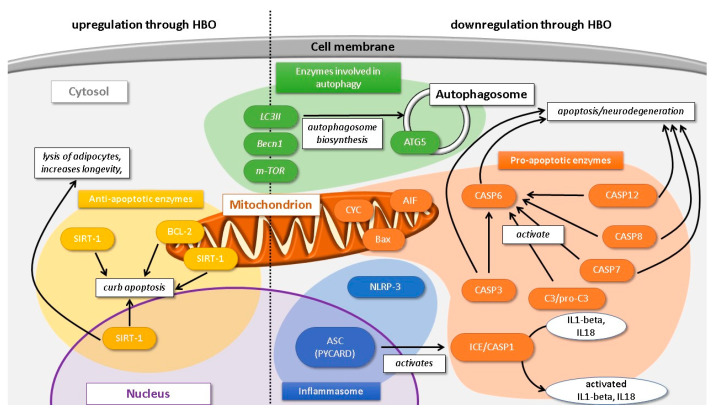
Current evidence suggests that hyperbaric oxygenation (HBO) exerts antiapoptotic effects via the downregulation of apoptotic enzymes: NLRP-3 interacts with components of damaged cells and, together with ASC, induces inflammation. Both form the inflammasome, engaging ICE/CASP1, which furthermore converts pro-inflammatory interleukins into an active form. C3/pro-C3 activates CASP6, CASP6/7/8/12 engage CASP3, and all mediate and effect apoptosis. CYC, Bax and AIF reside in the mitochondria and are pro-apoptotic. Conversely, the antiapoptotic mitochondrial enzymes SIRT1 (also present in nucleus and cytosol) and BCL-2 are upregulated by HBO which in turn enhance cell viability as they curb apoptosis. HBO exerts variable effects on proteins in the cytosol, LC3II, Becn1 and m-TOR, which are involved in autophagy processes; however, there is evidence that ATG5 protein residing in autophagosome membrane is downregulated by HBO.

References

    1. Francis A., Baynosa R. Ischaemia-reperfusion injury and hyperbaric oxygen pathways: A review of cellular mechanisms. Diving Hyperb. Med. J. 2017;47:110–117. doi: 10.28920/dhm47.2.110-117. - DOI - PMC - PubMed
    1. Mathieu D., Marroni A., Kot J. Tenth European Consensus Conference on Hyperbaric Medicine: Recommendations for acepted and non-accepted clinical indications and practic of hyperbaric oxygten treatment. Diving Hyperb. Med. 2017;47:24–32. doi: 10.28920/dhm47.2.131-132. - DOI - PMC - PubMed
    1. Smolle C., Lindenmann J., Smolle-Juettner F.M. The History and Development of Hyperbaric Oxygenation (HBO) in Thermal Burn Injury. Medicina. 2021;57:49. doi: 10.3390/medicina57010049. - DOI - PMC - PubMed
    1. Sun L., Zhao L., Li P., Liu X., Liang F., Jiang Y., Kang N., Gao C., Yang J. Effect of hyperbaric oxygen therapy on HMGB1/NF-kappaB expression and prognosis of acute spinal cord injury: A randomized clinical trial. Neurosci. Lett. 2019;692:47–52. doi: 10.1016/j.neulet.2018.10.059. - DOI - PubMed
    1. Dhamodharan U., Karan A., Sireesh D., Vaishnavi A., Somasundar A., Rajesh K., Ramkumar K.M. Tissue-specific role of Nrf2 in the treatment of diabetic foot ulcers during hyperbaric oxygen therapy. Free Radic. Biol. Med. 2019;138:53–62. doi: 10.1016/j.freeradbiomed.2019.04.031. - DOI - PubMed

LinkOut - more resources