Review
. 2021 Nov 6;22(21):12030.
doi: 10.3390/ijms222112030.

PRDM12 in Health and Diseases

Affiliations
Review

PRDM12 in Health and Diseases

Monica Rienzo et al. Int J Mol Sci. .

Abstract

PRDM12 is a member of the PRDI-BF1 (positive regulatory domain I-binding factor 1) homologous domain (PRDM)-containing protein family, a subfamily of Kruppel-like zinc finger proteins, controlling key processes in the development of cancer. PRDM12 is expressed in a spatio-temporal manner in neuronal systems where it exerts multiple functions. PRDM12 is essential for the neurogenesis initiation and activation of a cascade of downstream pro-neuronal transcription factors in the nociceptive lineage. PRDM12 inactivation, indeed, results in a complete absence of the nociceptive lineage, which is essential for pain perception. Additionally, PRDM12 contributes to the early establishment of anorexigenic neuron identity and the maintenance of high expression levels of pro-opiomelanocortin, which impacts on the program bodyweight homeostasis. PRDMs are commonly involved in cancer, where they act as oncogenes/tumor suppressors in a "Yin and Yang" manner. PRDM12 is not usually expressed in adult normal tissues but its expression is re-activated in several cancer types. However, little information is currently available on PRDM12 expression in cancers and its mechanism of action has not been thoroughly described. In this review, we summarize the recent findings regarding PRDM12 by focusing on four main biological processes: neurogenesis, pain perception, oncogenesis and cell metabolism. Moreover, we wish to highlight the importance of future studies focusing on the PRDM12 signaling pathway(s) and its role in cancer onset and progression.

Keywords: PRD-BF1 and RIZ homology domain containing gene family; PRDM12; cancer; cell metabolism; neurogenesis; pain perception.


Conflict of interest statement

There are no competing financial interests in relation to the work described.

Figures
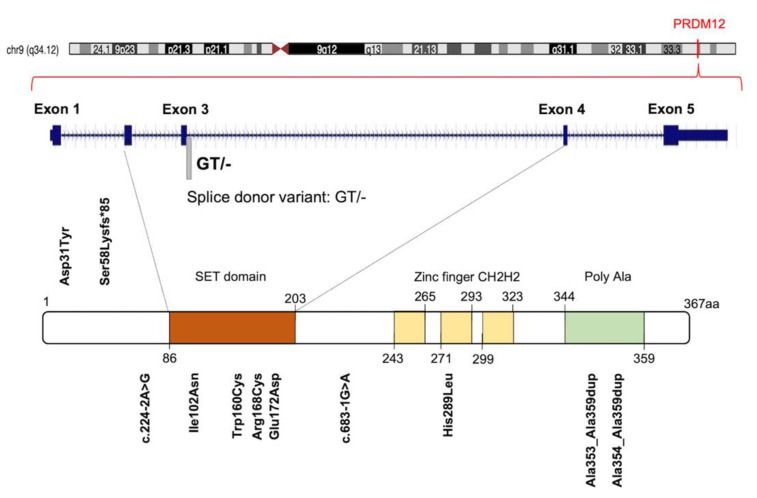
Figure 1
Figure 1
Graphic illustration of human PRDM12 gene, protein and distribution of known congenital insensitivity to pain (CIP)-causing mutations. Figure shows a schematic representation of PRDM12 architecture: Su(var)3-9, Enhancer-of-zeste and Trithorax (SET) domain, three ‘classical’ zinc fingers (ZnF_C2H2), and a Poly Ala region. Amino acid numbering is reported. See text for details.
Figure 2
Figure 2
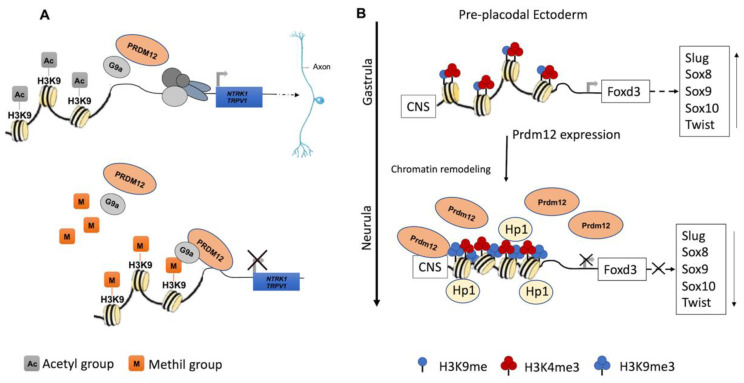
Recognized PRDM12 functions in neurogenesis. (A) PRDM12 lacks an intrinsic HKMTase activity, and it recruits, through its second zinc finger domain, the H3K9 methyltransferase G9a to dimethylate histone H3 at lysine 9 (H3K9me2), a repressive transcriptional mark. Particularly, PRDM12 regulates a nociceptor-specific transcriptional program, such as NTRK1/TRPV1. (B) In the pre-placodal ectoderm, PRDM12 is expressed and specifically stimulates the trimethylation of histone H3 at lysine 9 (H3K9me3) on the Foxd3 promoter to bind a conserved noncoding sequence (CNS). Additionally, Prdm12 inhibited the expression of different neural crest markers (Slug, Sox8, -9, -10 and Twist). A chromatin remodeling factor, HP1, recognizes the trimethylation of H3K9me3 and recruits other factors to convert euchromatin to heterochromatin.
Figure 3
Figure 3
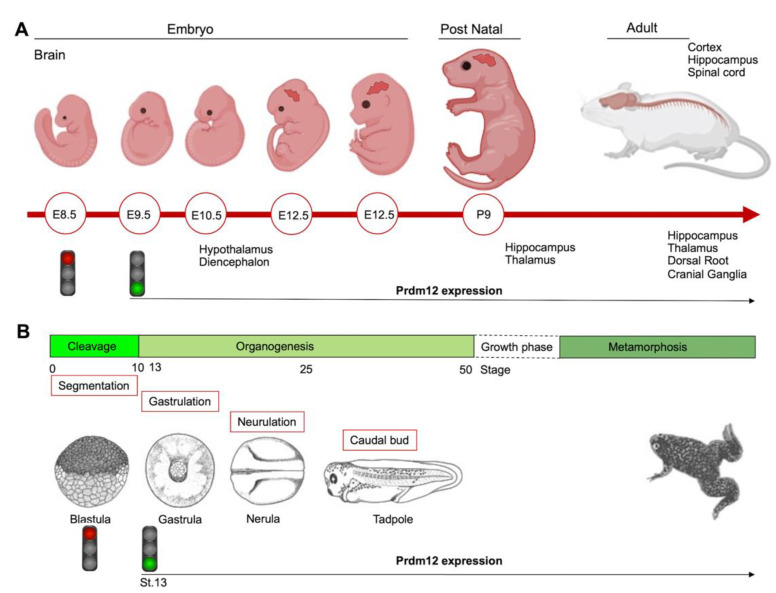
Schematics showing the Prdm12 expression data collected throughout mouse brain development and in different embryonal stages of Xenopus. (A) Prdm12 was expressed from early neurogenesis (E9.5) in the developing spinal cord. Additionally, Prdm12 can be detected weakly in the caudal forebrain and midbrain where it increases at E10.5 in precise neuronal progenitor areas. (B) prdm12 expression was revealed during the early neurula stage of Xenopus embryos, specifically in the lateral pre-placodal ectoderm after the late gastrula stage (St.13).
Figure 4
Figure 4
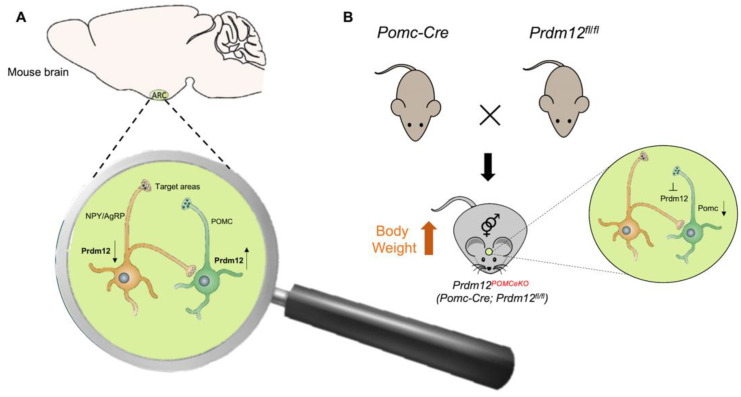
Possible mechanism of PRDM12 in POMC neurons. (A) PRDM12 expression level in POMC and NPY/AgRP neurons in the arcuate nucleus of the hypothalamus (ARH) in mouse brain. (B) To study the role of PRDM12 specifically in postmitotic POMC neurons, Pomc-Cre mice were bred with Prdm12fl/fl mice to generate Pomc-Cre; in Prdm12fl/fl mice Prdm12 was selectively deleted in embryonic POMC neurons (designated as Prdm12POMCeKO mice). The expression of Npy and Agrp remained unaffected. Prdm12POMCeKO mice lacking Prdm12 selectively from POMC neurons showed a considerable reduction in Pomc mRNA levels that led to severe obesity.

References

    1. Casamassimi A., Rienzo M., Di Zazzo E., Sorrentino A., Fiore D., Proto M.C., Moncharmont B., Gazzerro P., Bifulco M., Abbondanza C. Multifaceted Role of PRDM Proteins in Human Cancer. Int. J. Mol. Sci. 2020;21:2648. doi: 10.3390/ijms21072648. - DOI - PMC - PubMed
    1. Di Zazzo E., De Rosa C., Abbondanza C., Moncharmont B. PRDM Proteins: Molecular Mechanisms in Signal Transduction and Transcriptional Regulation. Biology. 2013;2:107–141. doi: 10.3390/biology2010107. - DOI - PMC - PubMed
    1. Hayashi K., Yoshida K., Matsui Y. A histone H3 methyltransferase controls epigenetic events required for meiotic prophase. Nature. 2005;438:374–378. doi: 10.1038/nature04112. - DOI - PubMed
    1. Eram M.S., Bustos S.P., Fernandes E.L., Siarheyeva A., Senisterra G., Hajian T., Chau I., Duan S., Wu H., Dombrovski L., et al. Trimethylation of Histone H3 Lysine 36 by Human Methyltransferase PRDM9 Protein. J. Biol. Chem. 2014;289:12177–12188. doi: 10.1074/jbc.M113.523183. - DOI - PMC - PubMed
    1. Pinheiro I., Margueron R., Shukeir N., Eisold M., Fritzsch C., Richter F.M., Mittler G., Genoud C., Goyama S., Kurokawa M., et al. Prdm3 and Prdm16 are H3K9me1 Methyltransferases Required for Mammalian Heterochromatin Integrity. Cell. 2012;150:948–960. doi: 10.1016/j.cell.2012.06.048. - DOI - PubMed