Review
. 2021 Nov 6;22(21):12029.
doi: 10.3390/ijms222112029.

Effects of Arachidonic Acid Metabolites on Cardiovascular Health and Disease

Affiliations
Review

Effects of Arachidonic Acid Metabolites on Cardiovascular Health and Disease

Yan Zhou et al. Int J Mol Sci. .

Abstract

Arachidonic acid (AA) is an essential fatty acid that is released by phospholipids in cell membranes and metabolized by cyclooxygenase (COX), cytochrome P450 (CYP) enzymes, and lipid oxygenase (LOX) pathways to regulate complex cardiovascular function under physiological and pathological conditions. Various AA metabolites include prostaglandins, prostacyclin, thromboxanes, hydroxyeicosatetraenoic acids, leukotrienes, lipoxins, and epoxyeicosatrienoic acids. The AA metabolites play important and differential roles in the modulation of vascular tone, and cardiovascular complications including atherosclerosis, hypertension, and myocardial infarction upon actions to different receptors and vascular beds. This article reviews the roles of AA metabolism in cardiovascular health and disease as well as their potential therapeutic implication.

Keywords: arachidonic acid; cardiovascular disease; prostaglandin; vascular tone.


Conflict of interest statement

The authors declare no conflict of interest.

Figures
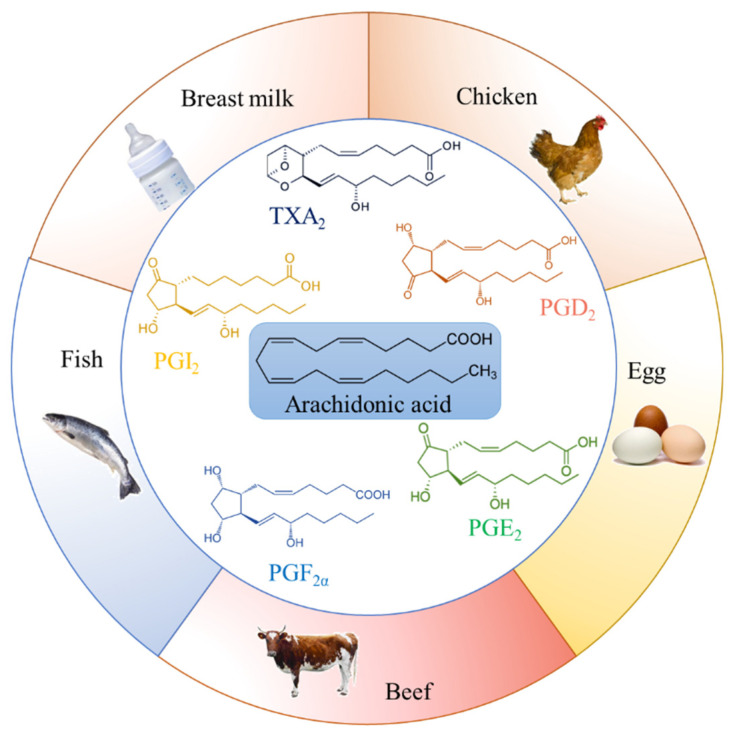
Figure 1
Figure 1
Food items rich in arachidonic acid. Chicken and chicken-mixed dishes, eggs, beef and beef products, pork and pork products, invertebrates and fish, breast milk and infant formula milk powder provide the most arachidonic acid intake to humans. Prostaglandin (PG)D2, PGE2, PGF, prostacyclin (PGI2), and thromboxanes (TX)A2 are major arachidonic acid metabolites. These polyunsaturated fatty acids play an important role in their growth and reproduction.
Figure 2
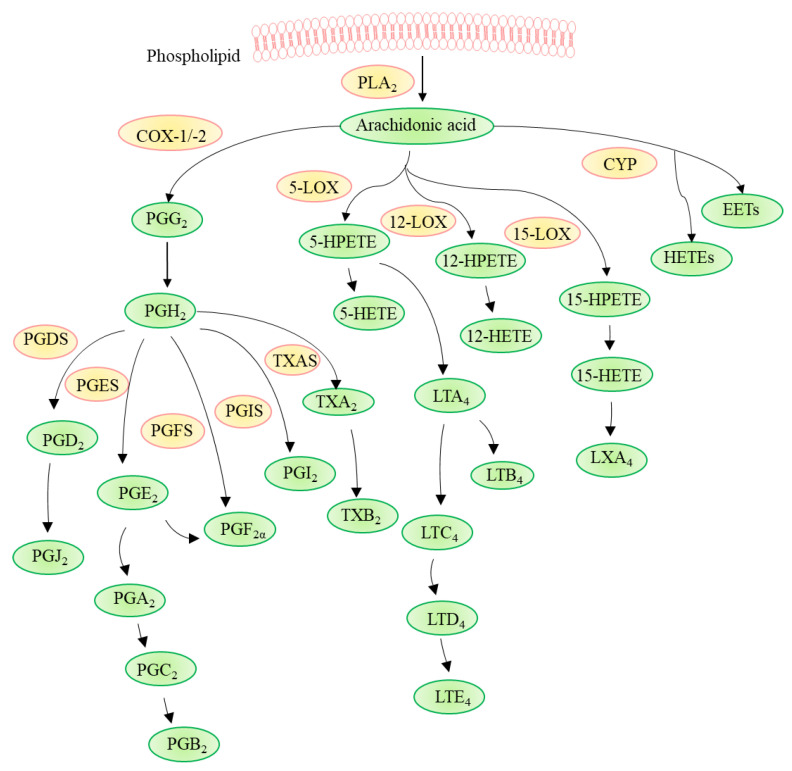
Figure 2
Arachidonic acid metabolism. Arachidonic acid is released from phospholipid by phospholipase A2 (PLA2) and, in turn, is metabolized through three different pathways involving cyclooxygenase (COX), cytochrome P450 (CYP) enzymes, or lipoxygenase (LOX). COX-1 and COX-2 convert arachidonic acid to prostaglandin (PG)G2 and PGH2, which are further metabolized to various prostaglandins (PGs) such as PGD2, PGE2, PGF, prostacyclin (PGI2), and thromboxanes (TX)A2 by corresponding synthases, i.e., PGD2 synthase (PGDS), PGE2 synthase (PGES), PGF synthase (PGFS), PGI2 synthase (PGIS), and TXA2 synthase (TXAS). LOXs catalyze the dioxygenation of polyunsaturated fatty acids to their corresponding hydroperoxyeicosatetraenoic acids (HPETEs), which are subsequently converted to hydroxyeicosatetraenoic acids (HETEs), leukotrienes (LTs), and lipoxins (LXs). CYP generates HETEs and epoxyeicosatrienoic acids (EETs).
Figure 3
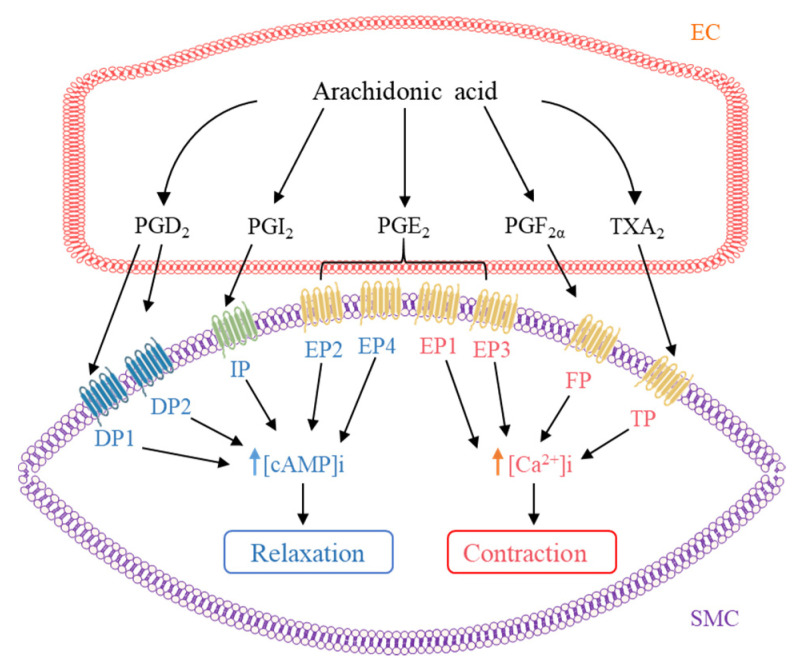
Figure 3
Regulation of vascular tone by arachidonic acid metabolites. Arachidonic acid metabolites produced in endothelial cell (EC) including prostaglandin (PG)D2, PGE2, PGF, prostacyclin (PGI2), and thromboxanes (TX)A2 target to their corresponding receptor in smooth muscle cell (SMC), increasing intracellular cAMP level [cAMP]i to induce relaxation or decreasing intracellular calcium level [Ca2+]i to induce contraction.
Figure 4
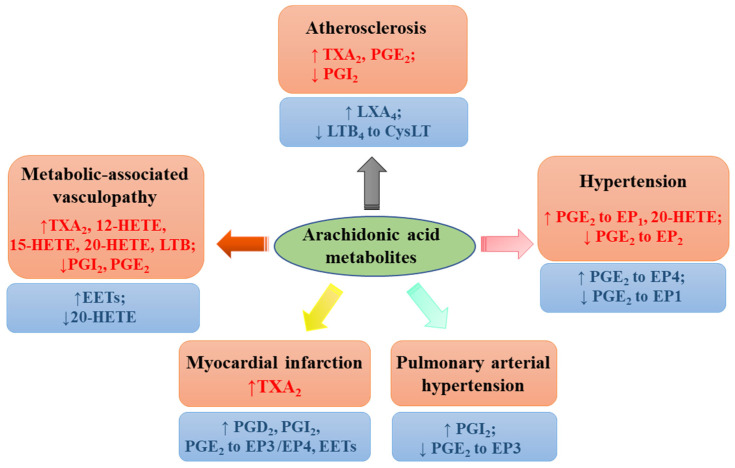
Figure 4
Effects of arachidonic acid metabolites on cardiovascular diseases. Various metabolites including prostaglandin (PG)D2 and PGE2 (to EP1, EP2, EP3 or EP4 receptor), prostacyclin (PGI2), thromboxane (TX)A2, leukotrienes B4 (LTB4) (to CysLT receptors), lipoxin A4 (LXA4), hydroxyeicosatetraenoic acids (HETEs), and epoxyeicosatrienoic acids (EETs) exert vasoprotective (labeled with blue color) and deteriorative effects (labeled with red color).

References

    1. Picard F., Steg P.G. Cardiovascular Disease Risk Reduction in Mild-Moderate Hypertriglyceridemia: Integrating Prescription of Omega-3 with Standard Treatment. Curr. Atheroscler. Rep. 2021;23:1–10. doi: 10.1007/s11883-021-00919-2. - DOI - PubMed
    1. Abdelhamid A.S., Martin N., Bridges C., Brainard J.S., Wang X., Brown T.J., Hanson S., Jimoh O.F., Ajabnoor S.M., Deane K.H.O., et al. Polyunsaturated fatty acids for the primary and secondary prevention of cardiovascular disease. Cochrane Database Syst. Rev. 2018;11:CD012345. doi: 10.1002/14651858.cd012345.pub3. - DOI - PMC - PubMed
    1. Yuan S., Back M., Bruzelius M., Mason A.M., Burgess S., Larsson S. Plasma Phospholipid Fatty Acids, FADS1 and Risk of 15 Cardiovascular Diseases: A Mendelian Randomisation Study. Nutrients. 2019;11:3001. doi: 10.3390/nu11123001. - DOI - PMC - PubMed
    1. Yuan T.H., Si S.C., Li Y.X., Li W.C., Chen X.L., Liu C.C., Li J.Q., Wang B.J., Hou L., Liu Y.X., et al. Roles for circulating polyunsaturated fatty acids in ischemic stroke and modifiable factors: A Mendelian randomization study. Nutr. J. 2020;19:1–11. doi: 10.1186/s12937-020-00582-4. - DOI - PMC - PubMed
    1. Hikita H., Shigeta T., Kimura S., Takahashi A., Isobe M. Coronary Artery Disease Severity and Cardiovascular Biomarkers in Patients with Peripheral Artery Disease. Int. J. Angiol. 2015;24:278–282. doi: 10.1055/s-0035-1555133. - DOI - PMC - PubMed

LinkOut - more resources