


Adaptation to Disaster Risk-An Overview
- PMID: 34769705
- PMCID: PMC8582783
- DOI: 10.3390/ijerph182111187
Adaptation to Disaster Risk-An Overview
Abstract
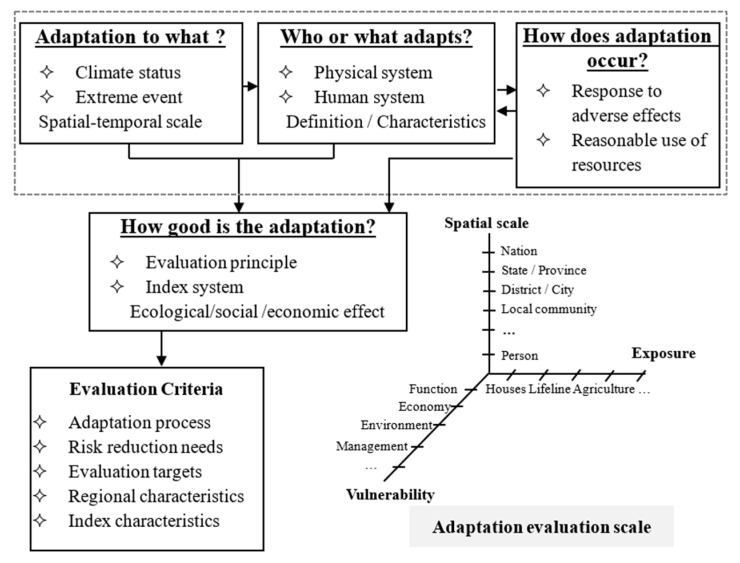
The role of natural disaster adaptation is increasingly being considered in academic research. The Paris Agreement and Sustainable Development Goal 13 require measuring the progress made on this adaptation. This review summarizes the development stages of adaptation, the multiple attributes and analysis of adaptation definitions, the models and methods for adaptation analysis, and the research progress of natural disaster adaptation. Adaptation research methods are generally classified into two types: case analysis and mathematical models. The current adaptive research in the field of natural disasters focuses primarily on the response of the social economy, especially the adaptive decision making and risk perception at farm-level scales (farmer households). The evaluation cases of adaptation in the field of disasters exist mostly as a part of vulnerability evaluation. Adaptation and adaptive capacity should focus on four core issues: adaptation to what; who or what adapts; how does adaptation occur; what is adaptation; and how good is the adaptation. The main purpose of the "spatial scale-exposure-vulnerability" three-dimensional scales of adaptation assessment is to explore the differences in index system under different scenarios, the spatial pattern of adaptations, and the geographical explanation of its formation mechanism. The results of this study can help and guide future research on integrating climate change and disaster adaptations especially in regional sustainable development and risk reduction strategies.
Keywords: adaptation; climate change; digital disaster reduction; disaster risk; method.
Conflict of interest statement
The authors declare no conflict of interest.
Figures
References
-
- Escaleras M., Anbarci N., Register C.A. Public sector corruption and major earthquakes: A potentially deadly interaction. Public Choice. 2007;132:209–230. doi: 10.1007/s11127-007-9148-y. - DOI
-
- Shi P.J., Li N., Ye Q., Dong W.J., Han G.Y., Fang W.H. Research on integrated disaster risk governance in the context of global environmental change. Int. J. Disaster Risk Sci. 2010;1:17–23.
-
- Zhou H.J., Wang X., Wang J.A. A way to sustainability: Perspective of resilience and adaptation to disaster. Sustainability. 2016;8:737. doi: 10.3390/su8080737. - DOI
-
- Guo H.D. Big Earth data: A new frontier in Earth and information sciences. Big Earth Data. 2017;1:4–20. doi: 10.1080/20964471.2017.1403062. - DOI
Publication types
MeSH terms
LinkOut - more resources
Full Text Sources
Medical
