


Stereopsis in Sports: Visual Skills and Visuomotor Integration Models in Professional and Non-Professional Athletes
- PMID: 34769799
- PMCID: PMC8583573
- DOI: 10.3390/ijerph182111281
Stereopsis in Sports: Visual Skills and Visuomotor Integration Models in Professional and Non-Professional Athletes
Abstract
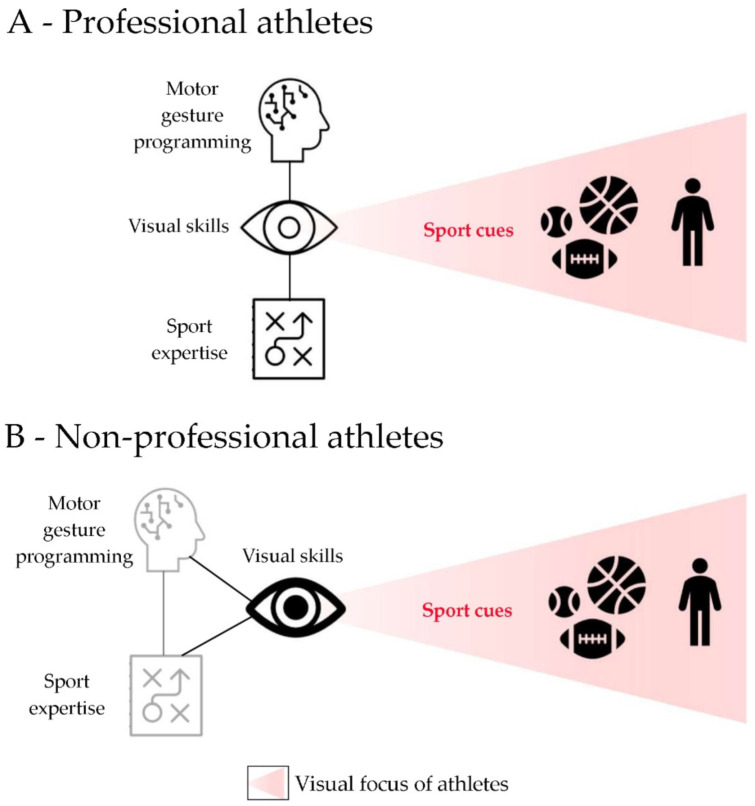
Visual skills in sport are considered relevant variables of athletic performance. However, data on the specific contribution of stereopsis-as the ability to perceive depth-in sport performance are still scarce and scattered in the literature. The aim of this review is therefore to take stock of the effects of stereopsis on the athletic performance, also looking at the training tools to improve visual abilities and potential differences in the visuomotor integration processes of professional and non-professional athletes. Dynamic stereopsis is mainly involved in catching or interceptive actions of ball sports, whereas strategic sports use different visual skills (peripheral and spatial vision) due to the sport-specific requirements. As expected, professional athletes show better visual skills as compared to non-professionals. However, both non-professional and professional athletes should train their visual skills by using sensory stations and light boards systems. Non-professional athletes use the visual inputs as the main method for programming motor gestures. In contrast, professional athletes integrate visual information with sport expertise, thus, they encode the match (or the athletic performance) through a more complex visuomotor integration system. Although studies on visual skills and stereopsis in sports still appear to be in their early stages, they show a large potential for both scientific knowledge and technical development.
Keywords: athletic performance; depth perception; sport expertise; sport vision.
Conflict of interest statement
The authors declare no conflict of interest.
Figures
References
-
- Stine C.D., Arterburn M.R., Stern N.S. Vision and sports: A review of the literature. J. Am. Optom. Assoc. 1982;53:627–633. - PubMed
-
- Hitzeman S., Beckerman S. What the literature says about sports vision. Optom. Clin. Off. Publ. Prentice Soc. 1993;3:145–169. - PubMed
-
- Newell A. Unified Theories of Cognition. Harvard University Press; Cambridge, MA, USA: 1994.
Publication types
MeSH terms
LinkOut - more resources
Full Text Sources
Research Materials
