


Resistance Training with Blood Flow Restriction Compared to Traditional Resistance Training on Strength and Muscle Mass in Non-Active Older Adults: A Systematic Review and Meta-Analysis
- PMID: 34769957
- PMCID: PMC8583588
- DOI: 10.3390/ijerph182111441
Resistance Training with Blood Flow Restriction Compared to Traditional Resistance Training on Strength and Muscle Mass in Non-Active Older Adults: A Systematic Review and Meta-Analysis
Abstract
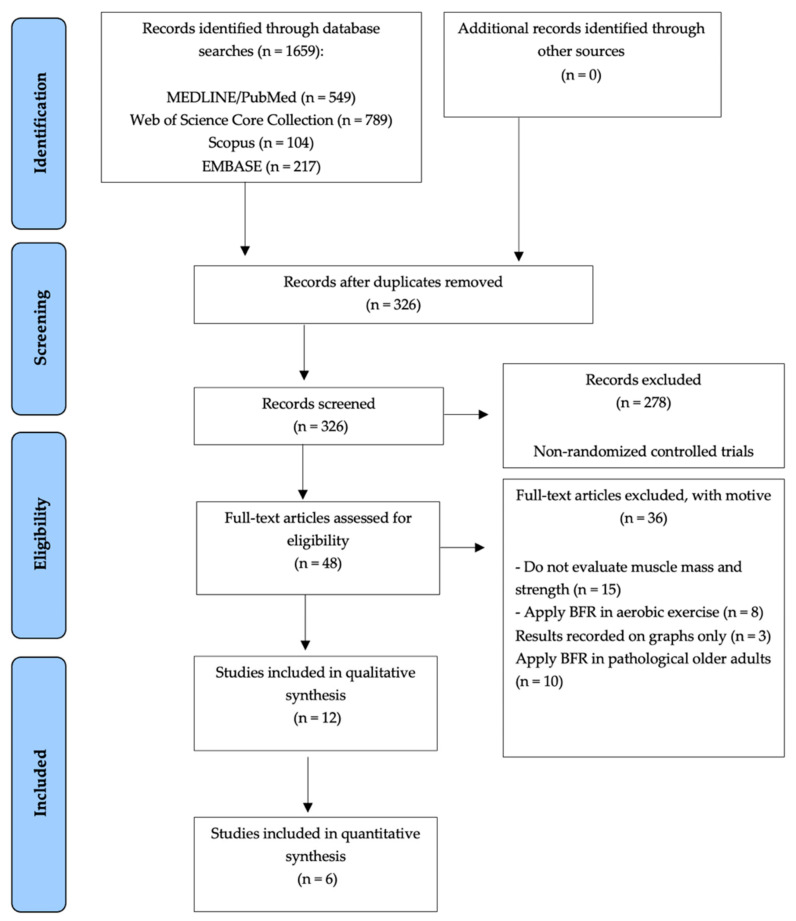
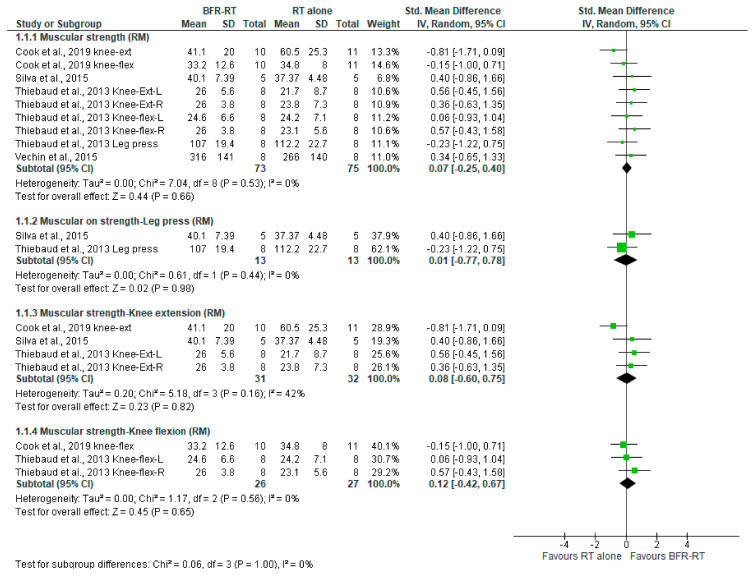
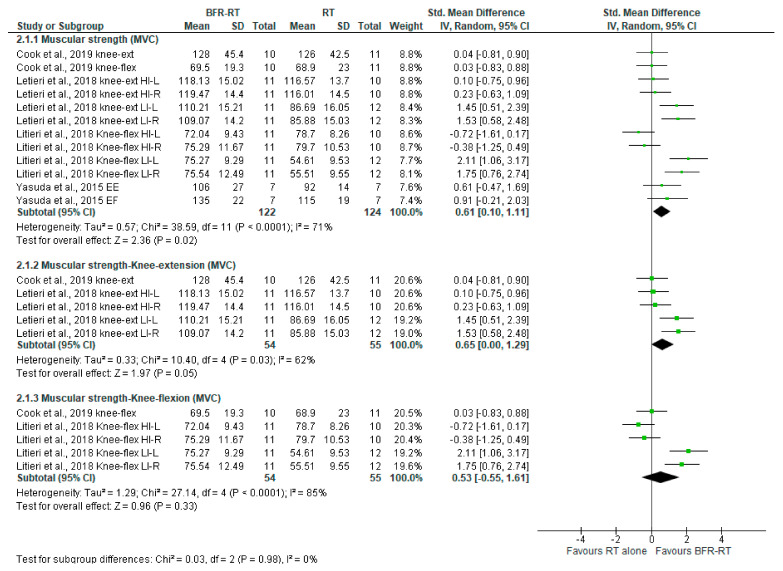
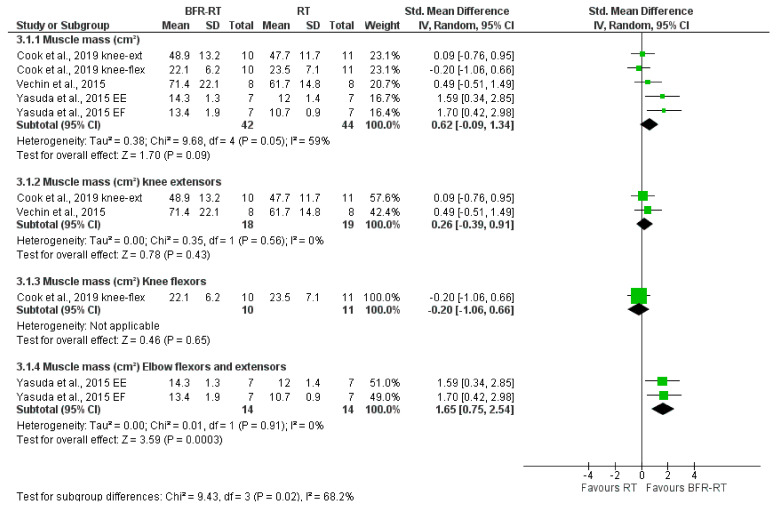
Low-intensity training with blood flow restriction (LI-BFR) has been suggested as an alternative to high-intensity resistance training for the improvement of strength and muscle mass, becoming advisable for individuals who cannot assume such a load. The systematic review aimed to determine the effectiveness of the LI-BFR compared to dynamic high-intensity resistance training on strength and muscle mass in non-active older adults. A systematic review was conducted according to the Cochrane Handbook and reportedly followed the PRISMA statement. MEDLINE, EMBASE, Web of Science Core Collection, and Scopus databases were searched between September and October 2020. Two reviewers independently selected the studies, extracted data, assessed the risk of bias and the quality of evidence using the GRADE approach. Twelve studies were included in the qualitative synthesis. Meta-analysis pointed out significant differences in maximal voluntary contraction (MVC): SMD 0.61, 95% CI [0.10, 1.11], p = 0.02, I2 71% p < 0.0001; but not in the repetition maximum (RM): SMD 0.07, 95% CI [-0.25, 0.40], p = 0.66, I2 0% p < 0.53; neither in the muscle mass: SMD 0.62, 95% CI [-0.09, 1.34], p = 0.09, I2 59% p = 0.05. Despite important limitations such as scarce literature regarding LI-BFR in older adults, the small sample size in most studies, the still differences in methodology and poor quality in many of them, this systematic review and meta-analysis revealed a positive benefit in non-active older adults. LI- BFR may induce increased muscular strength and muscle mass, at least at a similar extent to that in the traditional high-intensity resistance training.
Keywords: hypertrophy; katsu; low-intensity training; occlusive exercise; sarcopenia.
Conflict of interest statement
The authors declare no conflict of interest.
Figures
References
-
- World Health Organization Ageing and Health. World Health Organization. 2018. [(accessed on 25 June 2021)]. Available online: https://www.who.int/news-room/fact-sheets/detail/ageing-and-health.+Gene...
-
- Izquierdo M., Merchant R.A., Morley J.E., Anker S.D., Aprahamian I., Arai H., Aubertin-Leheudre M., Bernabei R., Cadore E.L., Cesari M., et al. International Exercise Recommendations in Older Adults (ICFSR): Expert Consensus Guidelines. J. Nutr. Health Aging. 2021;25:824–853. doi: 10.1007/s12603-021-1665-8. - DOI - PubMed
Publication types
MeSH terms
LinkOut - more resources
Full Text Sources
