Review
. 2021 Nov 7;13(21):5570.
doi: 10.3390/cancers13215570.

Radioimmunotherapy in Oncology: Overview of the Last Decade Clinical Trials

Affiliations
Review

Radioimmunotherapy in Oncology: Overview of the Last Decade Clinical Trials

Aurélie Rondon et al. Cancers (Basel). .

Abstract

The specific irradiation of tumors with selective radiolabeled antibodies constitutes an attractive therapeutic approach. Consequent preclinical research has been conducted by both biologists to identify pertinent targets and to select corresponding antibodies (mAb) and by radiochemists to radiolabel mAbs. These numerous preclinical investigations have ascertained the therapeutic interest of radioimmunotherapy (RIT) protocols in mice models. Here, we summarize the clinical studies that have been performed the last decade, including clinical trials (phases I, II, and III), prospective and retrospective studies, and cases series. We thereby reported 92 clinical studies. Among them, 62 concern the treatment of hematological malignancies, and 30 concern solid tumors. For hematologic diseases, the analysis was complex due to the high discrepancy of therapeutic strategies (first-line therapy, consolidation, stem cell transplantation conditioning) as well as the high variety of malignancies that were treated. The clinical studies from the last decade failed to expand anti-CD20 RIT indications but confirmed that RIT using radiolabeled anti-CD20 remains a pertinent choice for patients with relapse follicular lymphomas. For solid tumors, the positive benefit of RIT is more mitigated, apart for few malignancies that can be treated locally. Clinical trials also demonstrated the potential of some antibody formats, such as F(ab')2, which has already been approved by the China State FDA under the trend name Licartin®. Despite disparate results, mAb fragments are an interesting prospect for the improvement of RIT efficiency as well as for pretargeted strategies that delay the injection of radioactive treatments from the mAb ones.

Keywords: PRIT; RIT; antibody fragments; hematologic cancers; radionuclides; solid cancers.


Conflict of interest statement

The authors declare no conflict of interest.

Figures
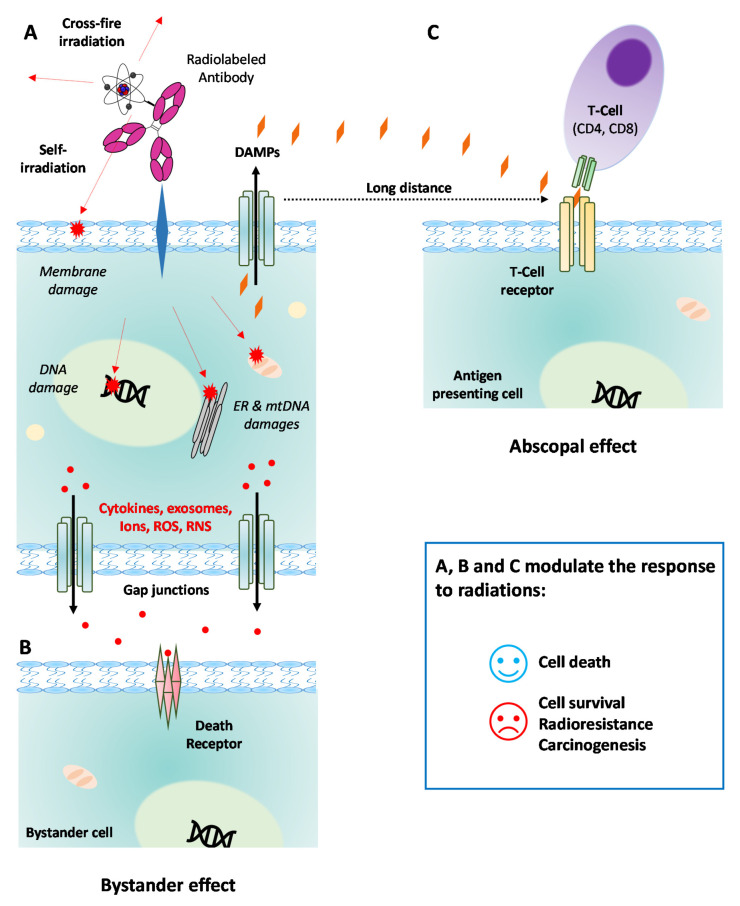
Figure 1
Figure 1
Cell mechanisms underlying radioimmunotherapy (RIT). (A) Targeted effects on tumor cell after binding by a radiolabeled mAb to its cognate membrane antigen. RIT induces direct damages to DNA, mtDNA, membranes, and other cell components (e.g., ER). Surrounding cells are also directly irradiated through the crossfire effect. Damages to the cell lead to the secretion of cytokines, ions, ROS, RNS, or exosomes that are released in the extracellular microenvironment. (B) Off-target bystander effect induced in other cancer cells (close or not). Cytokines and other death effectors released in the microenvironment bind to the cell death receptors. (C) Off-target abscopal effect involving the immune system response far away from the irradiated cells. DAMPs excreted by the irradiated cell can bind the T-cell receptor of an antigen-presenting cell, resulting in the activation of the immune system through the binding of the CD4 or CD8 T lymphocytes. NB: Similar mechanisms occur if RIT is performed with a radiolabeled mAb that can be internalized into the cell. DAMPs: damage-associated molecular patterns; ER: endoplasmic reticulum; mAb: monoclonal antibody; mtDNA: mitochondrial DNA; RNS: reactive nitrogen species; ROS: reactive oxygen species.
Figure 2
Figure 2
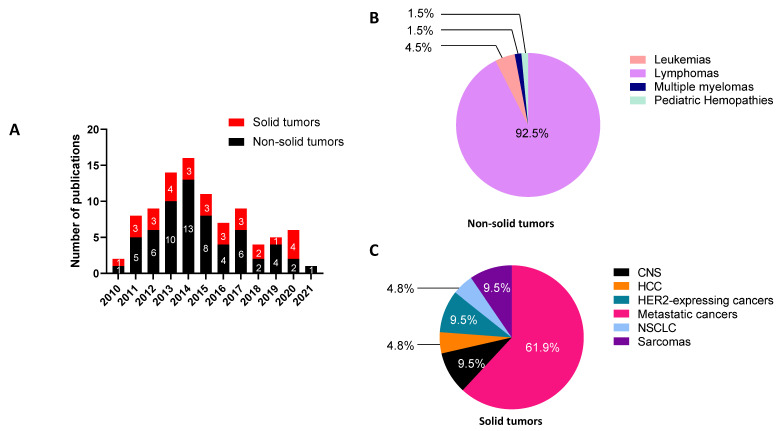
Publications about RIT clinical trials from 2010 to 2021. (A) Number of publications per year reporting clinical trials with RIT protocols for solid and non-solid tumors. (B) Repartition of clinical trials for non-solid cancer for the entire period of 2010–2021. Leukemias encompass acute myeloid leukemias and acute lymphoblastic leukemias; lymphomas encompass follicular lymphomas, mantle cell lymphomas, Burkitt lymphomas, diffuse large B-cell lymphomas, marginal zone lymphomas, and Hodgkin lymphomas. (C) Repartition of clinical trials for solid cancers for the entire 2010–2021 period. HER2-expressing cancers encompass breast cancer, peritoneal carcinomatosis, and gastric cancer; metastatic cancers were from colorectal cancers, prostate cancers, melanoma, pancreatic carcinomas, and renal cell carcinomas. CNS: central nervous system tumors (medulloblastomas and neuroblastomas); HCC: hepatocellular carcinoma; NSCLC: non-small cell-lung cancer.
Figure 3
Figure 3
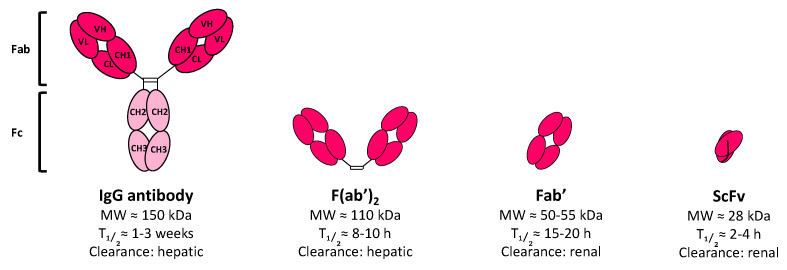
IgG fragment formats assessed in clinic for RIT. The molecular weight (MW), blood half-life (T12), and main clearance route are given for each format.
Figure 4
Figure 4
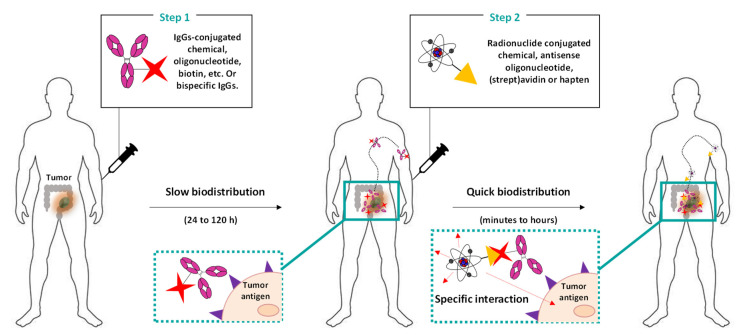
Pretargeted radioimmunotherapy (PRIT): general strategy. Antibodies or fragments are first functionalized with biotin, avidin, and oligonucleotides (e.g., phosphorodiamidate morpholinos, peptide nucleic acids) and are then chemically engineered to be bispecific. Then, the conjugated mAbs are administered (in most cases intravenously). After a delay of 24–72 h (to allow for the sufficient clearance of unbounded conjugated mAbs), radionuclides functionalized with a specific counterpart that is only able to recognize the conjugates attached to the mAbs (such as biotin, (strept)avidin, countersense oligonucleotide, chemical of haptens) are administered (intravenously, intraperitoneally, or locally). Due to the small size of the radioligand, the biodistribution and clearance are very quick (few hours), thereby limiting the off-target irradiation of healthy tissues.

References

    1. Bosch F., Rosich L. The Contributions of Paul Ehrlich to Pharmacology: A Tribute on the Occasion of the Centenary of His Nobel Prize. Pharmacology. 2008;82:171–179. doi: 10.1159/000149583. - DOI - PMC - PubMed
    1. Kohler G., Milstein C. Continuous cultures of fused cells secreting antibody of predefined specificity. Nature. 1975;256:495–497. doi: 10.1038/256495a0. - DOI - PubMed
    1. Navarro-Teulon I., Lozza C., Pelegrin A., Vives E., Pouget J.P. General overview of radioimmunotherapy of solid tumors. Immunotherapy. 2013;5:467–487. doi: 10.2217/imt.13.34. - DOI - PubMed
    1. Larson S.M., Carrasquillo J.A., Cheung N.K., Press O.W. Radioimmunotherapy of human tumours. Nat. Rev. Cancer. 2015;15:347–360. doi: 10.1038/nrc3925. - DOI - PMC - PubMed
    1. Herrero Alvarez N., Bauer D., Hernandez-Gil J., Lewis J.S. Recent Advances in Radiometals for Combined Imaging and Therapy in Cancer. ChemMedChem. 2021;16:2909–2941. doi: 10.1002/cmdc.202100135. - DOI - PubMed

LinkOut - more resources