


High-flow nasal cannula oxygen therapy in hypoxic patients with COVID-19 pneumonia: A retrospective cohort study confirming the utility of respiratory rate index
- PMID: 34772644
- PMCID: PMC8556581
- DOI: 10.1016/j.resinv.2021.10.005
High-flow nasal cannula oxygen therapy in hypoxic patients with COVID-19 pneumonia: A retrospective cohort study confirming the utility of respiratory rate index
Abstract
Background: Although high-flow nasal cannula (HFNC) oxygen treatment has been frequently used in coronavirus disease 2019 (COVID-19) patients with acute respiratory failure after the 3rd wave of the pandemic in Japan, the usefulness of the indicators of ventilator avoidance, including respiratory rate-oxygenation (ROX) index and other parameters, namely oxygen saturation/fraction of inspired oxygen ratio and respiratory rate (RR), remain unclear.
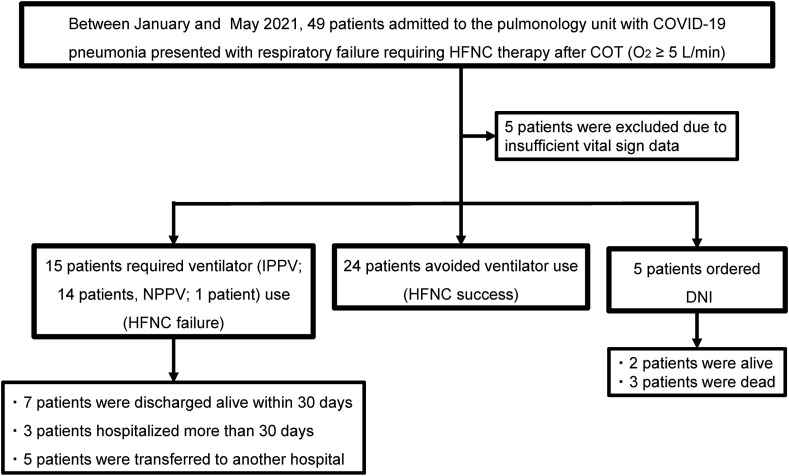
Methods: Between January and May 2021, our institution treated 189 COVID-19 patients with respiratory failure requiring oxygen, among which 39 patients requiring HFNC treatment were retrospectively analyzed. The group that switched from HFNC treatment to conventional oxygen therapy (COT) was defined as the HFNC success group, and the group that switched from HFNC treatment to a ventilator was defined as the HFNC failure group. We followed the patients' oxygenation parameters for a maximum of 30 days.
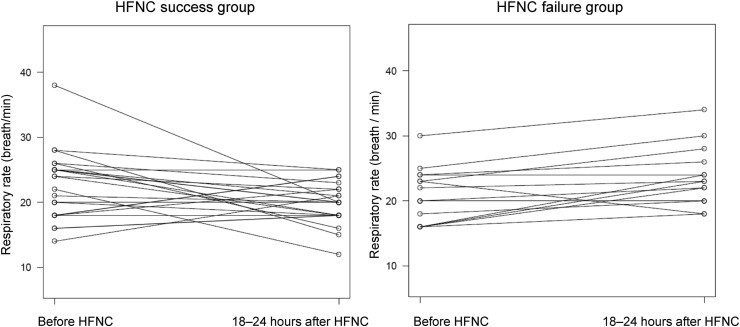
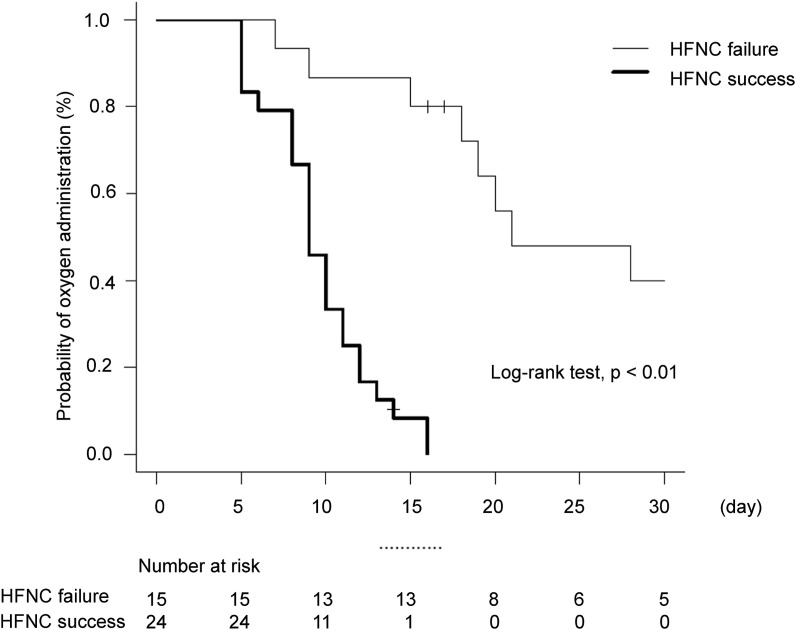
Results: HFNC treatment success occurred in 24 of 39 patients (62%) treated with HFNC therapy. Compared with the HFNC failure group, the HFNC success group had a significantly higher degree of RR improvement in the univariate analysis. Logistic regression analysis of HFNC treatment success adjusting for age, respiratory improvement, and a ROX index ≥5.55 demonstrated that an improved RR was associated with HFNC treatment success. The total COT duration was significantly shorter in the HFNC success group than in the HFNC failure group.
Conclusions: HFNC treatment can be useful for ventilator avoidance and allow the quick withdrawal of oxygen administration. RR improvement may be a convenient, useful, and simple indicator of HFNC treatment success.
Keywords: COVID-19; High-flow nasal cannula; Oxygen therapy; Respiratory failure; Respiratory rate.
Copyright © 2021 The Japanese Respiratory Society. Published by Elsevier B.V. All rights reserved.
Conflict of interest statement
Conflict of Interest J.T. has received research funding from Teijin Pharma Ltd as part of a collaborative research project with Chiba University and Teijin Pharma Ltd. Other authors report no conflicts of interest.
Figures
References
-
- National Institutes of Health. COVID-19 Treatment Guidelines Oxygenation and ventilation. 2020. https://www.covid19treatmentguidelines.nih.gov/critical-care/oxygenation... - PubMed
-
- The Australian and New Zealand intensive care society (ANZICS) COVID-19 guidelines. 2020. https://www.anzics.com.au/wp-content/uploads/2020/03/ANZICS-COVID-19-Gui... Version 1.
-
- Japanese Ministry of Health, Labor and Welfare . 5th edition. 2021. Guide for medical treatment of novel coronavirus infections.https://www.mhlw.go.jp/content/000785013.pdf
MeSH terms
Substances
LinkOut - more resources
Full Text Sources
Medical
Miscellaneous
