What are the distinguishing features and size requirements of biomolecular condensates and their implications for RNA-containing condensates?
- PMID: 34772786
- PMCID: PMC8675286
- DOI: 10.1261/rna.079026.121
What are the distinguishing features and size requirements of biomolecular condensates and their implications for RNA-containing condensates?
Abstract
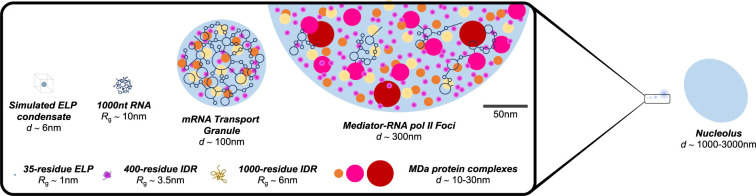
Exciting recent work has highlighted that numerous cellular compartments lack encapsulating lipid bilayers (often called "membraneless organelles"), and that their structure and function are central to the regulation of key biological processes, including transcription, RNA splicing, translation, and more. These structures have been described as "biomolecular condensates" to underscore that biomolecules can be significantly concentrated in them. Many condensates, including RNA granules and processing bodies, are enriched in proteins and nucleic acids. Biomolecular condensates exhibit a range of material states from liquid- to gel-like, with the physical process of liquid-liquid phase separation implicated in driving or contributing to their formation. To date, in vitro studies of phase separation have provided mechanistic insights into the formation and function of condensates. However, the link between the often micron-sized in vitro condensates with nanometer-sized cellular correlates has not been well established. Consequently, questions have arisen as to whether cellular structures below the optical resolution limit can be considered biomolecular condensates. Similarly, the distinction between condensates and discrete dynamic hub complexes is debated. Here we discuss the key features that define biomolecular condensates to help understand behaviors of structures containing and generating RNA.
Keywords: dynamic hub; phase separation; ribonucleoprotein particle; simulation.
© 2022 Forman-Kay et al.; Published by Cold Spring Harbor Laboratory Press for the RNA Society.
Figures
Similar articles
-
Using quantitative reconstitution to investigate multicomponent condensates.RNA. 2022 Jan;28(1):27-35. doi: 10.1261/rna.079008.121. Epub 2021 Nov 12. RNA. 2022. PMID: 34772789 Free PMC article. Review.
-
RNA in formation and regulation of transcriptional condensates.RNA. 2022 Jan;28(1):52-57. doi: 10.1261/rna.078997.121. Epub 2021 Nov 12. RNA. 2022. PMID: 34772787 Free PMC article. Review.
-
Weak multivalent biomolecular interactions: a strength versus numbers tug of war with implications for phase partitioning.RNA. 2022 Jan;28(1):48-51. doi: 10.1261/rna.079004.121. Epub 2021 Nov 12. RNA. 2022. PMID: 34772790 Free PMC article. Review.
-
RNA-driven phase transitions in biomolecular condensates.Mol Cell. 2024 Oct 3;84(19):3692-3705. doi: 10.1016/j.molcel.2024.09.005. Mol Cell. 2024. PMID: 39366355 Review.
-
Design considerations for analyzing protein translation regulation by condensates.RNA. 2022 Jan;28(1):88-96. doi: 10.1261/rna.079002.121. Epub 2021 Oct 20. RNA. 2022. PMID: 34670845 Free PMC article. Review.
Cited by
-
A biophysical basis for the spreading behavior and limited diffusion of Xist.Cell. 2025 Feb 20;188(4):978-997.e25. doi: 10.1016/j.cell.2024.12.004. Epub 2025 Jan 16. Cell. 2025. PMID: 39824183
-
Amphiphilic protein surfactants reduce the interfacial tension of biomolecular condensates.bioRxiv [Preprint]. 2025 Jun 21:2025.06.19.660548. doi: 10.1101/2025.06.19.660548. bioRxiv. 2025. PMID: 40666943 Free PMC article. Preprint.
-
Biomolecular condensates in kidney physiology and disease.Nat Rev Nephrol. 2023 Dec;19(12):756-770. doi: 10.1038/s41581-023-00767-0. Epub 2023 Sep 26. Nat Rev Nephrol. 2023. PMID: 37752323 Review.
-
Hydrodynamic Radii of Intrinsically Disordered Proteins: Fast Prediction by Minimum Dissipation Approximation and Experimental Validation.J Phys Chem Lett. 2024 May 16;15(19):5024-5033. doi: 10.1021/acs.jpclett.4c00312. Epub 2024 May 2. J Phys Chem Lett. 2024. PMID: 38696815 Free PMC article.
-
Purification of Low-Complexity Domain Proteins FUS, EWSR1, and Their Fusions.Curr Protoc. 2025 Apr;5(4):e70136. doi: 10.1002/cpz1.70136. Curr Protoc. 2025. PMID: 40285687 Free PMC article.
References
Publication types
MeSH terms
Substances
Grants and funding
LinkOut - more resources
Full Text Sources