


Current status of the assessment of sarcopenia, frailty, physical performance and functional status in chronic kidney disease patients
- PMID: 34772840
- PMCID: PMC8688315
- DOI: 10.1097/MNH.0000000000000763
Current status of the assessment of sarcopenia, frailty, physical performance and functional status in chronic kidney disease patients
Abstract
Purpose of review: Low physical function, frailty, and sarcopenia are common complications of chronic kidney disease (CKD). In this article, we review the epidemiology and pathogenesis of low physical function, as well as its associations with adverse outcomes in CKD patients. Additionally, we present various traditional and novel methods for assessment of physical function in CKD patients.
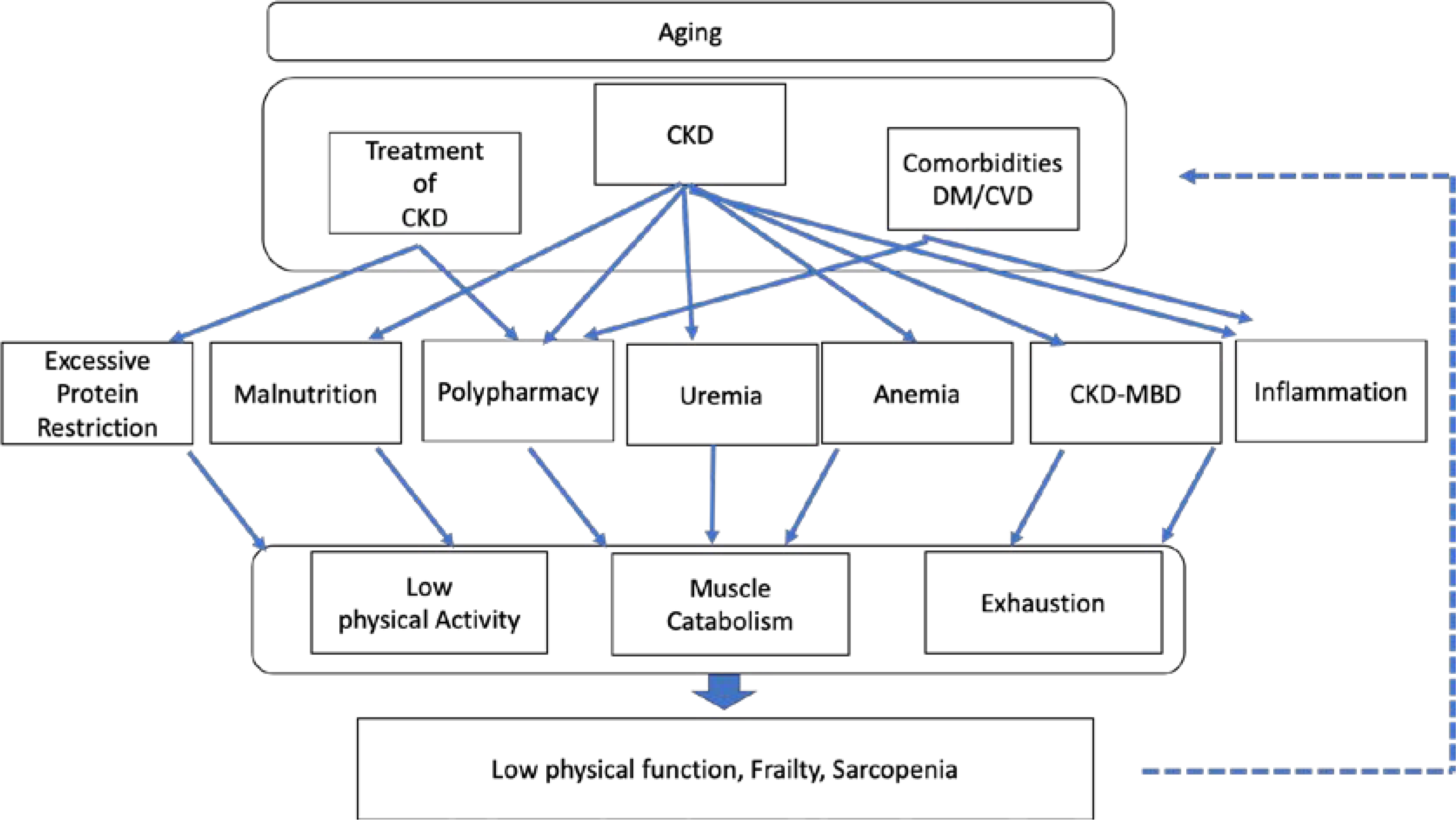
Recent findings: In nondialysis dependent (NDD) and dialysis-dependent CKD patients, the prevalence of low physical function, frailty, and sarcopenia are substantially higher than in the general population. The potential mechanisms of low physical function, frailty, and sarcopenia in CKD patients are due to various factors including underlying kidney disease, co-existing comorbidities, and certain therapeutic interventions utilized in CKD. Increasing evidence has also uncovered the ill effects of impaired physical function on clinical outcomes in CKD patients.
Summary: Routine assessment of physical function is an under-utilized yet important component in the management of CKD patients. Future studies are needed to determine how prescription of exercise and increased daily physical activity can be tailored to optimize the health and well-being of NDD and dialysis-dependent CKD patients in pursuit of successful aging.
Copyright © 2021 Wolters Kluwer Health, Inc. All rights reserved.
Conflict of interest statement
Conflicts of Interest
None of the authors have relevant disclosures to report.
Figures
References
-
- The Japanese Society for Dialysis Therapy. An overview of regular dialysis treatment in Japan. https://docs.jsdt.or.jp/overview/file/2019/pdf/03.pdf.
-
-
Matsunaga A Exercise Interventions in Dialysis Patients BT - Recent Advances of Sarcopenia and Frailty in CKD. In: Kato A, Kanda E, Kanno Y, eds. Singapore: Springer Singapore; 2020:85–110. doi: 10.1007/978-981-15-2365-6_6
** This article provides a review on physical function and exercise interventions in dialysis patients.
-
-
- Saitoh M, Matsunaga A, Yokoyama M, Fukuda M, Yoshida AMT. Effects of long-term hemodialysis therapy on physical function in patients with chronic renal failure [in Japanese]. J Jpn Soc Dial Ther. 2007;40(2):147–53.
