


CSNK2 in cancer: pathophysiology and translational applications
- PMID: 34773100
- PMCID: PMC8980014
- DOI: 10.1038/s41416-021-01616-2
CSNK2 in cancer: pathophysiology and translational applications
Abstract
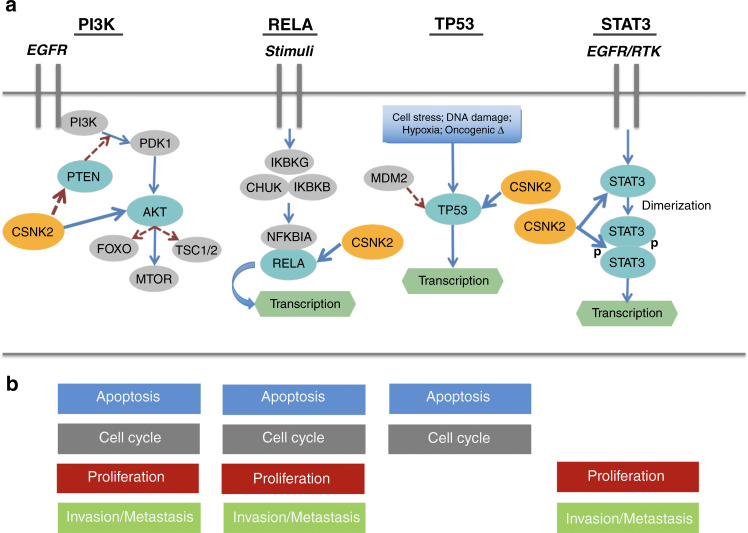
Protein kinase CSNK2 (CK2) is a pleiotropic serine/threonine kinase frequently dysregulated in solid and hematologic malignancies. To consolidate a wide range of biological and clinically oriented data from this unique kinase in cancer, this systematic review summarises existing knowledge from in vitro, in vivo and pre-clinical studies on CSNK2 across 24 different human cancer types. CSNK2 mRNA transcripts, protein levels and activity were found to be routinely upregulated in cancer, and commonly identified phosphotargets included AKT, STAT3, RELA, PTEN and TP53. Phenotypically, it frequently influenced evasion of apoptosis, enhancement of proliferation, cell invasion/metastasis and cell cycle control. Clinically, it held prognostic significance across 14 different cancers, and its inhibition in xenograft experiments resulted in a positive treatment response in 12. In conjunction with commentary on preliminary studies of CSNK2 inhibitors in humans, this review harmonises an extensive body of CSNK2 data in cancer and reinforces its emergence as an attractive target for cancer therapy. Continuing to investigate CSNK2 will be crucial to advancing our understanding of CSNK2 biology, and offers the promise of important new discoveries scientifically and clinically.
© 2021. The Author(s).
Conflict of interest statement
The authors declare no competing interests.
Figures
References
-
- Manning G, Whyte D, Martinez R, Hunter T, Sudarsanam S. The protein kinase complement of the human genome. Science. 2002;298:1912–1916. - PubMed
-
- Sharma K, D’Souza RCJ, Tyanova S, Schaab C, Wisniewski JR, Cox J, et al. Ultradeep human phosphoproteome reveals a distinct regulatory nature. Cell Rep. 2014;8:1583–1594. - PubMed
-
- Ahn NG, Resing KA. Toward the phosphoproteome. Nat Biotechnol. 2001;19:317–318. - PubMed
-
- Wilhelm M, Schlegl J, Hahne H, Gholami AM, Lieberenz M, Savitscki MM, et al. Mass-spectrometry-based draft of the human proteoma. Nature. 2014;509:582–587. - PubMed
Publication types
MeSH terms
Substances
LinkOut - more resources
Full Text Sources
Other Literature Sources
Medical
Research Materials
Miscellaneous
