Clinical Trial
. 2022 Feb;165(2):250-259.
doi: 10.1111/imm.13433. Epub 2021 Dec 6.

Whole blood-based measurement of SARS-CoV-2-specific T cells reveals asymptomatic infection and vaccine immunogenicity in healthy subjects and patients with solid-organ cancers

Affiliations
Clinical Trial

Whole blood-based measurement of SARS-CoV-2-specific T cells reveals asymptomatic infection and vaccine immunogenicity in healthy subjects and patients with solid-organ cancers

Martin J Scurr et al. Immunology. 2022 Feb.

Abstract

Accurate assessment of SARS-CoV-2 immunity is critical in evaluating vaccine efficacy and devising public health policies. Whilst the exact nature of effective immunity remains incompletely defined, SARS-CoV-2-specific T-cell responses are a critical feature that will likely form a key correlate of protection against COVID-19. Here, we developed and optimized a high-throughput whole blood-based assay to determine the T-cell response associated with prior SARS-CoV-2 infection and/or vaccination amongst 231 healthy donors and 68 cancer patients. Following overnight in vitro stimulation with SARS-CoV-2-specific peptides, blood plasma samples were analysed for TH 1-type cytokines. Highly significant differential IFN-γ+ /IL-2+ SARS-CoV-2-specific T-cell responses were seen amongst previously infected COVID-19-positive healthy donors in comparison with unknown / naïve individuals (p < 0·0001). IFN-γ production was more effective at identifying asymptomatic donors, demonstrating higher sensitivity (96·0% vs. 83·3%) but lower specificity (84·4% vs. 92·5%) than measurement of IL-2. A single COVID-19 vaccine dose induced IFN-γ and/or IL-2 SARS-CoV-2-specific T-cell responses in 116 of 128 (90·6%) healthy donors, reducing significantly to 27 of 56 (48·2%) when measured in cancer patients (p < 0·0001). A second dose was sufficient to boost T-cell responses in the majority (90·6%) of cancer patients, albeit IFN-γ+ responses were still significantly lower overall than those induced in healthy donors (p = 0·034). Three-month post-vaccination T-cell responses also declined at a faster rate in cancer patients. Overall, this cost-effective standardizable test ensures accurate and comparable assessments of SARS-CoV-2-specific T-cell responses amenable to widespread population immunity testing, and identifies individuals at greater need of booster vaccinations.

Keywords: COVID-19; SARS-CoV-2; T cells; antibodies; vaccine.


Conflict of interest statement

MJS is a founder of and holds equity in ImmunoServ Ltd. AnG is a founder of ImmunoServ Ltd. All other authors declare no conflicts of interest.

Figures

FIGURE 1
FIGURE 1
SARS‐CoV‐2‐specific T‐cell response identifies previously infected individuals. IFN‐γ (A) and IL‐2 (B) release in response to the SARS‐CoV‐2 S‐/NP‐/M‐combined peptide pool was measured in 102 evaluable, non‐vaccinated participants, subdivided into those with prior COVID‐19‐positive PCR test result (blue, n = 13–15), or those with no prior positive COVID‐19 test, termed ‘unknown/naïve’ (orange, n = 86–87). Statistical analyses indicate the results of a Kruskal–Wallis test (**** p < 0·0001). (C) The SARS‐CoV‐2‐specific IL‐2+ T‐cell response was correlated with the IFN‐γ+ response, subdivided by participant status. The anti‐SARS‐CoV‐2 RBD IgG antibody titre was correlated with the magnitude of IFN‐γ+ T‐cell response (D) and IL‐2+ T‐cell response (E); results of regression analyses are indicated. Sensitivity and specificity read‐outs for IFN‐γ (F) and IL‐2 (G) were defined by receiver operating characteristic curves (optimal cut‐off for IFN‐γ 22·7 pg/ml; IL‐2 23·31 pg/ml). The area under the curve (AUC) and associated P value are indicated
FIGURE 2
FIGURE 2
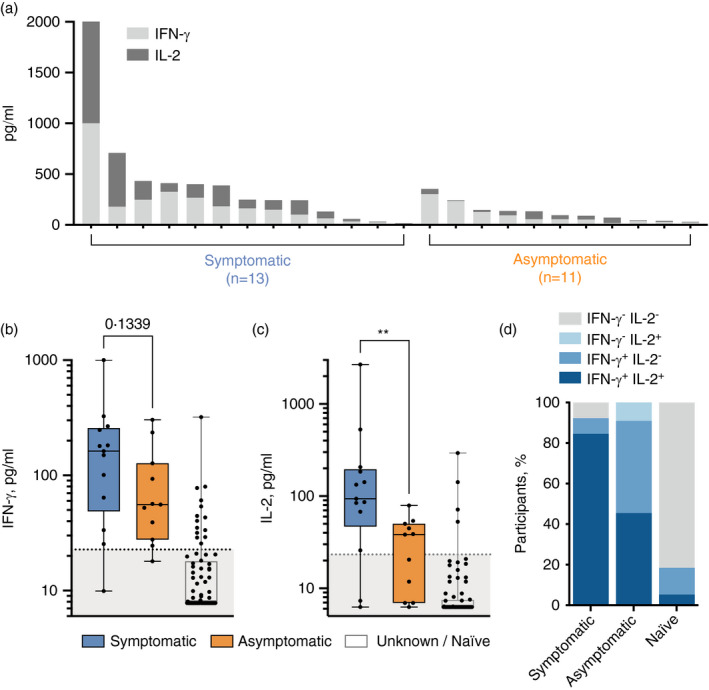
Asymptomatic participants exhibit reduced SARS‐CoV‐2‐specific T‐cell functionality. (A) IFN‐γ and IL‐2 T‐cell responses amongst thirteen symptomatic and eleven asymptomatic SARS‐CoV‐2‐infected donors are shown for each individual. IFN‐γ (B) and IL‐2 (C) release by T cells in response to the SARS‐CoV‐2 S‐/NP‐/M‐combined peptide pool was measured in the symptomatic, asymptomatic and naïve donors (n = 76). P values resulting from Mann–Whitney tests are shown (**p < 0·01). The proportion of symptomatic, asymptomatic and naïve participants mounting dual IFN‐γ+/IL‐2+, single IFN‐γ or IL‐2+ or no measurable T‐cell response is shown (D)
FIGURE 3
FIGURE 3
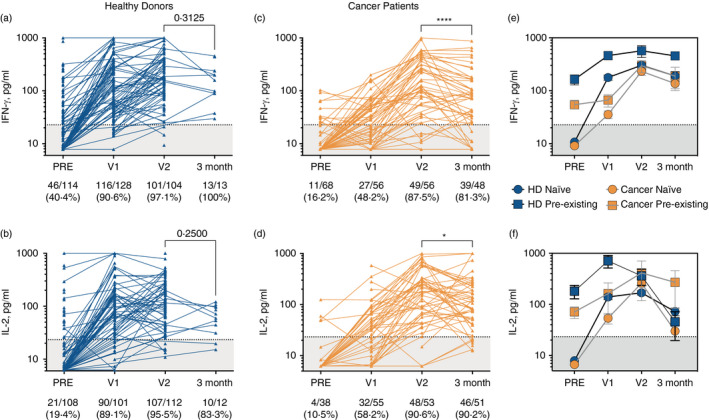
Utilizing SARS‐CoV‐2‐specific T‐cell response measurements as a read‐out for COVID‐19 vaccine efficacy amongst healthy donor and cancer patient cohorts. SARS‐CoV‐2‐specific T‐cell responses were measured using the whole‐blood assay at indicated time‐points immediately before (‘PRE’), 3–6 weeks after first dose of COVID‐19 vaccination (‘V1’), 3–6 weeks after second dose (‘V2’) and 3 months after second dose in healthy donors (A; IFN‐γ+, B; IL‐2+) and cancer patients (C; IFN‐γ+, D; IL‐2+). Two‐tailed P values resulting from Wilcoxon matched‐pairs signed rank tests are shown (* p < 0·05; **** p < 0·0001). Accumulated responses amongst healthy donors and cancer patients were monitored over the course of the vaccination schedule and separated based on pre‐existing IFN‐γ+ or IL‐2+ T‐cell responses being present prior to vaccination (squares indicate pre‐existing response, circles indicate no pre‐existing response/‘naïve’) (E and F, respectively)

References

    1. Grifoni A, Weiskopf D, Ramirez SI, Mateus J, Dan JM, Moderbacher CR, et al. Targets of T cell responses to SARS‐CoV‐2 coronavirus in humans with COVID‐19 disease and unexposed individuals. Cell. 2020;181:1489–501.e15. - PMC - PubMed
    1. Sette A, Crotty S. Pre‐existing immunity to SARS‐CoV‐2: the knowns and unknowns. Nat Rev Immunol. 2020;20:457–8. - PMC - PubMed
    1. Riou C, Schäfer G, du Bruyn E, Goliath RT, Stek C, Mou H, et al. Rapid, simplified whole blood‐based multiparameter assay to quantify and phenotype SARS‐CoV‐2 specific T cells. medRxiv. 2020. doi:10.1101/2020.10.30.20223099 - DOI - PMC - PubMed
    1. Le Bert N, Tan AT, Kunasegaran K, Tham CYL, Hafezi M, Chia A, et al. SARS‐CoV‐2‐specific T cell immunity in cases of COVID‐19 and SARS, and uninfected controls. Nature. 2020;584:457–62. - PubMed
    1. Zuo J, Dowell AC, Pearce H, Verma K, Long HM, Begum J, et al. Robust SARS‐CoV‐2‐specific T cell immunity is maintained at 6 months following primary infection. Nat Immunol. 2021;22:620–6. - PMC - PubMed

Publication types