. 2021;81(8):682.
doi: 10.1140/epjc/s10052-021-09403-2. Epub 2021 Aug 2.

Calibration of the Gerda experiment

M Agostini  1   2 G Araujo  3 A M Bakalyarov  4 M Balata  5 I Barabanov  6 L Baudis  3 C Bauer  7 E Bellotti  8   9 S Belogurov  6   10   11 A Bettini  12   13 L Bezrukov  6 V Biancacci  12   13 E Bossio  2 V Bothe  7 V Brudanin  14 R Brugnera  12   13 A Caldwell  15 C Cattadori  9 A Chernogorov  10   4 T Comellato  2 V D'Andrea  16 E V Demidova  10 N Di Marco  5 E Doroshkevich  6 F Fischer  15 M Fomina  14 A Gangapshev  7   6 A Garfagnini  12   13 C Gooch  15 P Grabmayr  17 V Gurentsov  6 K Gusev  14   4   2 J Hakenmüller  7 S Hemmer  13 R Hiller  3 W Hofmann  7 J Huang  3 M Hult  18 L V Inzhechik  6   19 J Janicskó Csáthy  2   20 J Jochum  17 M Junker  5 V Kazalov  6 Y Kermaïdic  7 H Khushbakht  17 T Kihm  7 I V Kirpichnikov  10 A Klimenko  14   7   21 R Kneißl  15 K T Knöpfle  7 O Kochetov  14 V N Kornoukhov  6   10 P Krause  2 V V Kuzminov  6 M Laubenstein  5 M Lindner  7 I Lippi  13 A Lubashevskiy  14 B Lubsandorzhiev  6 G Lutter  18 C Macolino  16 B Majorovits  15 W Maneschg  7 L Manzanillas  15 M Miloradovic  3 R Mingazheva  3 M Misiaszek  22 P Moseev  6 Y Müller  3 I Nemchenok  14   21 L Pandola  23 K Pelczar  22   18 L Pertoldi  2   13 P Piseri  24 A Pullia  24 C Ransom  3 L Rauscher  17 S Riboldi  24 N Rumyantseva  14   4 C Sada  12   13 F Salamida  16 S Schönert  2 J Schreiner  7 M Schütt  7 A-K Schütz  17 O Schulz  15 M Schwarz  2 B Schwingenheuer  7 O Selivanenko  6 E Shevchik  14 M Shirchenko  14 L Shtembari  15 H Simgen  7 A Smolnikov  14   7 D Stukov  4 A A Vasenko  10 A Veresnikova  6 C Vignoli  5 K von Sturm  12   13 T Wester  25 C Wiesinger  2 M Wojcik  22 E Yanovich  6 B Zatschler  25 I Zhitnikov  14 S V Zhukov  4 D Zinatulina  14 A Zschocke  17 A J Zsigmond  15 K Zuber  25 G Zuzel  22 Gerda Collaboration
Affiliations

Calibration of the Gerda experiment

M Agostini et al. Eur Phys J C Part Fields. 2021.

Abstract

The GERmanium Detector Array (Gerda) collaboration searched for neutrinoless double- β decay in 76 Ge with an array of about 40 high-purity isotopically-enriched germanium detectors. The experimental signature of the decay is a monoenergetic signal at Q β β = 2039.061 ( 7 ) keV in the measured summed energy spectrum of the two emitted electrons. Both the energy reconstruction and resolution of the germanium detectors are crucial to separate a potential signal from various backgrounds, such as neutrino-accompanied double- β decays allowed by the Standard Model. The energy resolution and stability were determined and monitored as a function of time using data from regular 228 Th calibrations. In this work, we describe the calibration process and associated data analysis of the full Gerda dataset, tailored to preserve the excellent resolution of the individual germanium detectors when combining data over several years.


Figures

Fig. 1
Fig. 1
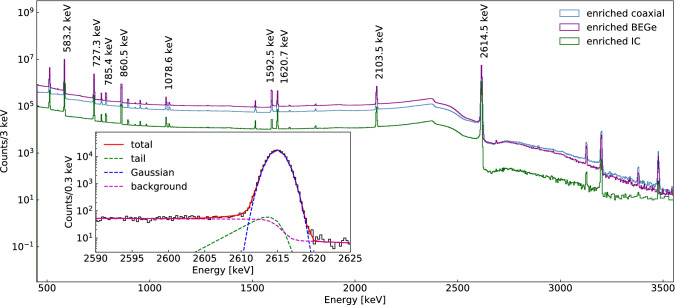
Combined Phase II energy spectrum for 228Th calibration data for all enriched detectors of BEGe, coaxial, and IC type after rebinning to 3 keV. The inset shows the fit to the 2.6 MeV line in the spectrum of the detector GD91A before the 2018 upgrade with 0.3 keV binning, with the components of the fit drawn separately (linear and step backgrounds are combined). The energies of the nine peaks that typically contribute to the formation of calibration curves are labelled
Fig. 2
Fig. 2
Fitting the residuals of the calibration curve with a quadratic function, as shown for detector ANG2 for the calibration on 15th October 2018
Fig. 3
Fig. 3
FWHM of the FEP as a function of time for detector GD76B, one of the BEGe detectors. Each data point comes from one calibration run. The full data acquisition period is divided into three partitions, shown in solid circle (blue), triangle (green), and diamond (red), respectively. The time of the 2018 upgrade is represented by the dashed line. A second partition (shown in triangles) began directly afterwards with a coincident improvement in resolution. A third partition (shown in diamonds) was created due to the jump in resolution in January 2019 when a hardware change took place
Fig. 4
Fig. 4
Distribution of FWHM resolution at Qββ per detector partition. The detector partitions with resolutions > 6 keV are due to two coaxial detectors whose resolutions degraded after the 2018 upgrade
Fig. 5
Fig. 5
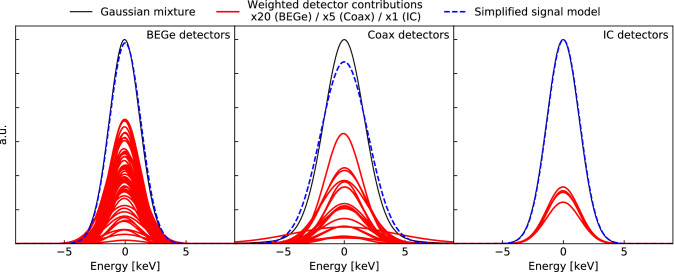
Comparison of simplified Gaussian signal model (dashed blue) to the more detailed Gaussian mixture signal model (solid black) of the FEP, for DTDs formed of the partitions of BEGe (left), coaxial (middle) and IC (right) detectors. Red lines show Gaussian shaped peaks for individual partitions, which have been rescaled by a factor of 20/5/1 for the BEGe/Coax/IC detectors for visibility
Fig. 6
Fig. 6
Effective resolution curves for BEGe (purple), coaxial (blue) and IC (green) DTDs. Open points indicate broadened lines not used to form the resolution curves, namely the double- and single-escape peaks of the 2.6 MeV line due to 208Tl decay. Square markers indicate the exposure-weighted resolutions of the lines in physics data due to 40K (1460.8 keV) and 42K (1524.7 keV) decays
Fig. 7
Fig. 7
Resolution of the 1524.7 keV 42K line as measured from physics data and extracted from calibration data, for each detector partition. The red line shows the case of perfect agreement

References

    1. Mohapatra RN, Smirnov AY. Ann. Rev. Nucl. Part. Sci. 2006;56:569. doi: 10.1146/annurev.nucl.56.080805.140534. - DOI
    1. Mount BJ, Redshaw M, Myers EG. Phys. Rev. C. 2010;81:032501. doi: 10.1103/PhysRevC.81.032501. - DOI
    1. M. Agostini et al. (GERDA Collaboration), Eur. Phys. J. C 79, 978 (2019). 10.1140/epjc/s10052-019-7353-8
    1. Domula A, Hult M, Kermaïdic Y, Marissens G, Schwingenheuer B, Wester T, Zuber K. Nucl. Instrum. Methods A. 2018;891:106. doi: 10.1016/j.nima.2018.02.056. - DOI
    1. M. Agostini et al. (GERDA Collaboration), Eur. Phys. J. C 78, 388 (2018). 10.1140/epjc/s10052-018-5812-2