. 2021 Oct 29:12:749786.
doi: 10.3389/fphar.2021.749786. eCollection 2021.

Machine Learning for Prediction of Stable Warfarin Dose in US Latinos and Latin Americans

Affiliations

Machine Learning for Prediction of Stable Warfarin Dose in US Latinos and Latin Americans

Heidi E Steiner et al. Front Pharmacol. .

Abstract

Populations used to create warfarin dose prediction algorithms largely lacked participants reporting Hispanic or Latino ethnicity. While previous research suggests nonlinear modeling improves warfarin dose prediction, this research has mainly focused on populations with primarily European ancestry. We compare the accuracy of stable warfarin dose prediction using linear and nonlinear machine learning models in a large cohort enriched for US Latinos and Latin Americans (ULLA). Each model was tested using the same variables as published by the International Warfarin Pharmacogenetics Consortium (IWPC) and using an expanded set of variables including ethnicity and warfarin indication. We utilized a multiple linear regression model and three nonlinear regression models: Bayesian Additive Regression Trees, Multivariate Adaptive Regression Splines, and Support Vector Regression. We compared each model's ability to predict stable warfarin dose within 20% of actual stable dose, confirming trained models in a 30% testing dataset with 100 rounds of resampling. In all patients (n = 7,030), inclusion of additional predictor variables led to a small but significant improvement in prediction of dose relative to the IWPC algorithm (47.8 versus 46.7% in IWPC, p = 1.43 × 10⁻¹⁵). Nonlinear models using IWPC variables did not significantly improve prediction of dose over the linear IWPC algorithm. In ULLA patients alone (n = 1,734), IWPC performed similarly to all other linear and nonlinear pharmacogenetic algorithms. Our results reinforce the validity of IWPC in a large, ethnically diverse population and suggest that additional variables that capture warfarin dose variability may improve warfarin dose prediction algorithms.

Keywords: Hispanic; Latino; anticoagulant; machine learning; pharmacogenetics; warfarin.


Conflict of interest statement

The authors declare that the research was conducted in the absence of any commercial or financial relationships that could be construed as a potential conflict of interest.

Figures
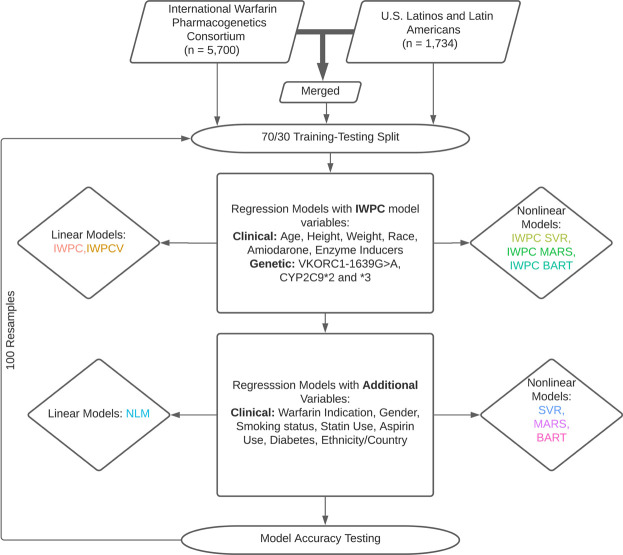
FIGURE 1
FIGURE 1
Dose Prediction Algorithm Creation and Testing. International Warfarin Pharmacogenetics Consortium (IWPC) data and data from US Latinos and Latin Americans (ULLA) were used for prediction independently and merged to test a combined sample. Linear and nonlinear models were fit with IWPC model variables and a set of extended variables in addition to IWPC predictors after a 70/30 training-testing split. All models were assessed for their ability to predict dose within 20% of actual. 100 replicates were performed from data splitting to model assessment.
FIGURE 2
FIGURE 2
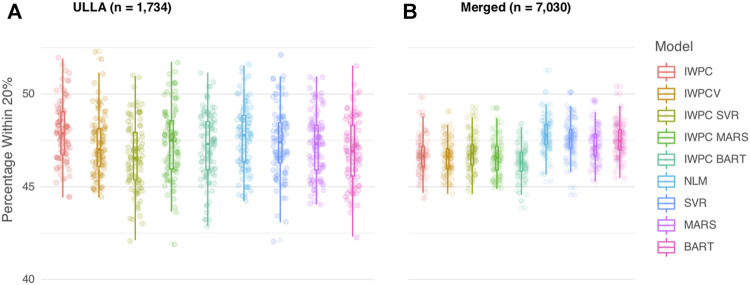
Comparison of Warfarin Dose Prediction Algorithms in the ULLA and Merged cohorts. Proportion of patients predicted within 20% of their actual dose is plotted in the (A) US Latinos and Latin Americans (ULLA) cohort and (B) Merged cohort containing both ULLA and IWPC cohorts. The boxplot visualizes five summary statistics (the median, 25 and 75% quartiles and two whiskers at 1.5* Interquartile Range). The points indicate the proportion of patients predicted within 20% at each of the 100 rounds of resampling. Models feature IWPC variables or IWPC variables in addition to new predictors. IWPC indicates International Warfarin Pharmacogenetics Consortium model, Merged, IWPC cohort plus ULLA cohort, IWPCV, IWPC variables, IWPC MARS, IWPC variables in a Multivariate Adaptive Regression Splines, IWPC SVR, IWPC variables in a Support Vector Regression, IWPC BART, IWPC variables in a Bayesian Additive Regression Trees, NLM, Novel Linear Model. From left to right, the first five models, IWPC, IWPCV, IWPC_SVR, IWPC_MARS, and IWPC_BART feature the clinical variables age, height, weight, race, enzyme inducer user, amiodarone use and the genetic variables CYP2C9 Diplotype and VKORC1-1639G>A Genotype, the next four models, NLM, SVR, MARS and BART feature the additional variables gender, ethnicity, statin use, aspirin use, history of diabetes, warfarin indication, the last model features only the clinical variables from the first set. IWPC indicates International Warfarin Pharmacogenetics Consortium model, IWPCV, IWPC variables, IWPC MARS, IWPC variables in a Multivariate Adaptive Regression Splines, IWPC SVR, IWPC variables in a Support Vector Regression, IWPC BART, IWPC variables in a Bayesian Additive Regression Trees, NLM, Novel Linear Model, Clinical, the IWPC Clinical model.
FIGURE 3
FIGURE 3
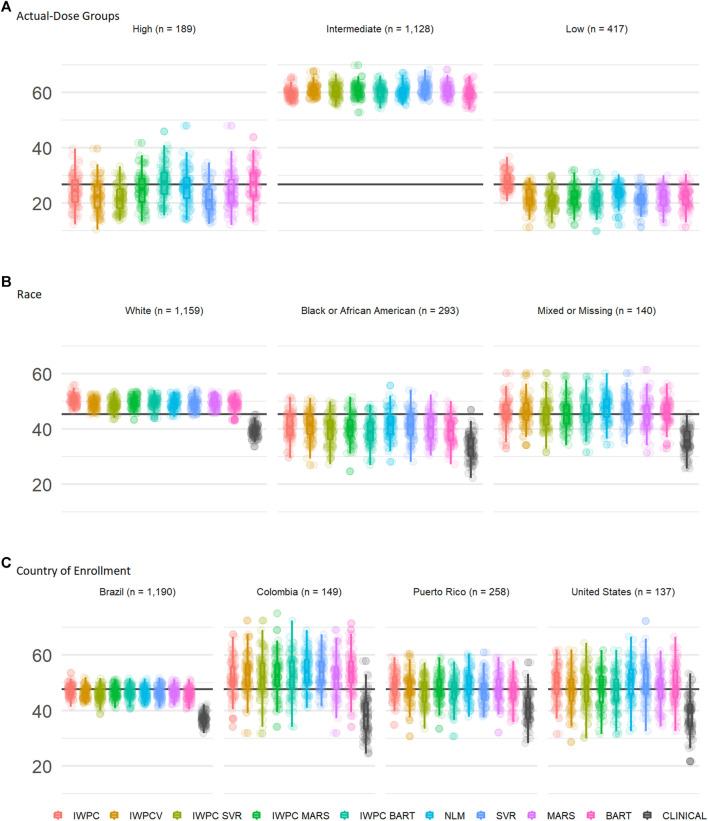
Subgroup Comparisons of Warfarin Dose Prediction Algorithms in the ULLA cohort. Proportion of patients predicted within 20% of their actual dose in the US Latinos and Latin Americans (ULLA) cohort by (A) actual-dose group, (B) race group, and (C) country of enrollment. The boxplot visualizes five summary statistics (the median, 25 and 75% quartiles and two whiskers at 1.5* Interquartile Range). The points indicate the proportion of patients predicted within 20% at each of the 100 rounds of resampling. The horizontal line indicates the median percentage predicted within 20% across all participants. From left to right, the first five models, IWPC, IWPCV, IWPC_SVR, IWPC_MARS, and IWPC_BART feature the clinical variables age, height, weight, race, enzyme inducer user, amiodarone use and the genetic variables CYP2C9 Diplotype and VKORC1-1639G>A Genotype, the next four models, NLM, SVR, MARS and BART feature the additional variables gender, ethnicity, statin use, aspirin use, history of diabetes, warfarin indication, the last model features only the clinical variables from the first set. IWPC indicates International Warfarin Pharmacogenetics Consortium model, IWPCV, IWPC variables, IWPC MARS, IWPC variables in a Multivariate Adaptive Regression Splines, IWPC SVR, IWPC variables in a Support Vector Regression, IWPC BART, IWPC variables in a Bayesian Additive Regression Trees, NLM, Novel Linear Model, Clinical, the IWPC Clinical model.

References

    1. Alzubiedi S., Saleh M. I. (2016). Pharmacogenetic-guided Warfarin Dosing Algorithm in African-Americans. J. Cardiovasc. Pharmacol. 67, 86–92. 10.1097/FJC.0000000000000317 - DOI - PubMed
    1. Arwood M. J., Deng J., Drozda K., Pugach O., Nutescu E. A., Schmidt S., et al. (2017). Anticoagulation Endpoints with Clinical Implementation of Warfarin Pharmacogenetic Dosing in a Real-World Setting: A Proposal for a New Pharmacogenetic Dosing Approach. Clin. Pharmacol. Ther. 101, 675–683. 10.1002/cpt.558 - DOI - PMC - PubMed
    1. Asiimwe I. G., Zhang E. J., Osanlou R., Krause A., Dillon C., Suarez-Kurtz G., et al. (2020). Genetic Factors Influencing Warfarin Dose in Black-African Patients: A Systematic Review and Meta-Analysis. Clin. Pharmacol. Ther. 107, 1420–1433. 10.1002/cpt.1755 - DOI - PMC - PubMed
    1. Barnes G. D., Lucas E., Alexander G. C., Goldberger Z. D. (2015). National Trends in Ambulatory Oral Anticoagulant Use. Am. J. Med. 128, 1300–5.e2. 10.1016/j.amjmed.2015.05.044 - DOI - PMC - PubMed
    1. Botton M. R., Bandinelli E., Rohde L. E., Amon L. C., Hutz M. H. (2011). Influence of Genetic, Biological and Pharmacological Factors on Warfarin Dose in a Southern Brazilian Population of European Ancestry. Br. J. Clin. Pharmacol. 72, 442–450. 10.1111/j.1365-2125.2011.03942.x - DOI - PMC - PubMed

LinkOut - more resources